

How to Overcome Mental Fatigue and Reclaim Your Daily Focus
How to Overcome Mental Fatigue and Reclaim Your Daily Focus
You wake up after eight solid hours of sleep, stretch your arms, and still feel like a thick fog surrounds your mind. Your muscles aren’t sore, but the thought of opening your inbox makes you want to crawl right back under the covers. If you’ve been wondering how to overcome mental fatigue and reclaim your daily focus, you aren’t alone. Traditional rest simply doesn’t fix a mind overloaded by constant micro-decisions, relentless digital alerts, and context-switching.
Table of Contents
- The Hidden Weight of Cognitive Overload: Why Traditional Rest Fails to Recharge You
- Why Does Mental Fatigue Happen Even When You Are Not Physically Tired?
- How to Overcome Mental Fatigue with Daily Cognitive Decompression Habits
- Syncing Work with Ultradian Rhythms to Prevent Midday Brain Drain
- Somatic Resets: Using Physical Movement and Environment Shifts to Clear Mental Clutter
- Setting Cognitive Boundaries: Protecting Your Mental Bandwidth from Daily Overload
- Crafting an Evening Downshift Routine for True Neurological Recovery
- Sustaining Everyday Vitality: Cultivating a Mindset of Proactive Energy Management
Most of us treat mental exhaustion as if it were a physical issue. We assume that lying on the couch or sleeping longer on the weekend will magically wipe the slate clean. Yet you can lounge on your sofa for an entire Sunday afternoon scrolling through feeds and still wake up on Monday morning feeling completely drained. That is because physical rest relaxes your muscles, but it does nothing to clear out mental residue.

This mismatch between physical stillness and mental exhaustion pops up constantly in real life. You see it voiced in candid productivity forum discussions on afternoon burnout, where people who eat well, sleep eight hours, and exercise regularly still hit a mental wall after just a few hours at their desks. Your brain isn’t failing you. It is simply drowning under cognitive overload. Every ping from your phone, every open tab in your browser, and every tiny choice about what to prioritize chips away at your prefrontal cortex.
Think of your cognitive bandwidth like your computer’s short-term memory. When you have dozens of background apps open at once, the processor overheats and everything freezes, even if the computer is plugged into a wall outlet. Modern life keeps our cognitive background apps running 24 hours a day. We bounce between composing emails, checking messages, reading news headlines, and double-checking automated tasks. That frantic juggling creates subtle, ongoing tension. In fact, clinical research on prolonged cognitive load shows that sustained mental strain keeps your sympathetic nervous system stuck on high alert, shutting down the calm parasympathetic state you need to actually recharge.
Understanding the difference between passive rest and active neural recovery is the turning point. As explored in recovery discussions like the wellness audio session above, staying trapped in fatigue usually happens when we use passive distractions to numb ourselves instead of practices that actually rebuild our baseline capacity. Collapsing onto the couch to watch television or read dense material still forces your visual and language centers to process continuous information. It is quiet time, but it isn’t cognitive downtime.
True clarity requires a different playbook. Learning how to overcome mental fatigue means shifting from passive collapse to intentional cognitive decompression. Over the following sections, we will break down the hidden sources of brain drain, look at the biological rhythms that govern your attention, and put simple, daily habits into place so you can safeguard your energy and feel sharp again every day.
Why Does Mental Fatigue Happen Even When You Are Not Physically Tired?
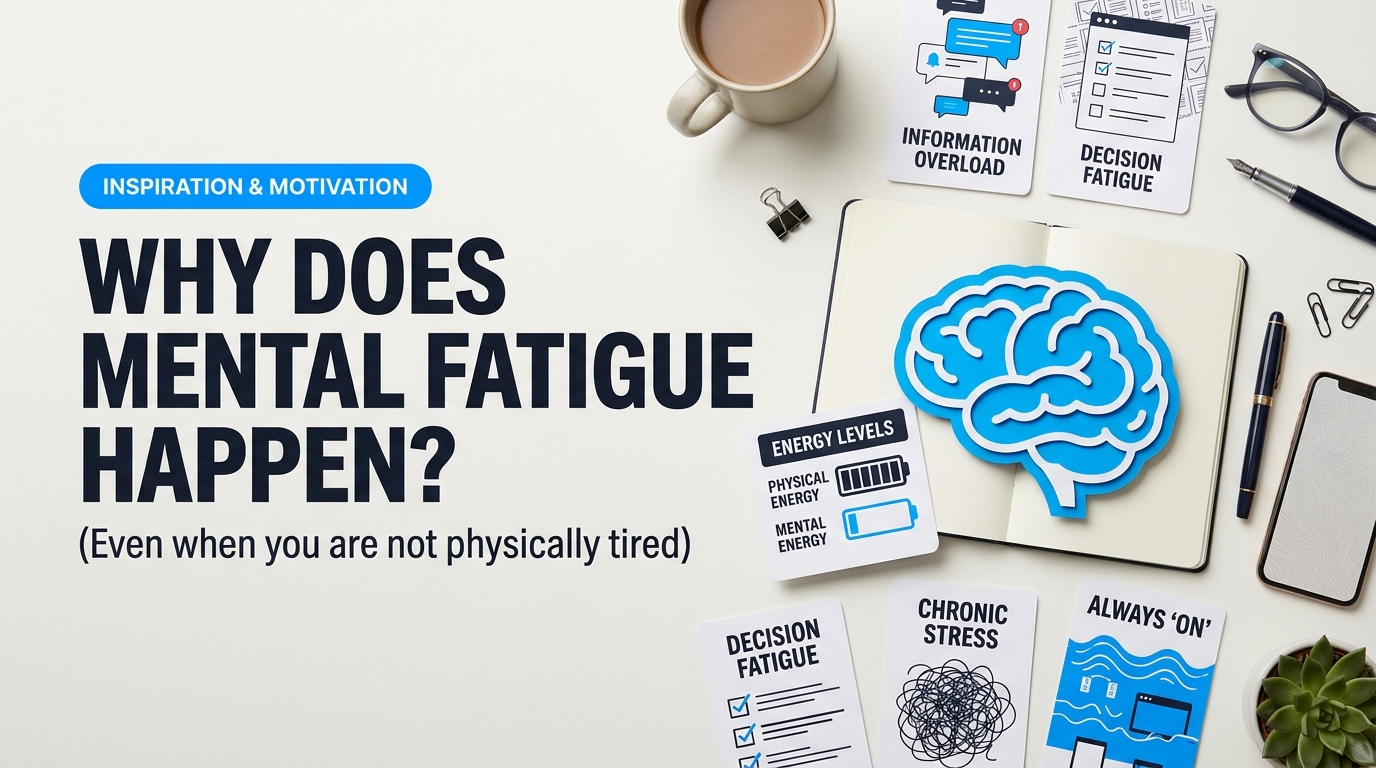
You spent seven hours sitting in an ergonomic chair. Your muscles didn’t lift heavy weights. Your heart rate never climbed above a gentle resting pulse. Yet, by five in the evening, moving from your desk to the kitchen feels like wading through wet cement.
You aren’t imagining this heaviness. Many people in community discussions on post-work mental drain describe feeling thoroughly wiped out after a day spent staring at screens. They often wonder how their bodies can feel paralyzed when they barely moved all day. The answer lies in how your nervous system burns fuel.
Your brain represents roughly two percent of your body weight, but it eats up twenty percent of your daily metabolic energy. When you spend hours solving problems, resisting impulses, and sorting information, your prefrontal cortex burns through glucose at an incredible rate. Recent neurochemical research highlights that prolonged cognitive effort causes metabolic waste products—specifically glutamate—to accumulate in the synapses of your brain’s control center. That heavy, foggy pressure behind your eyes is real biological friction.
To see how your nervous system signals this hidden strain, watch this helpful breakdown by Verified Creator on the difference between simple sleepiness and true neurological depletion:
Pinpointing Invisible Drains: How to Overcome Mental Fatigue at the Source
Understanding these silent energy thieves is the first real step in discovering how to overcome mental fatigue and reclaim your daily focus. Unlike physical exhaustion, which makes its source obvious through sore muscles and heavy limbs, mental burnout creeps in through subtle habits you barely notice.
| Indicator | Physical Fatigue | Mental Fatigue |
|---|---|---|
| Primary Trigger | Muscle exertion, oxygen debt, mechanical strain | Prefrontal overload, glutamate accumulation |
| Core Sensations | Limb soreness, yawning, physical heaviness | Brain fog, short temper, lack of motivation |
| Best Antidote | Sleep, physical stillness, balanced food | Mental quiet, closing open tasks, novelty |
Four major neurological culprits quietly drain your cognitive battery while you sit still:
- Decision Fatigue: Every choice carries a metabolic cost. Choosing what clothes to wear, deciding which email gets priority, or picking your lunch all pull from the same finite pool of executive function. By late afternoon, your brain tries to conserve fuel by going numb, making even tiny decisions feel overwhelming.
- Continuous Context Switching: Bouncing between an open spreadsheet, an urgent instant message, and an incoming phone call disrupts your brain’s rhythm. Each jump leaves an “attention residue.” A piece of your focus stays stuck on the previous task, forcing your brain to recalibrate repeatedly until your mental gears grind down.
- Continuous Partial Attention: You draft an email while half-listening to a team call and keeping one eye on your phone’s notification light. You never feel fully engaged with anything. This constant, shallow monitoring keeps your amygdala and alertness networks humming on high alert, bleeding energy without delivering meaningful output.
- Unclosed Cognitive Loops: Psychologists call this the Zeigarnik effect. Your brain naturally clings to half-finished tasks, unread messages, and loose commitments. It refuses to let them go until they reach a clear resolution. These open loops operate like dozens of background apps running silently on a smartphone, quietly burning through your battery until you hit total exhaustion.
“The mind is not an infinite sponge; it is an engine with clear fuel limits. Treat mental strain with the same respect you give physical exertion.”
When you recognize that thinking requires real energy, your perspective changes. You stop blaming yourself for feeling lazy after a long day at your desk. You realize that your mind needs deliberate space to clear its internal slate, reset its chemical balance, and restore its natural drive.
How to Overcome Mental Fatigue with Daily Cognitive Decompression Habits
You finish a four-hour block of intense problem-solving. Your eyes burn, your temples feel tight, and your patience is paper-thin. Instinctively, you pick up your phone, open a video feed, and scroll for ten minutes. You tell yourself you’re taking a break. When you lock the screen, your head feels even heavier. Your focus is shot, and your mental battery sits at zero.
That sluggish sensation isn’t personal weakness. It is executive function burnout. Your prefrontal cortex handles decision-making, emotional control, and complex reasoning. Think of it like your computer’s active memory. When you leave dozens of programs running in the background, the entire system slows down. Glancing at notifications or skimming articles doesn’t close those background programs. It forces your brain to open even more tabs.
Resetting Executive Brain Function: How to Overcome Mental Fatigue in Real Time
Learning how to overcome mental fatigue during a demanding workday isn’t about escaping your schedule. It’s about giving your executive network short, intentional windows of zero processing demand. You need active downshifts that quiet your internal alert system without requiring a two-hour afternoon nap.
One of the fastest ways to reboot your processing power is Non-Sleep Deep Rest (NSDR). When you deliberately slow your breathing and relax your visual focus, your nervous system switches from fight-or-flight mode into a restorative state. Just ten minutes of sensory quiet can restore mental clarity and replenish dopamine reserves that were drained by sustained attention.
If you feel your brain locking up during the midday rush, visual guidance can help you downshift without overthinking the process. The video below breaks down simple physical resets you can use at your desk to calm mental chatter in minutes.
Try pairing these somatic resets with optical relaxation. Looking at a screen forces your eyes into a tight, narrow focus that signals alertness to your brain. Look up from your monitor. Gaze out an open window or let your eyes soften toward the furthest wall in the room. Expanding your visual field to take in your peripheral surroundings physically relaxes the muscles around your eyes and signals your brain to turn down its stress response.
The External Hard Drive Method: Clearing Working Memory
Your working memory is surprisingly small. It can only juggle a handful of information packets at any given moment. When you try to remember three emails you haven’t sent, an upcoming deadline, and what to make for dinner, your executive centers burn energy just keeping those thoughts from slipping away.
“By compartmentalizing improvement, you extend your mental battery instead of draining it. Reduce cognitive noise and minimize input overload.”
As participants highlight in productivity forum discussions on post-work decompression, letting ideas spin freely inside your head is the quickest route to complete exhaustion. You need an external holding pen.
Keep a blank pad of paper beside your keyboard. When mental fog rolls in, stop working for three minutes and dump every lingering thought onto the paper. Write down unfinished tasks, sudden anxieties, or random reminders without organizing them. Seeing those thoughts on paper tells your nervous system that the data is safe. You don’t have to spend precious cognitive energy holding onto it anymore.
Swapping Digital Pseudo-Rest for True Low-Stimulation Stillness
Most people rest the wrong way. When mental exhaustion hits, we often trade high-effort cognitive tasks for low-effort digital consumption. We browse forums, check text messages, or stream background television. This creates a state of pseudo-rest: your body is still, but your sensory organs are bombarded with light, sound, and micro-decisions.
True recovery requires low-stimulation downtime. You need moments where your mind is free to wander without taking in fresh information. Here is how standard pseudo-rest compares to real biological decompression:
| Habitual “Break” | The Hidden Cost | Restorative Alternative |
|---|---|---|
| Scrolling short video clips | Sensory overload and dopamine depletion | Staring at the clouds or horizon for 5 minutes |
| Listening to an informational podcast | Continuous auditory processing | Sitting in silence while drinking a cup of warm tea |
| Online window shopping | Unconscious micro-evaluations and decision fatigue | Gentle stretching on a carpet with eyes closed |
Reclaiming your daily focus doesn’t demand radical lifestyle overhauls. It requires guarding your mental margins. Give your mind spaces of absolute quiet throughout the day, externalize the clutter onto paper, and let your brain catch its breath before you dive into the next challenge.
Syncing Work with Ultradian Rhythms to Prevent Midday Brain Drain
Most of us treat our minds like light switches. We expect to flip them on at 8:00 AM and keep them burning bright until evening. When your energy plummets around 2:00 PM, you reach for an extra espresso or try to white-knuckle your way through another spreadsheet. It rarely works. Your eyes glaze over, simple sentences turn into gibberish, and your brain feels packed with wet cotton.
Your brain is not a machine. It does not run on a flat, eight-hour battery.
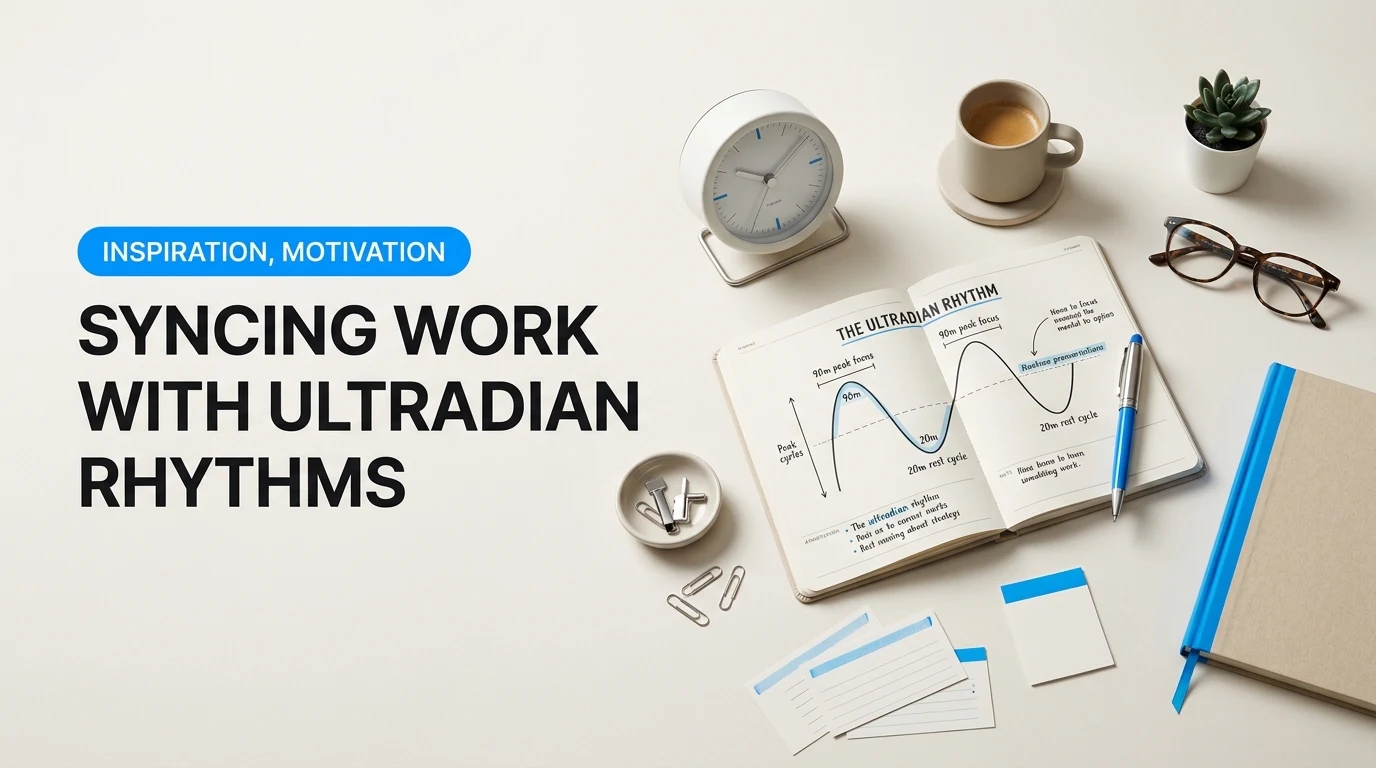
During the night, your mind moves through roughly 90-minute sleep cycles, shifting between deep sleep and REM states. What most people forget is that this exact pattern continues while you are awake. Known as the Basic Rest-Activity Cycle, your alertness rises, peaks, and dips every hour and a half. Working with these 90-minute ultradian rhythms lets you ride your natural biological surges instead of constantly fighting them.
Riding the 90-Minute Wave: How to Overcome Mental Fatigue at Work
When you start a demanding task, your brain fires on all cylinders. Focus comes easy. Concepts click. But after about 75 to 90 minutes of high-intensity concentration, your brain runs low on glucose, cellular waste builds up in your synapses, and focus begins to drift. That sudden urge to check social media or wander to the kitchen isn’t laziness. It is your brain waving a white flag, signaling that its internal battery needs a recharge.
If you ignore that signal, your body releases cortisol and adrenaline to keep you upright. You get a cheap, jittery burst of fake energy. You might keep typing, but you make sloppy mistakes. By mid-afternoon, that artificial fuel runs out, and you hit a brick wall. Learning how to overcome mental fatigue isn’t about finding stronger stimulants; it’s about honoring the natural ebb and flow of your nervous system.
| Phase | What Your Brain Does | Your Best Action |
|---|---|---|
| The Surge (0–20 min) | Warms up, locks onto context, filters out background noise. | Clear away all tabs and tackle one single priority. |
| The Peak (20–80 min) | Optimal problem-solving, high cognitive speed, deep immersion. | Protect focus. Do not switch tasks or answer calls. |
| The Valley (80–110 min) | Dopamine dips, working memory clears out cached thoughts. | Step away from screens completely for 15 to 20 minutes. |
The secret to keeping your mental tank full is scheduling strategic mental buffers. Think of these buffers as cool-down periods for your brain. If you finish writing a complex brief and immediately open your inbox, you give your mind zero time to process what just happened. That mental residue carries over into your emails, slowing your thinking down and doubling your stress.
“When you stack tasks back-to-back without empty space, you don’t save time. You just drag yesterday’s fog into today’s work.”
Back-to-back multitasking creates compounding fatigue. Every time you flip from writing a report to replying to a chat notification, your attention fractures. Neuroscientists call this “attention residue.” A tiny piece of your working memory stays stuck on the previous chore. Switch back and forth ten times, and you leave your working memory in pieces.
To break this drain, establish a clean break between your 90-minute focus blocks. Stand up. Walk to a window and look at the horizon to let your eye muscles relax. Drink a glass of cold water. Do not pick up your phone, and do not read the news. Give your prefrontal cortex ten to twenty minutes of quiet, unhurried space. You will return to your desk fresh, sharp, and ready to work without fighting your own biology.
Somatic Resets: Using Physical Movement and Environment Shifts to Clear Mental Clutter
When your brain stalls, your primary instinct is often to push harder. You stare at the blinking cursor. You drink another cup of dark roast. Nothing moves. Trying to think your way out of mental exhaustion is like trying to fix an overheating engine by stepping on the gas. It doesn’t work. When professionals reflect on sustained brain drain, they rarely describe simple sleepiness. Instead, as shared in Reddit discussions on chronic cognitive dullness, it feels like “living with a rock in my head, in a state of permanent dullness.” That heavy, unresponsive sensation is your nervous system locking up under prolonged strain.
Physical Resets: How to Overcome Mental Fatigue Through the Body
Your posture sends constant status reports directly to your brain stem. Slumping over a desk collapses your rib cage and restricts your diaphragm. Your breathing turns shallow and rapid. Your subconscious mind reads that restricted breath as a sign of distress, keeping stress hormones gently simmering in your blood. Stand up immediately. Roll your shoulders back, plant your feet wide, and let your belly expand with a slow, low breath. Shaking your limbs for thirty seconds—flapping your wrists, bouncing on your heels, and rolling your neck—discharges built-up physical tension. It clears the biological buffer so your mental faculties can restart cleanly.
If you feel stuck in a midday freeze response, body-led interventions can reset your internal state far faster than sheer willpower ever could.
Modern desk work pins your vision inside a tiny rectangle. Staring at a display sixteen inches away forces your eye muscles into constant focal convergence. This tight visual field activates the sympathetic branch of your nervous system, keeping your brain in a state of quiet, high-alert surveillance. Your mind never truly stands down while your gaze is locked onto a screen.
Step outside and take a ten-minute walk to generate optic flow. As you stride down the street, buildings, trees, and sidewalks slide past your peripheral vision. This natural lateral movement of images across your retina actively turns down the threat centers in your brain. It quiets your inner alarm bells and creates immediate cognitive breathing room.
| Stagnant State | Somatic Reset | Biological Result |
|---|---|---|
| Screen-locked tunnel vision | Optic flow walk outdoors | Quiets amygdala and widens visual awareness |
| Spinal compression & slump | Full-body shakeout & deep twist | Restores oxygen exchange and loosens muscles |
| Cognitive overheating | Cold water face splash | Triggers dive reflex and slows resting heart rate |
| Lethargic brain signaling | Mineral water hydration | Re-establishes cellular conductivity |
Your brain tissue consists of roughly three-quarters water. Even a mild dip of two percent in your total hydration levels measurably degrades working memory, blunts your attention span, and makes simple tasks feel overwhelming. Gulping plain water often washes out critical salts when you are already drained. Drink a tall glass of cool water mixed with a pinch of unrefined sea salt or electrolytes to replenish the minerals your neurons need to fire cleanly.
Pair proper hydration with a fast sensory pattern interrupt. Walk to the nearest sink and run cold tap water over your wrists, or splash it directly across your eyes and temples. This thermal shock wakes up the mammalian dive reflex, slowing your pulse and nudging your nervous system toward calm clarity. True daily focus does not come from forcing an exhausted mind into submission. Learning how to overcome mental fatigue starts by giving your body the physical signals it needs to release mental clutter and begin anew.
Setting Cognitive Boundaries: Protecting Your Mental Bandwidth from Daily Overload
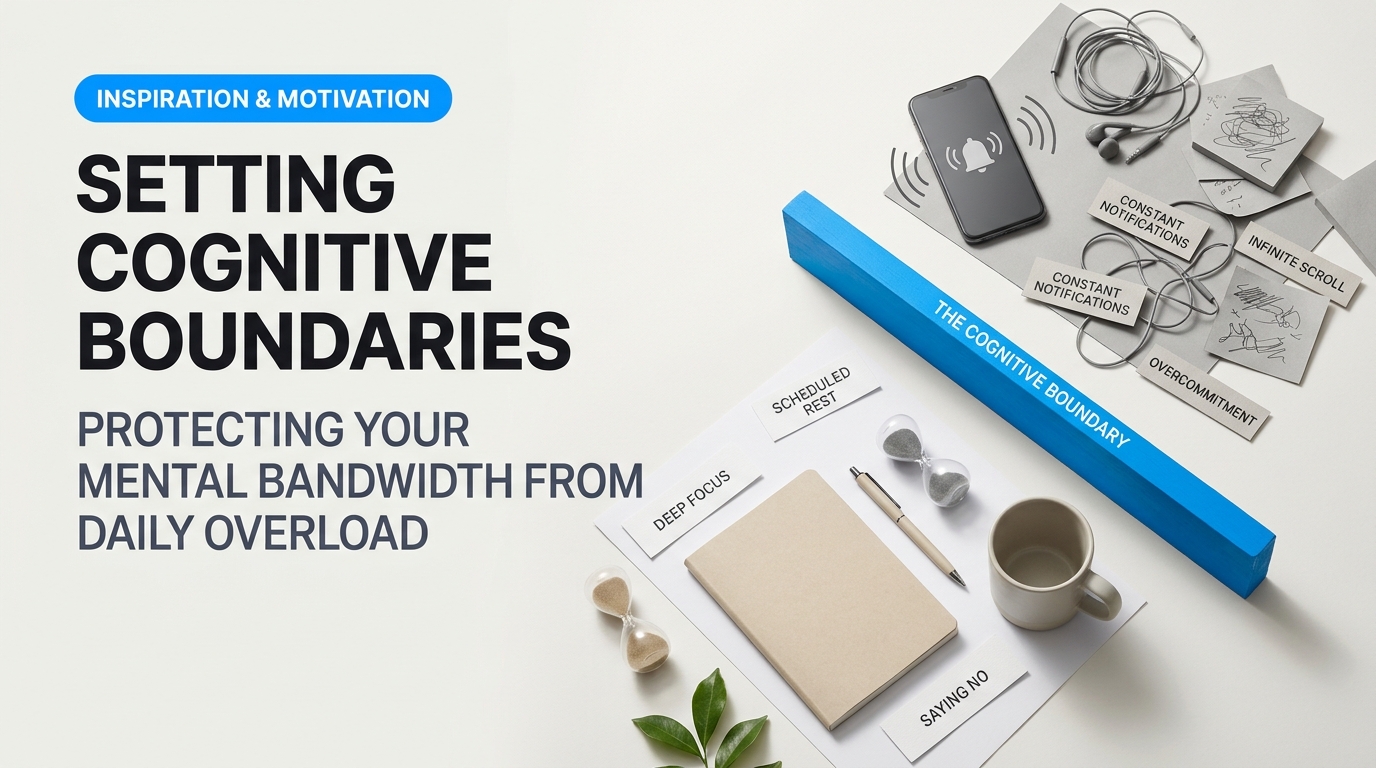
Mental energy rarely drains in one dramatic burst. Instead, it leaks out through dozens of quiet, emotional concessions. You answer a non-urgent notification while eating dinner. You say yes to a weekend commitment because you dread disappointing a friend. You absorb a coworker’s midday panic in the hallway and spend your afternoon ruminating on their problem. By four o’clock, your head feels heavy, dense, and incapable of deep thought.
Every unmade decision drains you. When your brain juggles too many external demands, working memory clogs up. In community discussions around daily burnout, participants frequently observe how a drained mind becomes defenseless. A compelling thread on cognitive depletion and decision fatigue highlights that an overloaded mind defaults to compliance simply because resisting requires energy it doesn’t have. People-pleasing isn’t just a habit; it is often the direct reaction of an overstimulated nervous system hunting for immediate relief.
How to Overcome Mental Fatigue Through Clear Daily Boundaries
You cannot out-sleep a routine that grants everyone unconditional access to your mind. Learning how to overcome mental fatigue is less about adding elaborate recovery routines and more about eliminating unnecessary emotional leaks. To reclaim your daily focus, start by separating availability from accessibility. Being logged into your laptop or holding your phone does not mean your attention is up for grabs.
Think of your mental bandwidth like a phone plan with a strict daily data cap. Every time you field an unscheduled interruption, soothe someone else’s emotional storm, or review a non-priority document “real quick,” you burn through your fastest processing speeds. Once that allowance is gone, your brain throttles back into a protective fog. Keeping that reserve intact requires firm conversational scripts you can deploy without guilt.
For household and partner requests: “I want to help with this, but I don’t have the mental bandwidth to strategize right now. Can we revisit it tomorrow, or can you make the call on this one?”
For workplace digital pings: “I’m in deep focus on our core priority until 3:00 PM. I will read your note then and circle back if you still need my input.”
For social commitments: “Thank you for the invite! My energy is completely booked for rest this weekend, so I’ll have to pass.”
These responses work because they are neutral, direct, and free of over-apologizing. When you stop negotiating your capacity with everyone around you, your nervous system stops bracing for impact.
Persistent mental cloudiness is rarely a personal flaw. As explored in the clinical breakdown above, an exhausted brain is often waving a red flag that it hasn’t received genuine downtime. If your attention is constantly on call, biological rest never truly starts. Setting cognitive boundaries gives your mind safe harbor to breathe, reset, and sustain sharp concentration day after day.
Crafting an Evening Downshift Routine for True Neurological Recovery
You crawl into bed completely spent. Your eyes burn, your shoulders ache, and you want nothing more than eight hours of deep sleep. Yet the moment your head hits the pillow, your thoughts start racing like a runaway engine. You review conversations from noon, anticipate tomorrow’s deadlines, and stare at the ceiling. You are exhausted, yet intensely awake.
This frustrating state is cognitive hyper-arousal. Your nervous system is stuck in survival mode. Think of your brain like a commercial airliner cruising at five hundred miles per hour. If the pilot points the nose straight down and tries to touch the runway instantly, disaster follows. Airplanes need a gradual descent path. Your mind requires the exact same downshift. You cannot jump straight from aggressive problem-solving into deep, restorative sleep and expect your brain to play along.
Step-by-Step Evening Habits: How to Overcome Mental Fatigue Before Bed
Understanding how to overcome mental fatigue requires looking closely at how you close out your evenings. True neurological recovery does not begin when your eyes shut. It starts two hours earlier with intentional boundaries that signal safety to your nervous system. When you give your brain clear cues that the workday is done, it stops producing stress hormones and begins the cellular repair work that restores your daily focus.
“Turning your lights down a couple hours before you get ready for bed changes everything.” — Shared during productivity community discussions on wind-down routines, highlighting how simple environmental shifts ease mental pressure.
To pull your mind out of overdrive, split your evening into three clear phases:
- The Cognitive Closeout (Ten Minutes): Never walk away from your desk with tasks half-done in your head. When tasks stay unfinished without a plan, your brain keeps tracking them in the background. Take ten minutes at the end of your workday to write out tomorrow’s top three priorities. Close all browser tabs. Close your physical laptop lid. Say out loud: “The workday is complete.” This simple physical ritual acts as an off-switch for your subconscious mind.
- The Sensory Downshift (Sixty Minutes Before Bed): Bright blue light from phones, tablets, and overhead bulbs tricks your internal clock into thinking it is still high noon. Swap bright ceiling fixtures for warm, dim table lamps. Put your phone on a charger across the room. If you need entertainment, choose low-stimulation options: read physical fiction books, sketch, or listen to calm instrumental music. You are letting your sensory inputs taper off gradually.
- The Somatic Settle (Ten Minutes): High mental strain locks tension into your physical body. Before climbing under the blankets, spend a few minutes gently releasing that trapped physical tightness. Roll your neck, stretch your hips, or sit on the edge of the bed while practicing slow exhales. Extending your exhale to be twice as long as your inhale tells your heart rate to drop and nudges your nervous system into restorative rest.
Your evening routine does not need to be fancy or complex. Keep it gentle. When you remove nighttime screen glare, close your mental tabs on paper, and allow your body to decompress, you finally learn how to overcome mental fatigue at its root. You give your brain permission to stop fighting, letting you wake up clear-headed, refreshed, and ready to meet the day.
Sustaining Everyday Vitality: Cultivating a Mindset of Proactive Energy Management
Shifting from Reaction to Renewal: How to Overcome Mental Fatigue for Good
Look around your workplace or friend group. It often seems like certain people possess boundless enthusiasm. They finish long work shifts, tackle gym sessions, cook dinner, and still have energy to laugh through an evening hobby. Meanwhile, you might drag yourself across the living room rug after answering twenty emails and putting away dishes.
Many people turn to online communities asking how high performers manage to do it all without burning out. We tell ourselves they were just born lucky. We label ourselves naturally low-energy people and accept brain fog as a mandatory tax on adulthood. That assumption is simply untrue.
Cognitive stamina isn’t an unchangeable personality trait. It behaves like personal wealth. If you spend every dollar the minute it hits your checking account, you stay broke. Your brain functions the exact same way. When you run full throttle until your eyes burn, you live on borrowed cognitive credit. Learning how to overcome mental fatigue requires swapping reactive band-aids for proactive energy management. You stop asking how to survive exhaustion and start asking how to protect your cognitive fuel before it empties.
To build reliable mental stamina, you must treat your attention with the same care athletes give their muscles. Early self-help pioneer Arnold Bennett addressed this exact principle over a century ago, explaining that mental sharpness comes from deliberate habit design rather than sheer willpower.
Watching Bennett’s philosophy on mental efficiency highlights a clear truth: daily clarity begins with intentional structure. Modern research agrees. Studies analyzing daily proactive vitality management show that individuals who deliberately allocate their personal reserves stay sharper, happier, and significantly more resilient against afternoon crashes.
Pacing is not surrender. Taking a somatic reset between tasks isn’t laziness. Stepping away from glowing screens protects your biology so your mind can work when it counts.
Pay close attention to your daily habits tomorrow. Notice where your attention leaks. Notice when you open social media apps while pretending to rest. Real cognitive renewal happens in quiet, ordinary choices. Every time you honor an ultradian dip, step outside for fresh air, or close your laptop at a sensible hour, you make a solid investment in your well-being.
Sustained energy isn’t something you accidentally stumble into; it is a lifestyle you construct through patient, intentional boundaries.
Start treating your attention like the irreplaceable resource it is. Reclaim your daily focus by letting go of the pressure to sprint without stopping. Once you master daily rhythms and tune in to quiet mental cues, you won’t just survive your day—you’ll have plenty of life left over to enjoy it.
