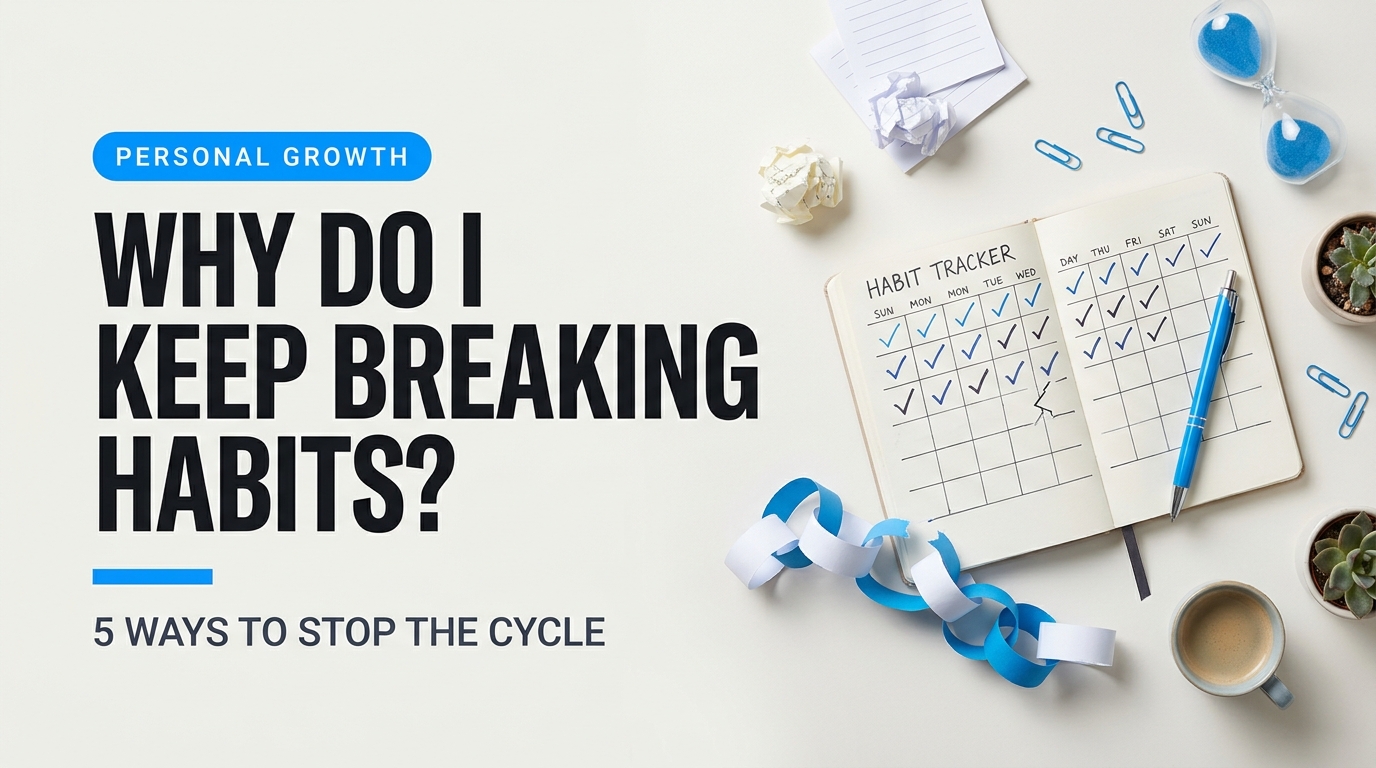
Why Do I Keep Breaking Habits? 5 Ways to Stop the Cycle
Why Do I Keep Breaking Habits? 5 Ways to Stop the Cycle
Every few months, the pattern repeats. You buy the journal, set the 5:30 AM alarm, and swear that this time will be different. For ten days, you feel unstoppable. Then, a stressful Thursday derails your evening, one skipped workout turns into three, and you quietly ask yourself: why do I keep breaking habits? If you feel trapped in this exhausting start-and-stop rhythm, take a deep breath. You aren’t lazy, and you don’t lack self-discipline. Most people trying to build a better life get caught in this exact trap, cycling between bursts of intense motivation and the guilt of another abandoned routine. Learning how to stop the cycle requires understanding the hidden forces steering your daily choices.
We love the promise of a clean slate. Starting fresh gives us an immediate rush of dopamine. It makes us feel in control of our future. Yet when real life collides with an overly rigid plan, our momentum evaporates. We often treat inconsistency like a moral failing, assuming that successful people simply possess superhuman grit. That belief is false. Willpower functions like a phone battery; it drains quickly under stress, decision fatigue, and emotional overwhelm. When you rely solely on determination to carry a routine, failure is almost guaranteed. Habits do not stick because of raw desire. They survive because they fit the natural architecture of human behavior.
Table of Contents
- The Frustration of the Clean Slate: Understanding the Habit-Breaking Loop
- Why Do I Keep Breaking Habits? The Cognitive Traps Sabotaging Your Routine
- How to Audit Your Routine: Diagnosing the Exact Point of Failure
- Immediate Pivots: Quick Ways to Reclaim Momentum Without Starting Over
- Building Resilient Systems: How to Design Habits That Withstand Bad Days
- How to Prevent Future Lapses During Travel, High Stress, and Burnout
- Shifting from Habit Enforcement to Long-Term Identity Evolution
Friction kills routines far faster than a lack of passion. Pioneering behavioral research on contextual habit cues demonstrates that automatic behaviors depend on stable environments, low-effort initiation, and clear feedback loops. When you design a routine around your ideal self on your best day, you set yourself up to fail on an average Tuesday. The secret to long-term consistency isn’t pushing harder through exhaustion. It comes down to eliminating invisible friction points, forgiving your slip-ups, and building flexible systems that bend instead of break when life gets hectic.
Why Do I Keep Breaking Habits? The Cognitive Traps Sabotaging Your Routine
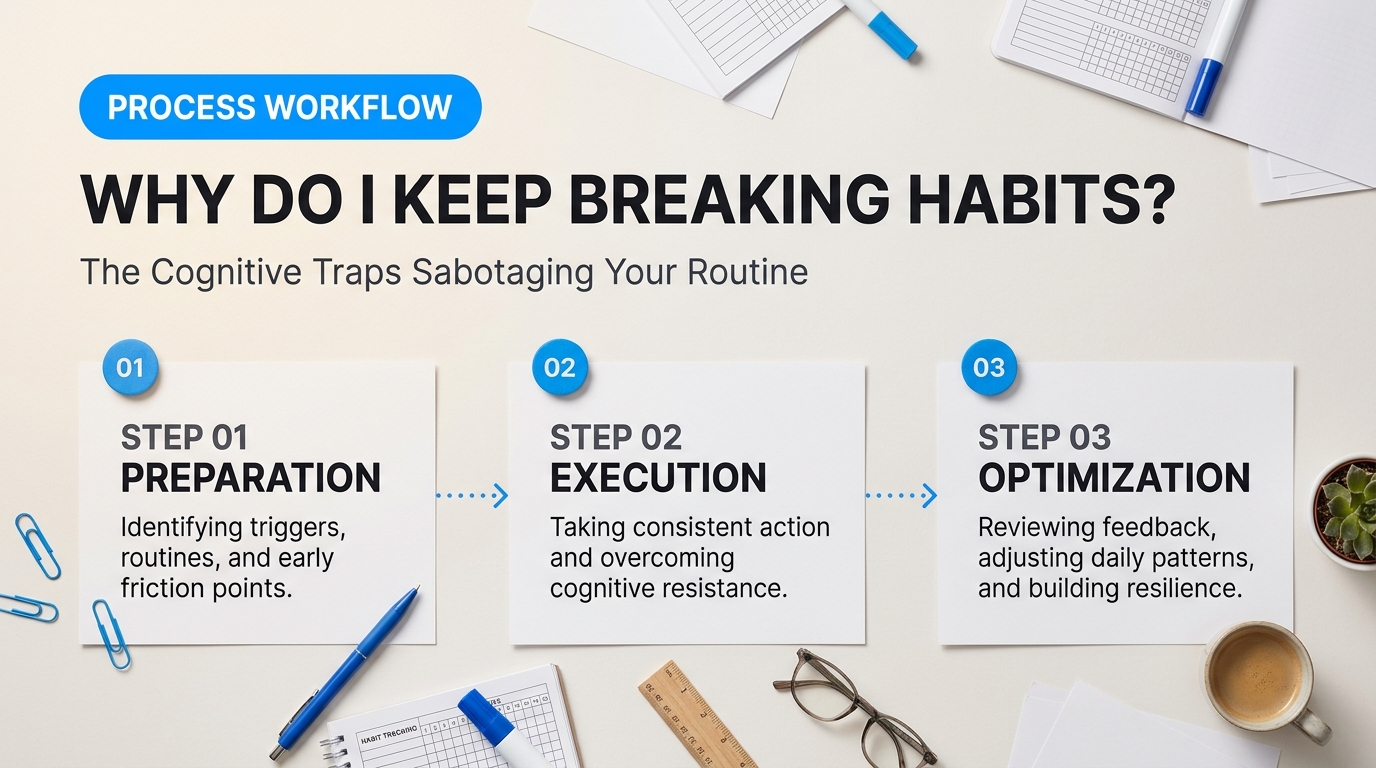
You set the alarm for six in the morning. For five days straight, you hit the floor running, full of clean energy and quiet resolve. Then day eight rolls around. You hit snooze three times, wake up feeling behind, and abandon the entire routine by dinner. It feels like a personal failure, like you just lack the grit other people seem to possess. It isn’t a character flaw. Your brain is simply executing predictable mental patterns designed to conserve your energy.
The Biological Cliff: Why Do I Keep Breaking Habits After Week Two?
When you start a fresh routine, your brain treats it like a major event. Dopamine surges through your nervous system, sparked entirely by the idea of becoming a better version of yourself. Think of dopamine as a chemical down payment on future success. It makes early mornings feel easy and hard workouts feel thrilling. You ride that wave for several days, convinced this time will be different.
Novelty always has an expiration date. Around day ten or twelve, your brain adjusts. The novelty evaporates, and dopamine production drops back down to baseline levels. Suddenly, waking up early isn’t a bold personal transformation anymore. It’s just cold floors and heavy eyelids. When you sit on the edge of your bed asking, “why do I keep breaking habits that I spent hours planning?” you aren’t fighting a weak character. You are experiencing the natural biochemical drop that happens when excitement leaves and raw maintenance begins.
At this exact transition point, another mental trap quietly takes over: all-or-nothing thinking.
Habits don’t survive on emotional highs. They survive on practical systems that keep working when your mood turns cold.
Psychologists call this the “what-the-hell effect.” You decide to read thirty pages of a book every evening. One night, you come home late, tired and unfocused. You only have time for five pages. Instead of reading those five pages, your brain treats the situation as a total failure. You close the book, scroll on your phone for an hour, and tell yourself you will restart next Monday. Missing one session doesn’t ruin your life. Believing that a messy effort equals zero effort is what actually kills your momentum.
Friction Overload and the Myth of Emotional Willpower
Most routines collapse because they are far too heavy for an average Tuesday. We design our habits on our best days, when energy is high and stress is low. Then we expect ourselves to execute those same ambitious plans on our worst days.
- The Energy Tax: If your new gym habit requires packing a bag, driving twenty minutes through traffic, and finding parking, you will skip it the moment you feel drained. Lower the steps between you and the action.
- The Perfection Penalty: Committing to an hour-long daily routine leaves zero margin for life’s emergencies. A ten-minute version keeps the chain unbroken without draining your reserves.
- Emotional Dependency: Waiting to feel “motivated” gives your temporary feelings veto power over your long-term goals. Action creates the mood, not the other way around.
Relying on motivation is like trying to heat your house with paper towels. You get a sudden, brilliant blaze that burns out in thirty seconds. Behavior design works like an efficient furnace. By shaping your environment, cutting out friction, and ditching the need to be perfect, you create routines that survive even your most exhausting days.
How to Audit Your Routine: Diagnosing the Exact Point of Failure
Most of us treat a broken streak like a character flaw. You miss four days of journaling, feel a wave of guilt, and whisper the familiar question to yourself: why do I keep breaking habits that I genuinely want to keep? You assume the answer is a lack of discipline. You promise to push harder next Monday, buy a new planner, and hope pure enthusiasm carries you through.
Relying on sheer resolve is a trap. Willpower is like a phone battery; it drains steadily with every decision, difficult conversation, and stressful commute. When your routine collapses, your character didn’t fail. Your system did. To stop the cycle of rebuilding and abandoning goals, you need to treat your daily schedule like a diagnostic puzzle rather than a moral test.
Diagnosing the Breaking Point: Why Do I Keep Breaking Habits So Quickly?
A habit is a fragile chain of micro-actions. If one link snaps, the entire routine grinds to a halt. When people ask whether running a manual audit on their daily habits is worth the investment of time, they often worry it will feel like tedious homework. The reality is simple: taking ten minutes to inspect where your behavior derailed saves months of wasted restarts.
To find the exact fracture point, walk your failed habit through three distinct diagnostic lenses:
| Diagnostic Lens | The Common Assumption | The Real Problem |
|---|---|---|
| Energy Alignment | “I don’t have enough time in my calendar.” | You have the hours, but you scheduled high-focus tasks during low-energy biological slumps. |
| Trigger Precision | “I forgot to do it because I got distracted.” | The starting cue was invisible, vague, or actively competing with an existing comfort habit. |
| Transition Friction | “I was too lazy to get started.” | The emotional dread of shifting between two radically different mental states froze you in place. |
Start with energy alignment. Most people manage their calendars around open blocks of time instead of available bandwidth. You might have an open hour at 8:00 PM, but if your job drains your mental focus by 6:00 PM, scheduling creative writing or an intense workout at night is setting yourself up to quit. Look back at the last three times you skipped your intended action. Did you skip because the clock ran out, or because your brain felt like wet concrete?
Next, uncover your invisible triggers. Habits do not occur in a vacuum; they attach to cues in your physical environment. Vague intentions like “I will read more in the evening” fail because “evening” is not an actionable trigger. Compare that to: “When I set my dinner plate in the sink, I will open my book to page one.” If your cue is fuzzy, competing triggers win every time. When you collapse onto the couch after work, the television remote sitting on the coffee table offers an instant, effortless cue that easily overpowers your unseen intention to study.
A routine never fails at the moment of execution. It fails ten minutes earlier, during the quiet friction of the transition.
Finally, identify the emotional resistance hiding in transition moments. The hardest part of going for a run is rarely the running itself; it is the clumsy friction of changing clothes, finding matching socks, and walking out the front door. Psychologists call this “state-switching resistance.” Your brain craves safety and momentum. When you attempt to switch abruptly from a comfortable resting state to a demanding activity, your nervous system interprets that sudden shift as a threat. You freeze, reach for your phone, and lose forty minutes to mindless scrolling.
When you sit down to diagnose why an old pattern collapsed, don’t ask what was wrong with your willpower. Ask where the energy drained, which cue went missing, and what emotional wall blocked your transition. Once you locate the exact fracture, you can fix the broken link instead of throwing away the entire chain.
Immediate Pivots: Quick Ways to Reclaim Momentum Without Starting Over
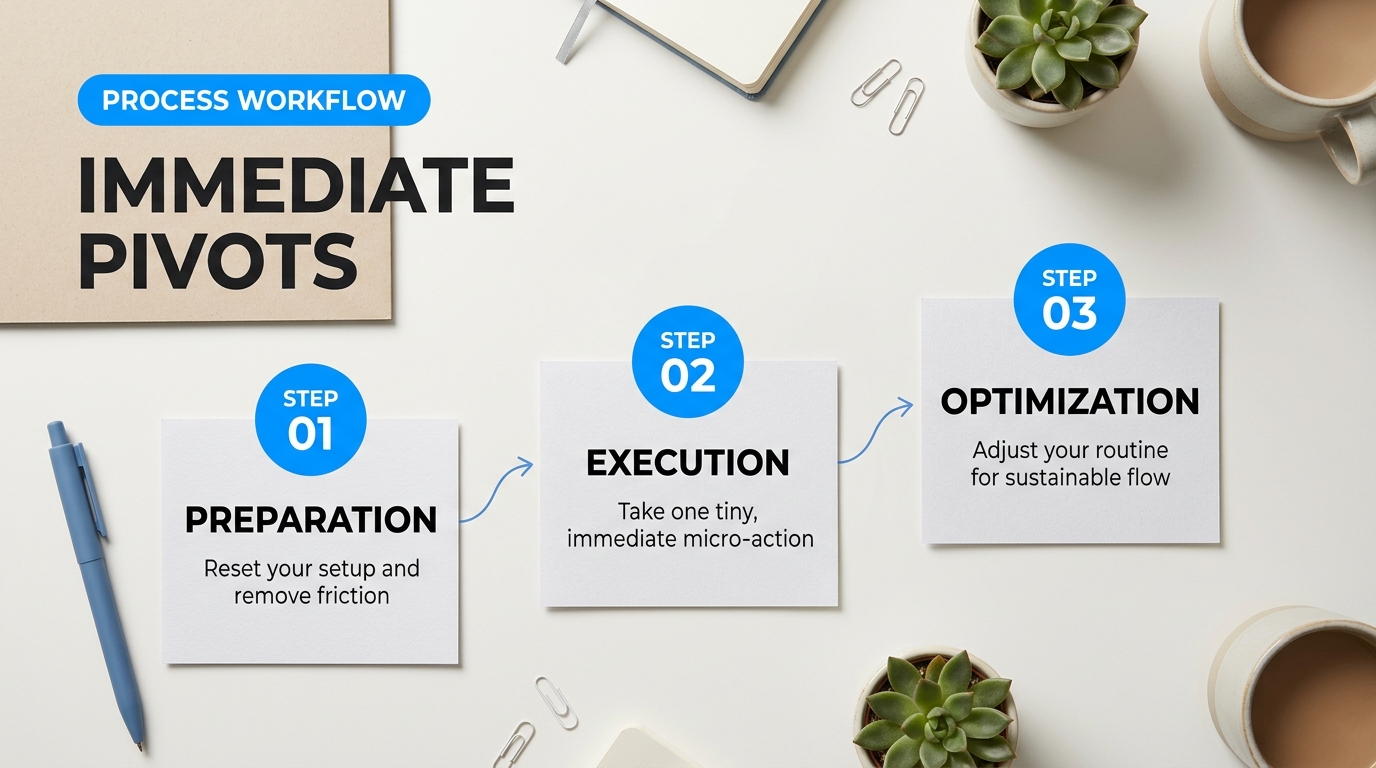
You missed your morning alarm. You skipped your run. By lunchtime, you grabbed fast food because you told yourself the day was already ruined. Most people believe that recovering from a slip-up requires a clean slate. They promise themselves they will start fresh next Monday or on the first of the month. That delay is where momentum dies.
A single missed session does not erase your neurological progress. Your brain holds onto behavioral patterns far longer than you think. Slipping up only turns into failure when you abandon the entire routine out of frustration.
Why Do I Keep Breaking Habits After One Slip? The Reset Fallacy
When you ask yourself, “why do I keep breaking habits?”, the answer usually isn’t poor willpower. The real culprit is all-or-nothing thinking. Behavioral researchers call this the “what-the-hell effect.” You eat a cookie outside your meal plan, decide the day is wasted, and end up eating the entire box. You treat your habits like a glass vase that shatters beyond repair the moment it hits the floor.
Habits are not fragile glass. They are more like muscles. If you skip a bicep curl on Tuesday, your arm doesn’t suddenly waste away by Wednesday. To break the endless cycle of restarting, you need low-friction recovery protocols that take effect within minutes of a lapse.
Start with the “Never Miss Twice” rule popularized by James Clear's guide to habit consistency. Missing once is an accident. Life throws emergencies at you, deadlines shift, and energy dips. Missing twice, however, marks the beginning of a brand-new habit of opting out.
If you fail to write your morning journal entry, write a single sentence on your phone before you turn out the lights. If you miss your planned gym session, do twenty air squats while waiting for your dinner to heat up. The goal isn’t to hit a personal record. The goal is to cast a vote for your desired identity on a bad day.
The Two-Minute Minimum Viable Action
When mental resistance is high, shrink the scope of the task. Do not abandon the routine altogether. Scale the behavior down until it feels laughably easy to complete. Your subconscious cannot argue against an action that takes less effort than brushing your teeth.
| Intended Habit | The Full Routine | The Two-Minute Pivot |
|---|---|---|
| Daily Exercise | 60-minute intense gym workout | Put on running shoes and do 10 pushups |
| Deep Reading | Read 30 pages of a difficult book | Read one paragraph before turning off the lamp |
| Mindfulness | 20-minute seated silent meditation | Take three conscious, deep breaths at your desk |
| Clean Nutrition | Cook an elaborate, whole-food meal | Drink a tall glass of cold water before snacking |
Shrinking the action preserves the ritual. It keeps the cognitive hook firmly planted in your daily schedule. When your schedule clears up tomorrow, the routine will still be waiting for you.
Neutralize Guilt Before It Triggers Self-Sabotage
Guilt is a trap. When you shame yourself for missing a milestone, your brain seeks fast relief from the emotional pain. Ironically, it seeks comfort through your easiest vices: scrolling social media, eating sugar, or shopping online. Self-criticism does not build discipline. It drives you back to short-term numbing behaviors.
Shift your inner dialogue immediately after a missed task. Treat the slip the way you would treat a friend who hit unexpected traffic on their morning commute. You wouldn’t advise them to abandon their car and quit their job. You would simply tell them to take the next exit and keep driving.
“Missing a day is an isolated event. Giving up is an active decision. Treat your personal systems like an open document with auto-save: you never lose your life’s progress unless you deliberately close out and throw away the file.”
Momentum isn’t an unbroken line of flawless days. Real momentum is the speed at which you recover after falling off track. Shorten the distance between your mistake and your next positive choice, and the clean-slate illusion disappears forever.
Building Resilient Systems: How to Design Habits That Withstand Bad Days
Most habit routines collapse because we design them for sunny days. We write our goals on Sunday afternoons when our energy is high, our coffee is warm, and our schedule looks wide open. Then Thursday arrives with a brutal headache, an overflowing inbox, and an unplanned family emergency. Your ambitious routine shatters by dinner.
When you ask yourself, “why do I keep breaking habits?”, you’re usually blaming your own willpower. But willpower is a draining battery. It empties fast. If your routine demands heroic self-discipline every single day, it’s already set up to fail. You don’t need more grit. You need an operating system that protects your habits when your motivation hits rock bottom.
Why Do I Keep Breaking Habits? Redesigning Your Daily Environment
Human behavior flows like water along the path of least resistance. If you have to fight your surroundings to take positive action, you will lose that battle whenever you feel tired. Designing your space turns self-control into an automated reflex.
Think of your environment as an invisible partner. Every object in your room offers a silent suggestion. A smartphone on your nightstand whispers to be checked. A book placed directly on your pillow whispers to be opened. When you arrange physical spaces to make constructive actions effortless and destructive choices difficult, consistency stops feeling like an uphill climb.
The secret to ironclad self-discipline isn’t exceptional character. It is simply living inside an environment that quietly nudges you toward the right choice.
Start by auditing friction points. If your goal is to drink two liters of water daily, keep filled bottles on your desk and kitchen counter. If you want to stop snacking on ultra-processed sweets late at night, store them in opaque containers on the highest pantry shelf. You don’t need superhuman resistance when temptation stays out of sight.
Identity Anchoring: Moving Past Superficial Goals
Surface-level goals create fragile commitments. Saying “I want to exercise five mornings a week” ties your habit to a mechanical output. On days when you feel sluggish, your mind readily negotiates: I can skip today and double up on Saturday. The output gets compromised, and the routine quickly erodes.
Identity anchoring solves this mental negotiation. Instead of focusing on what you want to achieve, shift your focus entirely to who you wish to become. Every conscious decision serves as a vote for your future self:
- Outcome Focus: “I need to run three miles this morning to burn off calories.”
- Identity Anchor: “I am someone who honors their physical health, even when it is raining.”
- Outcome Focus: “I have to read twenty pages before bed to finish this book.”
- Identity Anchor: “I am an active learner who chooses curiosity over doom-scrolling.”
When you shift the target to personal identity, skipping a habit costs more than missing a checkbox. It creates a subtle fracture in your self-image. You stop asking whether you feel motivated enough to act. You show up simply because that is who you are.
Tiered Habit Elasticity: How to Survive Low-Energy Days
All-or-nothing thinking is the quiet killer of personal progress. People often wonder if designing rigid, complex routines is worth the effort, especially when sudden schedule disruptions strike out of nowhere. When real life gets messy, people abandon their entire routine because they can’t complete the full, ideal version.
The antidote is habit elasticity. Build your routines across three flexible intensity tiers based on your daily capacity. On high-energy days, you complete the full routine. On chaotic days, you downshift to the bare minimum required to keep the psychological chain unbroken.
| Habit Focus | Low Energy (The Bad Day Tier) | Standard Energy (Baseline) | High Energy (Peak Day) |
|---|---|---|---|
| Daily Movement | 5 wall pushups or a 3-minute stretch | 30-minute brisk outdoor walk | 60-minute strength session |
| Mindfulness | 3 deep, conscious breaths | 10 minutes seated meditation | 20 minutes silent contemplation |
| Deep Work & Study | Read 1 page of a book | Read 1 chapter (15 minutes) | 45 minutes focused note-taking |
| Reflective Journaling | Write 1 sentence about the day | Fill 1 page of thoughts | Complete a full weekly review |
Completing a low-tier habit feels absurdly simple. That is the whole point. Doing five wall pushups doesn’t transform your physique overnight, but it prevents the habit loop from decaying. It sends a message to your brain: I didn’t quit today. Preserving momentum always matters more than hitting maximum intensity.
Habit Stacking: Piggybacking on Existing Momentum
Starting a new routine from scratch requires substantial mental bandwidth. Your brain has to remember when to start, what to do, and where to go. You can eliminate this mental friction by anchoring your new habit to an automatic behavior you already perform every day.
Think of it like plugging a new device into a live electrical socket. You don’t build a new generator. You simply use existing energy.
Use a simple pairing formula:
“After I [Current Habit], I will immediately [New Elastic Habit].”
If you brew a pot of coffee every morning without fail, that is your anchor. Do not try to meditate at a random time during the afternoon. Instead, decide: After I press the start button on the coffee maker, I will do two minutes of deep breathing at the kitchen island. The aroma of the coffee becomes the natural cue. You remove the decision-making process entirely.
When you align your environment, anchor your identity, grant yourself permission to scale down, and stack new actions onto old routines, bad days stop being catastrophic. They become minor ripples inside a resilient, enduring system.
How to Prevent Future Lapses During Travel, High Stress, and Burnout
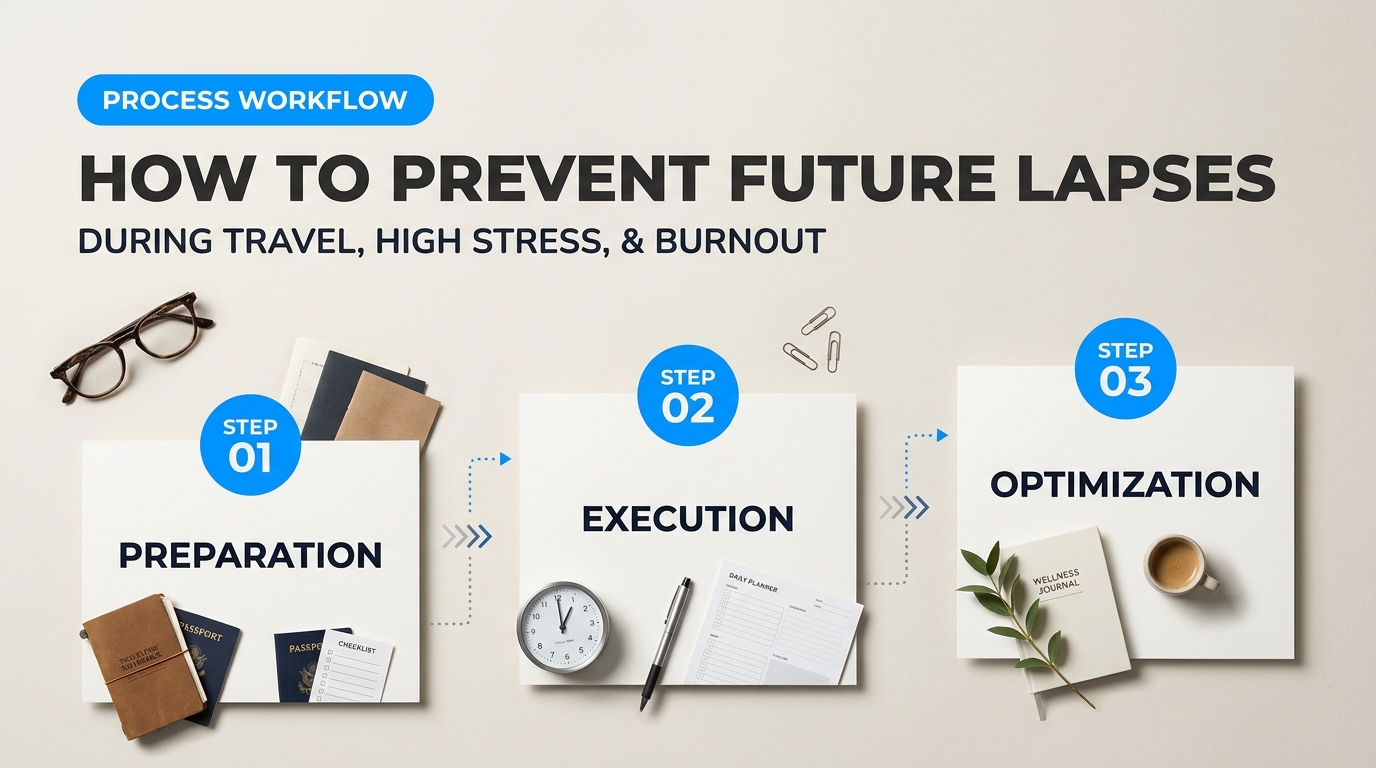
Routines don’t break because you lack discipline. They break because life moves. You catch a delayed flight, your child catches a sudden fever, or a crushing quarterly deadline lands on your desk. Within forty-eight hours, your peaceful morning routine dissolves. You miss three days of workouts, stop journaling, and grab takeout on the couch. By Sunday evening, you find yourself staring at the ceiling, wondering, “Why do I keep breaking habits whenever things get busy?”
You aren’t broken. Your systems are just too brittle. Most routines are designed for perfect, sunny Tuesdays where you have complete control over your calendar. The moment real-world friction appears, rigid systems snap. To stop the cycle of restarting from scratch every month, you must build routines that bend without breaking.
Why Do I Keep Breaking Habits When Life Gets Chaotic?
Stress drains your cognitive battery. When you operate under emotional fatigue, your prefrontal cortex—the part of the brain responsible for impulse control and deliberate planning—hands the steering wheel over to your basal ganglia. Your brain defaults to low-energy survival mode. It seeks immediate comfort over long-term payoffs.
Expecting yourself to maintain an hour-long gym session after twelve hours of travel is like asking a car to drive fifty miles on an empty gas tank. It won’t work. When you force a high-energy habit onto an empty battery, failure is practically guaranteed. Then comes the guilt. That guilt triggers the classic “what-the-hell effect,” where one missed habit turns into two weeks of abandoned self-care.
| Context | Ideal Habit (Baseline) | Fallback Habit (Disruption Mode) |
|---|---|---|
| Business Travel | 45-minute gym strength workout | 10 hotel-room bodyweight squats and 10 pushups |
| High-Stress Work Crunch | Reading a book for 30 minutes before bed | Reading a single paragraph on your nightstand |
| Illness or Burnout | Cooking a balanced, whole-food dinner | Drinking a glass of cold water with a store-bought soup |
The goal during chaotic seasons is not optimization. The goal is identity preservation. By performing a two-minute version of your routine, you keep the behavioral loop alive in your nervous system without burning through your remaining energy.
Adapting Habits Seasonally Instead of Forcing Static Consistency
Nature doesn’t bloom year-round, yet we expect our personal productivity to stay identical in deep December and sunny June. Real life operates in seasons. There are sprinting seasons where your career demands long hours, resting seasons where your body asks for recovery, and exploring seasons where travel disrupts your familiar environment.
When you enter a demanding quarter, sit down and intentionally dial back your targets before life forces your hand. Decide which habits you will put on maintenance mode. A habit on maintenance mode isn’t a failure. It’s a strategic pause that saves your willpower for what matters most right now.
“Compassion toward your limitations is not an excuse to give up; it is the shock absorber that prevents self-criticism from wrecking your momentum.”
Practicing Radical Self-Compassion After a Slip
What happens when you drop the ball completely? You miss the fallback habit, sleep past the alarm, and abandon your intentions for four days straight.
Treat the lapse like an unexpected rainstorm, not a moral failure. Shame creates a heavy mental tax that makes re-entry ten times harder. When you beat yourself up, your brain associates your habits with emotional pain, leading to avoidance. Forgive the missed days instantly. Take one slow breath, pick the absolute smallest action you can complete right now, and step back onto the path without looking back.
Shifting from Habit Enforcement to Long-Term Identity Evolution
Most habit advice treats you like an unruly employee who needs constant supervision. You buy new planners, set louder morning alarms, and download digital trackers to keep yourself accountable. Yet within three weeks, the system falls apart. You miss a Tuesday workout or skip an evening meditation session, and suddenly the entire structure collapses under the weight of guilt. This is the enforcement model of personal growth, and it almost always fails because policing yourself is exhausting.
Habit enforcement relies on brute willpower. It demands perfection and offers shame as the primary motivator whenever you slip up. Identity evolution works in the opposite direction. Instead of asking what rules you need to follow, you ask who you want to become. You stop acting like a warden watching over your own life. True consistency starts the moment you stop treating self-discipline as a daily test of character.
Beyond the Reset Button: Why Do I Keep Breaking Habits?
Every time you ask yourself, why do I keep breaking habits, remind yourself that routines don’t fail because you lack grit. They break because life is unpredictable. Travel happens. Work deadlines pile up. Sickness drains your energy. If your approach to consistency leaves zero room for real life, breaking your routine isn’t a failure. It’s an inevitable mathematical certainty.
Perfection is a trap. You don’t lose all your physical progress because you missed two gym sessions during a hectic week. You only lose momentum when you convince yourself that missing those days wipes out your hard work. That all-or-nothing mindset is what keeps you trapped in the cycle of starting over every single Monday. When you view habits as an ongoing conversation with yourself rather than a fragile streak to defend, the pressure disappears.
Consistency isn’t never missing a day. It is simply refusing to quit when you do.
Real change is quiet. It doesn’t arrive with a dramatic life overhaul or an intense thirty-day challenge that drains your reserves. It shows up in the quiet, forgiving adjustments you make when everything goes wrong. When dinner plans fall through and you eat take-out, you don’t throw your hands up and abandon healthy eating for the rest of the month. You simply prepare a nourishing breakfast the next morning without punishing yourself.
Shift your standard from flawless execution to gentle self-alignment. When you miss a step, don’t demand a clean slate. Meet yourself where you are right now. Take the very next small action that reflects the person you want to be. That single pivot breaks the habit-breaking cycle permanently, turning daily discipline into a sustainable, lifelong way of living.