
How to Build Lasting Daily Habits That Actually Stick
How to Build Lasting Daily Habits That Actually Stick
Everyone knows the sting of a fresh start gone cold. You wake up on a quiet Monday morning filled with explosive ambition, convinced that this season of your life will be different. Yet, understanding how to build lasting daily habits that actually stick rarely comes down to sheer grit. Most people sprint out of the gate on pure enthusiasm, only to slam into an invisible wall two weeks later when stress hits and energy evaporates.
Table of Contents
- The Hidden Psychology Behind Why New Routines Disintegrate
- How Does the Neurological Habit Loop Actually Work?
- How to Build Lasting Daily Habits Using Identity-Based Architecture
- Why Starting Small Beats Aggressive Goal-Setting Every Time
- How to Design Your Physical Environment for Effortless Consistency
- What Is Habit Stacking and How Does It Anchor New Behaviors?
- How to Recover When You Inevitably Break the Chain
- Mastering the Art of Sustainable Self-Evolution
Relying on motivation is a trap. Feelings come and go like the weather. When you depend on an emotional spark to hit the gym, meditate, or write, your routine dies the moment life becomes chaotic. Real behavioral change fails when we treat discipline like an infinite reservoir instead of a battery that drains with every single decision you make throughout your day.
Your brain is wired for survival, not personal perfection. It treats conscious effort as expensive fuel. Every time you force yourself to do something unfamiliar through willpower alone, your prefrontal cortex burns mental reserves. By evening, decision fatigue sets in. You default back to your oldest, easiest comfort patterns simply because your nervous system craves relief.
Mastering how to build lasting daily habits requires shifting away from white-knuckle force toward quiet behavioral automation. Think of automation like setting up direct deposit for your energy. Instead of wrestling with yourself each morning, you design triggers that prompt actions automatically. This protects your limited mental bandwidth for creative work and unexpected crises.
Emotional regulation plays an equally vital role. When you skip a workout or open social media during deep work, guilt usually follows. That guilt triggers stress, and stress drives you right back into the comfort of the bad habit you wanted to break. Breaking this spiral means viewing slips as neutral feedback rather than moral failures.
When you align your lifestyle routines with your biological wiring, consistency stops feeling like an endless fight. Real growth happens in small, protected steps that respect your cognitive capacity. Once you lift the crushing burden of high expectations, your daily actions can finally take root and flourish.
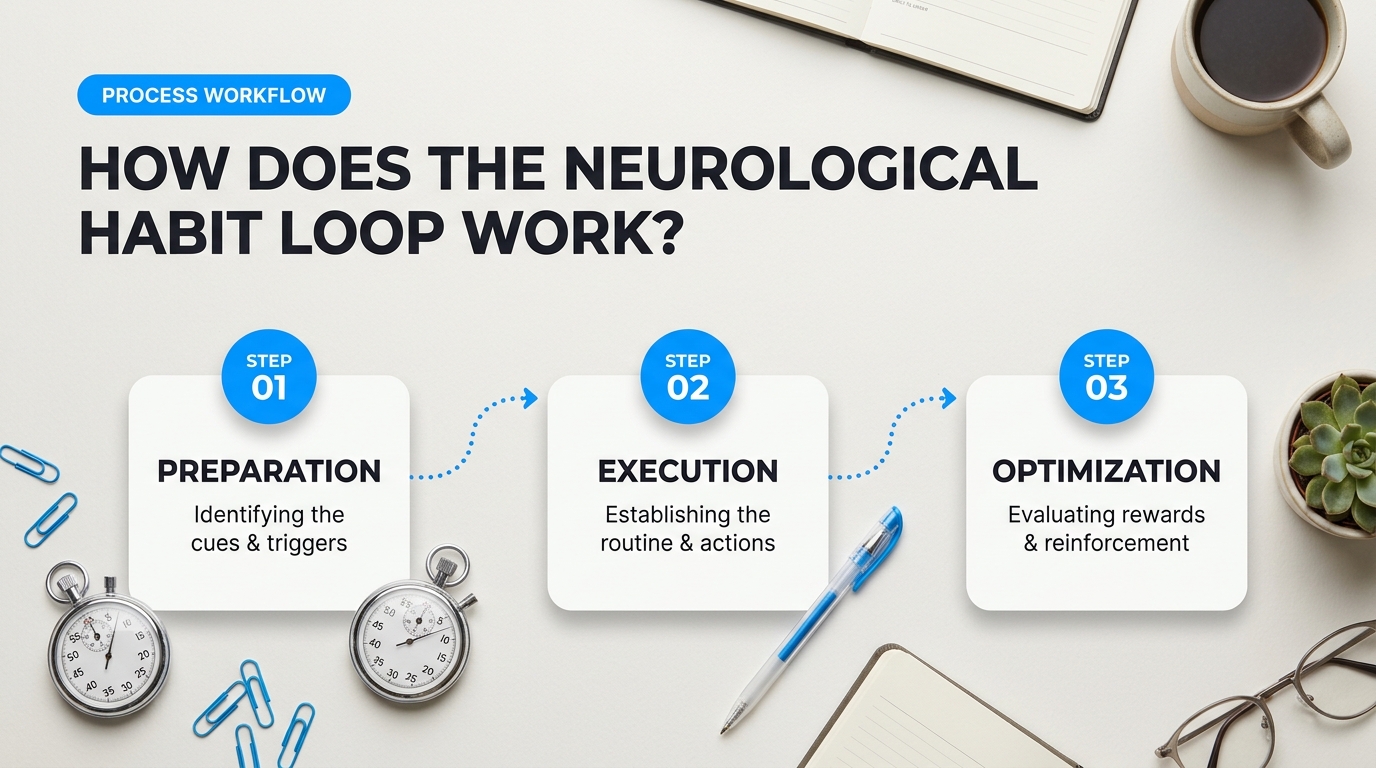
How Does the Neurological Habit Loop Actually Work?
Willpower feels noble. It also fails constantly. When you force yourself to write, exercise, or meditate through raw discipline, your prefrontal cortex burns through energy fast. It works like a muscle that tires out by mid-afternoon. People often wonder if studying neurological mechanics is worth the investment of time compared to just trying harder. Relying solely on grit is an exhausting, manual effort. Your brain hates wasting glucose, so it constantly seeks ways to automate repetitive behaviors.
Deep inside your skull sits the basal ganglia. This ancient, golf-ball-sized cluster of neurons handles your automated scripts. It controls everything from backing your car out of the driveway to brushing your teeth before bed. Understanding this system lets you trade exhausting self-discipline for effortless momentum.
| Element | The Willpower Method | The Habit Loop Method |
|---|---|---|
| Primary Driver | Conscious struggle and friction | Automatic sensory prompts |
| Energy Cost | High prefrontal drain | Near-zero metabolic load |
| Long-Term Result | Decision fatigue and burnout | Routines that actually stick |
Every automated behavior runs on a basic three-step neurological loop: the cue, the routine, and the reward. The cue acts like a tripwire. It tells your brain to step back and let the basal ganglia take the wheel. The routine is the physical, mental, or emotional action you take. The reward is the payoff that tells your brain, “That felt great; let’s record this pattern for next time.”
Rewiring Your Biology: How to Build Lasting Daily Habits with Anticipation
Most people misunderstand dopamine. We imagine it as a chemical trophy our brain hands us after completing a marathon or closing an important deal. It isn’t. Dopamine is not the molecule of satisfaction; it is the neurotransmitter of longing, pursuit, and anticipation.
“Dopamine levels do not spike when you receive a prize; they surge the second you realize a prize is possible.”
Think about walking past a fresh bakery. You don’t experience a massive chemical high when swallowing the third bite of a pastry. The flood of excitement happens the exact moment your nose catches the warm scent of cinnamon from the street corner. That scent is the cue. Your brain generates a craving wave that propels your feet through the bakery door before your rational mind can intervene.
This biological quirk explains why bad habits form so easily and why good intentions often collapse. Social media apps exploit this loop brilliantly. The notification chime creates an irresistible urge to check your phone because you crave the surprise waiting behind the screen, not the screen itself.
You can ethically use this exact biological machinery to serve your personal growth. If you want to master how to build lasting daily habits, you must shift your focus from the effort of the routine to the pull of the anticipation. Pair hard routines with immediate, sensory cues that trigger eager expectation:
- Pair friction with pleasure: Only listen to your favorite storytelling podcast while walking on the treadmill. Your brain starts craving the walk because it anticipates the story.
- Shrink the reward window: Never rely on distant prizes like “better health in ten years.” Reward yourself immediately with a warm shower, a quiet cup of coffee, or two minutes of deliberate pride right after you finish your habit.
- Spotlight the sensory cues: Lay out your running shoes under a warm light the night before, or set an open journal on your desk with your favorite pen resting across the clean page.
When you align the cue and the craving, consistency stops feeling like punishment. Your brain naturally chases what it expects will feel good, turning self-improvement from an endless battle into a natural daily reflex.
How to Build Lasting Daily Habits Using Identity-Based Architecture
Most resolutions crumble because they focus entirely on what you want to achieve rather than who you want to become. You decide to run a marathon. You force yourself out into the freezing dawn at five in the morning, gritting your teeth through every step. It feels like an exhausting daily battle against your own nature. When your daily actions clash with how you secretly see yourself, your old self-image wins every single time.
Relying on brute force to transform your routine feels like running an engine without motor oil. You burn through immense willpower just to cross items off a checklist. Learning how to build lasting daily habits requires flipping the entire equation upside down. Instead of working from the outside in, start from the core of your identity.
The Problem with Outcome-Driven Intentions
Outcome-driven goals focus on an external result. Identity-driven commitments focus on your internal character. The difference sounds subtle, but it reshapes your entire emotional state.
| Outcome-Based Intention | Identity-Based Reframe |
|---|---|
| “I want to write a 300-page book.” | “I am a writer.” |
| “I want to save ten thousand dollars.” | “I am an investor who builds wealth.” |
| “I need to drop twenty pounds this spring.” | “I am someone who honors my physical health.” |
When someone offers you a cigarette while you are quitting, you have two ways to respond. You can say, “No thanks, I’m trying to quit.” That statement signals you still view yourself as a smoker who is currently suffering through deprivation. Or you can say, “No thanks, I’m not a smoker.” That tiny shift signals a closed chapter. It costs zero willpower because non-smokers do not crave cigarettes.
How to Build Lasting Daily Habits by Shifting Your Self-Image
You cannot change your self-image simply by standing in front of a mirror and chanting positive affirmations. The human brain detects hollow statements instantly. Lasting belief requires real, tangible proof. Every action you take throughout the day functions as a vote for the type of person you wish to become.
“True behavior change is identity change. You might start a habit because of motivation, but the only reason you’ll stick with one is that it becomes part of who you are.”
To construct an identity-based system that sticks without mental fatigue, follow this three-step blueprint:
- Clarify the avatar: Ask yourself who embodies the results you want. What does a healthy person eat for lunch? How does a calm person react when someone cuts them off in traffic? What does a prolific artist do on a rainy Tuesday afternoon?
- Cast small votes: Do not worry about running five miles on day one. Put on your running shoes and step outside for two minutes. That single micro-action casts a vote for the runner identity. One pushup casts a vote for the athlete. Reading one page casts a vote for the scholar.
- Reframe your self-talk: Catch the negative labels you quietly tell yourself. Swap phrases like “I’m always disorganized” or “I’ve never had good discipline” for “I am practicing order” and “I am becoming someone who honors their commitments.”
Many people wonder if this mental reframe takes too much emotional energy compared to simple tracking apps. When discussing personal productivity on forums, people often compare manual tracking workflows against automated systems to see which delivers better consistency. Pure willpower operates like a manual workflow: exhausting, clunky, and prone to error. An identity-based system operates like natural muscle memory. When a habit becomes an expression of who you are, consistency stops feeling like work and starts feeling like second nature.
Why Starting Small Beats Aggressive Goal-Setting Every Time
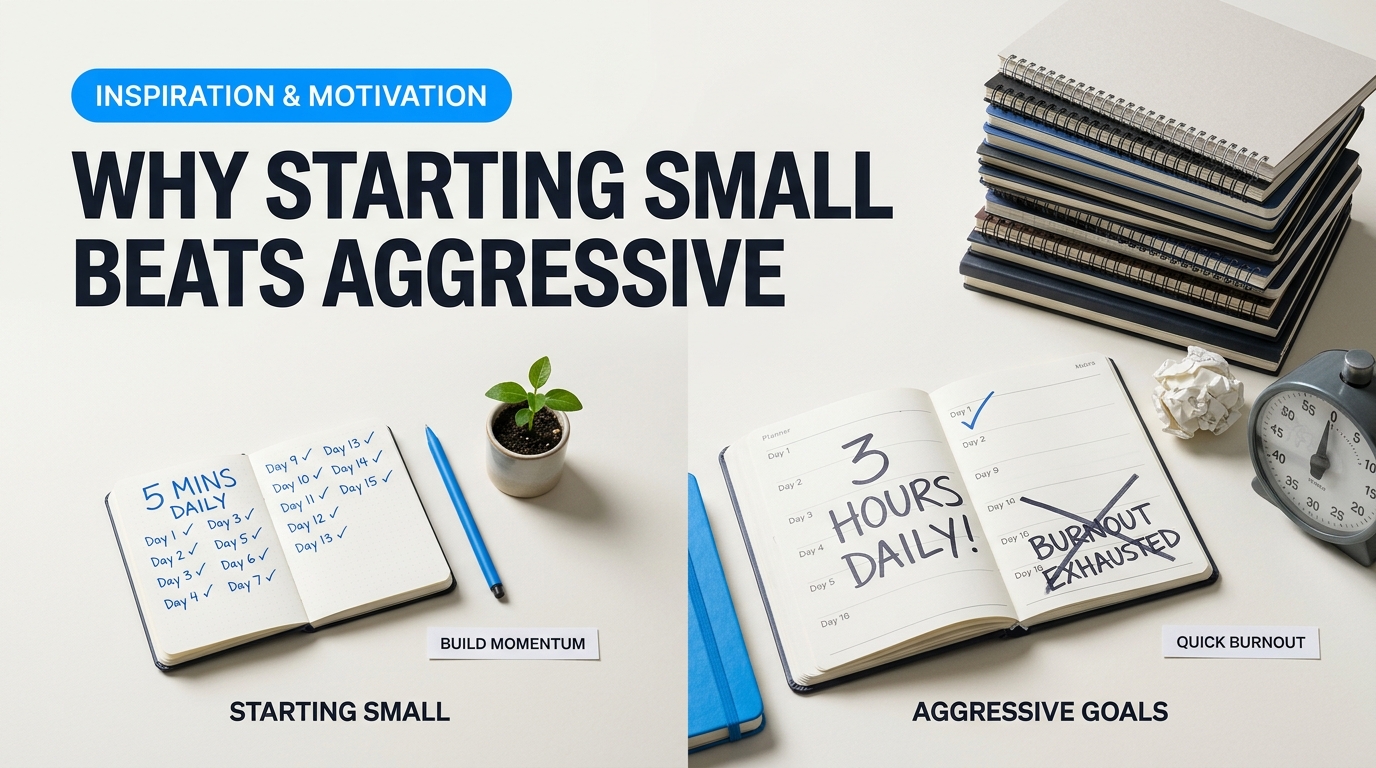
Big leaps feel thrilling on paper. When inspiration strikes, you tell yourself you will hit the gym for ninety minutes every day, write an entire chapter before sunrise, or overhaul your diet overnight. Then a rough workday hits. Exhaustion creeps in. The sheer mental weight of that massive commitment triggers instant dread, and you spend the evening paralyzed on the couch.
Aggressive goal-setting fails because it relies on peak willpower. Willpower drains fast under stress. When a habit demands massive mental energy while your personal fuel tank sits near empty, your brain slams on the brakes. Psychologists call this executive dysfunction. Your mind registers a massive new task as a genuine threat to your finite reserves of energy. You don’t abandon the plan because you lack discipline. You quit because the initial barrier to entry is ridiculously high.
Shrinking the Friction: How to Build Lasting Daily Habits with Micro-Steps
Micro-habits dismantle cognitive resistance by making early action almost effortless. Instead of forcing yourself through a grueling workout, your only assignment is pulling on your running shoes. Instead of writing two thousand words, you write two sentences. Instead of meditating for thirty minutes, you sit quietly for sixty seconds.
This approach hinges on the two-minute rule: whenever you start a new daily routine, make sure the initiation ritual takes less than two minutes. Anyone can read one page, floss one tooth, or wipe down one counter. By reducing the physical and psychological friction to near zero, you bypass the inner debate entirely.
The goal is not to perform miracles on day one. The goal is simply to become the type of person who shows up every single day without an argument.
Skeptics often ask whether shrinking your targets to micro-steps is actually worth the investment of your daily focus. If you only read one page a day, won’t it take years to finish a book? That critique misses the point of neurological habit formation. You aren’t optimizing for daily output yet. You are establishing ritual initiation over performance intensity.
| Core Dimension | Aggressive Goal-Setting | Micro-Habit Initiation |
|---|---|---|
| Activation Energy | High (demands peak motivation) | Negligible (bypasses mental dread) |
| Low-Energy Days | Routine collapses completely | Baseline standard stays unbroken |
| Primary Focus | Immediate, unsustainable output | Gateway trigger consistency |
| Self-Identity Built | “I failed another ambitious plan” | “I am someone who never misses” |
Think of a freight train. Getting thousands of tons of steel moving from a dead stop requires massive energy. Keeping those wheels spinning along flat tracks takes almost nothing. Aggressive goals try to accelerate the train from zero to ninety miles an hour in two seconds, blowing out the engine. Micro-habits simply nudge the train an inch forward.
Once you sit down at your desk and write a single sentence, momentum takes over. You will often choose to keep going because starting was the only hard part. Even on days when you stop right after two minutes, you win. You reinforced the neurological groove of the trigger. You protected the streak.
Mastering gateway behaviors removes the guilt of imperfect performance. You cannot optimize a routine that doesn’t exist in the real world. Establish the rhythm first, and expand the volume later. That simple priority shift is how to build lasting daily habits that survive bad days, low energy, and busy schedules.
How to Design Your Physical Environment for Effortless Consistency
Willpower runs dry by three in the afternoon. You start the day determined to eat clean, read thirty pages, and write your journal before bed. Then life happens. Your energy dips, your focus fractures, and you fall back onto your default settings. Most people blame their lack of discipline when routines collapse. In reality, your surroundings are quietly making your choices for you.
Every room sends silent commands to your brain through sightlines, textures, and convenience. Psychologists call this choice architecture. If your phone sits on your nightstand within arm’s reach, checking notifications is your brain’s natural response to waking up. If a bag of chips sits open on the kitchen counter, you will snack even when you aren’t hungry. When you understand how to build lasting daily habits through space design, discipline stops feeling like an exhausting daily battle.
Designing Spaces: How to Build Lasting Daily Habits Without Sheer Willpower
Your environment should make productive actions obvious and counter-productive actions inconvenient. The brain naturally seeks the path of least resistance. You can turn this natural laziness into an advantage by engineering sensory triggers that launch you directly into positive behaviors.
Start with the concept of visual priming. Keep the tools for your constructive habits in direct eye contact. If you want to hydrate first thing in the morning, place a full glass of water on your bathroom vanity before you go to sleep. Want to practice acoustic guitar every evening? Take it out of its case and set it on a stand next to your favorite armchair. When an action requires zero setup, starting becomes almost automatic.
The secret to consistent personal growth is not building ironclad self-control. It is removing the need for self-control altogether by shaping the rooms where you live.
The inverse principle matters just as much. You need to introduce strategic friction to habits you want to drop. Friction refers to any small physical barrier that delays immediate gratification. Adding just twenty seconds of effort between an urge and an action gives your conscious mind enough time to intervene.
| Target Behavior | Default Friction Trap | Environmental Redesign |
|---|---|---|
| Morning Workout | Searching for clean gym clothes in the dark closet. | Set shoes, socks, and gear right next to the bed the night before. |
| Deep Focus Work | Smartphone vibrating beside the keyboard while working. | Leave the charger in another room during working hours. |
| Evening Reading | TV remote resting comfortably on the coffee table. | Stash remotes inside a drawer and place an open book on the pillow. |
A frequent skepticism arises in self-improvement forums. Readers on Quora discussions on personal productivity routines often ask whether overhauling a living space is truly worth the time investment compared to simply trying harder. The answer comes down to return on energy. White-knuckling your habits drains your finite mental battery every single hour. Taking ninety minutes on a Sunday afternoon to rearrange your workspace pays dividends every single day for months.
Designate single-purpose zones inside your home. If you work from home, avoid working from bed or your relaxation couch. When you mix spaces, you blur sensory associations. Your brain enters your bedroom and doesn’t know whether to rest or stress over unanswered emails. Keep your relaxation zones peaceful and clear of clutter. Keep your work zones focused and stripped of idle entertainment. Your brain quickly learns what behavior belongs in each square foot of your home, turning consistency into second nature.
What Is Habit Stacking and How Does It Anchor New Behaviors?
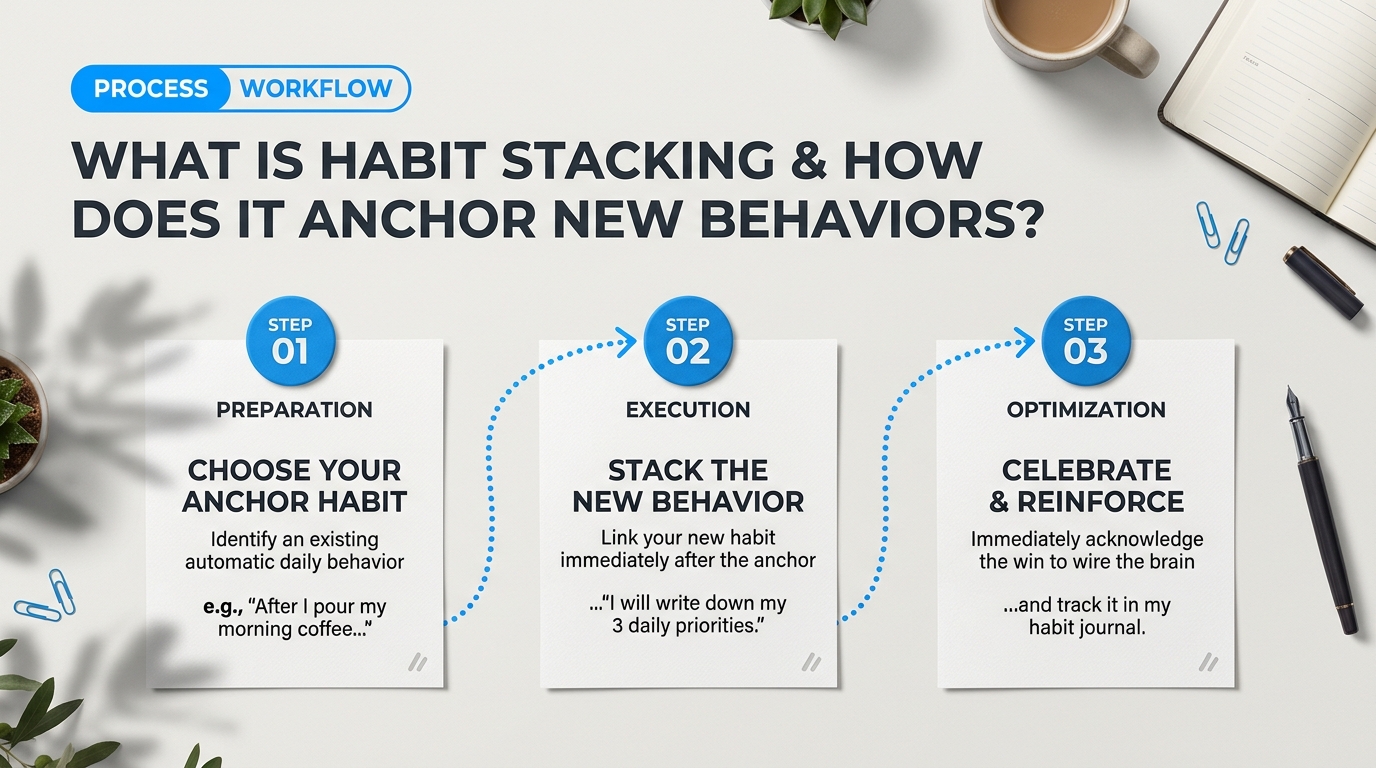
Think of your brain as a busy electrical grid. Every routine you perform without thinking—like pouring your morning coffee, brushing your teeth, or locking the front door—runs on deeply paved, high-speed neural superhighways. When you try to install a completely new behavior from scratch, your brain treats it like laying fresh asphalt through rough terrain. It takes conscious effort. It exhausts your mental energy. Habit stacking solves this problem by hitching a ride on the highways you’ve already built.
Instead of pairing a new habit with a vague time or fleeting burst of motivation, you anchor it directly to an established, non-negotiable behavior. Your existing routine serves as the cue. You don’t need reminders, sticky notes, or phone alarms. The momentum of what you’re already doing carries you right into what you want to do next.
Mastering the Stacking Formula: How to Build Lasting Daily Habits Without Burnout
The operational framework for stacking is deceptively simple:
“After [CURRENT HABIT], I will [NEW HABIT].”
Understanding how to build lasting daily habits doesn’t require superhuman willpower or punishing self-discipline. It requires clean choreography. When people struggle with consistency, they often fall into predictable friction points. As highlighted in online community discussions on habit stacking pitfalls, stacks break down when your anchor is too ambiguous or when your new commitment demands too much mental real estate at once.
Saying “After I wake up, I will meditate” rarely sticks because “waking up” is a drawn-out process. Are you waking up when the alarm sounds? When you sit up in bed? When you walk to the kitchen? A precise anchor sounds like this: “After my feet touch the floor beside my bed, I will take three deep breaths.” Specificity removes decision fatigue.
| Target Objective | Established Anchor Routine | The Stacked Micro-Habit | Daily Energy Payoff |
|---|---|---|---|
| Mental Clarity | Pouring your first cup of coffee | Write down three non-negotiable priorities for the day | Eliminates morning scatter before you open your inbox |
| Physical Vitality | Closing your laptop for lunch | Drink a full glass of water and stretch for 60 seconds | Prevents afternoon energy slumps without relying on caffeine |
| Creative Focus | Shutting down your workstation at the day’s end | Jot down the opening sentence for tomorrow’s project | Gives your subconscious an easy runway to start fast the next morning |
When you align habits this way, you avoid the heavy friction of deciding when and where to act. The anchor does the heavy lifting. You simply step into the slipstream of your regular day, stacking health, mindset, and productivity practices into a continuous flow that feels natural rather than forced.
How to Recover When You Inevitably Break the Chain
You missed a morning workout. You skipped your evening meditation, or you ate the sugary donut you swore you would avoid. Suddenly, a quiet voice whispers: Well, you blew it. You might as well give up for the rest of the week.
Psychologists call this the “what-the-hell effect.” You make one tiny misstep, feel an immediate wave of guilt, and decide to abandon your goal altogether. It feels like dropping your phone on the kitchen floor, noticing a faint scuff on the protective case, and then stomping on the screen until it shatters. It makes zero sense. Yet, we do this to our personal routines all the time.
Streaks feel intoxicating when they work. Watching a row of checkmarks grow across your calendar gives you a genuine chemical high. But an unbroken chain turns your habit into fragile glass. The moment real life intervenes—a sick child, unexpected traffic, or plain exhaustion—the glass breaks. If your standard is 100% perfection, any single disruption feels like absolute failure.
“A lapse is just an event. A collapse is an interpretation.”
When you want to understand how routines survive over years, you have to trade pristine perfection for durability. Real life will punch holes in your schedule. Surviving those hits requires mental elasticity, not brittle willpower.
Resetting Your Mindset: How to Build Lasting Daily Habits After a Lapse
When people struggle with how to build lasting daily habits, they often ask whether starting over is worth the emotional investment. They wonder why their consistency crumbles after a few productive weeks. The issue rarely comes down to discipline. It stems from the story you tell yourself the day after a slip-up.
If you beat yourself up with harsh self-criticism, your brain associates your habit with pain and shame. To escape that bad feeling, you naturally avoid the very behavior you want to cultivate. Self-compassion does the opposite. Treating yourself like a supportive friend keeps your stress hormones low. It keeps you calm enough to simply try again tomorrow.
| The Perfectionist Trap | The Resilient Mindset |
|---|---|
| Missing one session resets your score to zero. | Missing one session is just a normal dip in a lifelong practice. |
| Relies on guilt and self-blame to spark action. | Relies on curiosity and kindness to uncover why you slipped. |
| Focuses strictly on an unbroken visual streak. | Focuses on your overall percentage over three to six months. |
The Never Miss Twice Rule
Never miss twice. It is that straightforward.
Missing once is an accident. Life happens. You get a migraine, your flight gets delayed, or your work shift runs late. That is life flexing its unpredictable muscles. But missing twice in a row signals the start of an entirely new, unwanted behavior. One missed day is an anomaly; two missed days is the seed of a competing pattern.
If you miss your Tuesday writing session, Wednesday becomes your priority. You do not need to double your output on Wednesday to make up for Tuesday. In fact, trying to compensate by doing twice the work usually burns you out. Just show up and write three sentences. Protect the rhythm above everything else.
Reframing Your Consistency as a Batting Average
Think of your habits like a professional baseball player step-by-step stepping up to the plate. The greatest hitters in history fail sixty-five to seventy percent of the time. If they quit after two consecutive strikeouts, they would never make the Hall of Fame.
Why do we demand a 1.000 batting average from ourselves? If you complete your morning walk twenty-four out of thirty days, you did not fail for six days. You logged an 80% success rate. That is a solid B-plus in any classroom and a championship-level performance in real life.
To discover how to build lasting daily habits that actually stick through chaotic seasons, you must lower the threshold of entry on your worst days. Define your baseline fallback. If your goal is reading thirty pages of a book, your bad-day fallback is reading one single paragraph before bed. You keep your identity intact without demanding heroic energy when your tank is completely empty.
Slip-ups are not warning signs that your routine has collapsed. They are standard friction points on the road to long-term change. Acknowledge the missed day without panic, dust off your shoes, and show up again the next morning.
Mastering the Art of Sustainable Self-Evolution
Real transformation rarely announces itself. It happens in the quiet moments when you choose a single glass of water, write three sentences in a journal, or step outside for a five-minute walk. Big leaps feel exciting. Yet small shifts endure. When we explore how to build lasting daily habits, we often assume massive transformations demand sudden, exhausting overhauls. We burden ourselves with rigid expectations, only to abandon them the moment life pushes back.
You don’t need a clean slate to begin. Waiting for the perfect Monday, the start of a new month, or a sudden burst of inspiration only delays your progress. Sustainable self-evolution is an ongoing conversation between who you were yesterday and who you choose to be in this exact moment. Every tiny action is a vote for your future self.
Reframing How to Build Lasting Daily Habits for the Long Run
All-or-nothing thinking remains the single greatest threat to personal growth. Missing one workout doesn’t wipe out your athletic identity. Eating a rushed, unbalanced lunch won’t undo weeks of mindful nourishment. Life will get messy. Work deadlines escalate, family members need unexpected care, and fatigue inevitably sets in. True consistency isn’t about maintaining an unbroken streak under museum-grade conditions. It’s about how quickly and kindly you guide yourself back to your baseline.
“Perfection is a brittle strategy. Resilience comes from making your routines small enough to survive your hardest days.”
Give yourself permission to dial back the volume without quitting entirely. If you don’t have forty-five minutes to exercise, take two minutes to stretch on the living room rug. If you don’t have the bandwidth to read an entire chapter, read a single paragraph before turning out the light. Preserving the behavior’s boundary matters far more than its scale.
Take a breath and choose one behavior right now. Don’t worry about next year, next month, or even next week. Pick a single, microscopic habit that anchors easily into the life you already live, and commit to showing up for it today. When you honor that tiny promise, you aren’t just completing a chore—you are quietly rebuilding trust in your own capacity to grow.
