How to Stop Negative Self-Talk Using Cognitive Reframing
How to Stop Negative Self-Talk Using Cognitive Reframing – how to stop negative self talk daily
You drop a glass, miss an email deadline, or catch your reflection after a restless night, and an abrasive inner voice strikes: You always mess things up. Learning how to stop negative self talk daily is not about slapping fake smiles onto real struggles. It is about catching the runaway mental scripts that secretly run your life. When you master your inner dialogue, you reclaim control over your energy, your focus, and your daily self-worth.
Table of Contents
- The Invisible Weight of Your Inner Critic and Why It Matters
- Recognizing the Four Hidden Forms of Daily Cognitive Distortions
- How to Stop Negative Self Talk Daily: A 4-Step Cognitive Reset
- Why Neutral Thinking Beats Toxic Positivity When Reframing Thoughts
- Identifying Physical and Digital Triggers That Fuel Negative Self-Talk
- Daily Mental Hygiene Habits to Build Long-Term Cognitive Resilience
- Sustaining a Compassionate Inner Monologue for Long-Term Growth
Most of us live with a relentless critic sitting in the back of our minds. Cognitive therapists refer to these rapid-fire thoughts as automatic negative thoughts (ANTs). They do not arrive with sirens. Instead, they slip into your conscious stream like quiet background static, convincing you that harsh self-judgment is simply objective reality. Over days and months, this silent self-punishment creates an invisible emotional drag. It drains your motivation, inflates minor slip-ups into catastrophes, and dims your confidence before you even try.
Why do we tolerate this internal bullying? Many people quietly worry that without a stern critic, they will turn lazy and lose their edge. In honest community discussions on persistent inner critic patterns, participants often realize that the critic gets loud because it mistakenly believes it is shielding them from danger or embarrassment. It runs outdated survival code. But motivating yourself with shame is like putting bad fuel into a high-performance engine. It creates friction, wears you down, and ultimately blocks genuine productivity.
Real emotional resilience begins when you stop treating every negative thought as absolute fact. Your brain produces thousands of random impressions each day, and many of them are simply inaccurate. By leaning on cognitive reframing, you learn to spot distorted reasoning, step back into grounded perspective, and replace panic with calm clarity. Mastering how to stop negative self talk daily through thoughtful reframing is the foundation for lasting self-respect, peace of mind, and meaningful personal growth.
Recognizing the Four Hidden Forms of Daily Cognitive Distortions
Your inner voice often bends the truth. It does not do this out of spite. Your brain wants to protect you from danger, so it leans on fast mental shortcuts that twist everyday events into false alarms. Cognitive scientists call these habitual thought patterns cognitive distortions. When you learn to catch these mental glitches as they appear, you uncover the real secret behind how to stop negative self talk daily.
Most negative internal monologues do not stem from bad intentions. They grow from four specific cognitive traps that warp your perspective like a carnival mirror.
The video above breaks down why the human brain defaults to these defensive shortcuts. Watching how these mental loops form makes it easier to step back and observe your reactions without self-judgment.
Spotting Mind Traps: How to Stop Negative Self Talk Daily
Real-time awareness changes everything. When an unsettling thought spikes your pulse, check it against these four primary distortions.
1. Catastrophizing (The Worst-Case Engine)
Catastrophizing turns a small hiccup into an absolute disaster. You make a minor typo in an email, and your brain instantly leaps ahead: your boss will fire you, you will lose your apartment, and your career is over. You jump straight to the apocalypse. Your nervous system reacts to your imagined disaster as if it were happening right now on your screen. Catch this trap by asking yourself a grounding question: What is the most likely outcome here, rather than the absolute worst one?
2. Black-and-White Thinking (The Polarizer)
Also called all-or-nothing thinking, this trap wipes away all shades of gray. You are either a complete success or a total failure. If you break your clean eating streak with one cookie, this trap tells you the whole week is ruined, so you might as well eat the entire box. In peer discussions on black-and-white thinking and anxiety, members often describe how splitting reality into extremes fuels constant perfectionism and emotional exhaustion. Life rarely lives at the extremes; it unfolds in the middle.
3. Emotional Reasoning (The Feelings-As-Facts Trap)
Emotional reasoning assumes that because you feel something strongly, it must be an objective truth. You feel guilty, so you assume you did something wrong. You feel out of place at a social gathering, so you conclude that nobody in the room likes you. Your emotions are valid biological signals, but they make terrible historians. Feelings reflect your energy levels, stress hormones, and old memories—not necessarily the physical reality in front of you.
4. Personalization (The Self-Blame Magnet)
Personalization convinces you that other people’s bad moods or neutral actions are direct reactions to you. When a coworker answers your morning greeting with a short, quiet nod, personalization whispers that they are angry with you. You take ownership of events outside your control. In reality, your coworker might just have a splitting headache or a broken car. You are rarely the lead character in someone else’s bad morning.
| Distortion Type | The Automatic Thought | The Reality Check |
|---|---|---|
| Catastrophizing | “I messed up the presentation. I’m going to lose my job.” | One rough slide does not erase years of good performance. |
| Black-and-White | “I skipped my morning workout. My fitness journey is dead.” | A missed day is just a rest day. Progress is cumulative. |
| Emotional Reasoning | “I feel overwhelmed and inadequate, so I must be incompetent.” | Tiredness feels heavy. Fatigue is an physical state, not a character flaw. |
| Personalization | “My friend hasn’t texted back all day. They must be sick of me.” | People get busy. Their response time reflects their schedule, not your worth. |
“You cannot fix a glitch in your internal dialogue until you know which button your brain is pressing. Name the pattern, and the panic loses its power.”
Pay close attention over the next twenty-four hours. When your inner voice turns harsh or foreboding, pause for three seconds. Label the pattern out loud or in your journal: “That is catastrophizing,” or “I’m using emotional reasoning right now.” That tiny gap between experiencing an automatic thought and naming it gives you the space to rewrite the script.
How to Stop Negative Self Talk Daily: A 4-Step Cognitive Reset
Your inner voice often behaves like an overactive smoke detector. It catches a slight awkward pause during a call or spots a minor typo in an email, and suddenly it sounds a five-alarm emergency. People wrestling with self-criticism often share that exact fatigue: no matter how hard they work, an inner voice whispers that they are falling behind or failing to measure up.
Quieting that noise does not require years of deep psychological theory. You need a fast, reliable routine you can run in real time. Cognitive reframing gives us a straightforward four-step protocol to reset mental static right when it hits: Catch, Challenge, Neutralize, and Reframe.
Seeing how mental loops form makes interrupting them much easier. In the video above, cognitive therapy principles show how quickly an unchecked thought can derail an entire afternoon if you accept it as fact.
Mastering the 4 Steps: How to Stop Negative Self Talk Daily
When an unhelpful reaction strikes, running through these four stages takes less than thirty seconds, yet it reliably breaks the loop before it drags your mood down for the rest of the day.
- 1. Catch the thought early. Step out of autopilot. Most self-defeating thoughts do their damage because we treat them as absolute truth before we even notice them happening. In an insightful AskReddit discussion on interrupting inner criticism, contributors emphasized that simply recognizing the spiral and pausing without self-judgment is half the battle. Think of the thought like a push notification on your phone. You don’t have to open it; you just notice that a notification popped up.
- 2. Challenge the premise. Put the statement on trial. Ask yourself: What objective facts support this thought? What evidence contradicts it? If your mind says, “You always mess things up,” target the absolute word. Have you truly ruined every single thing you touched? Of course not. Harsh self-talk almost always relies on wild exaggerations that fall apart under gentle cross-examination.
- 3. Neutralize the emotional voltage. Bring the temperature down to room level. Many people try to counter negative thoughts by forcing bright, bubbly cheerfulness, but that usually feels fake and unconvincing. Neutrality works better. Strip away the dramatic adjectives. You aren’t “a hopeless disaster”; you are simply someone who forgot to attach a file to a message.
- 4. Reframe toward constructive agency. This is where genuine cognitive reframing takes root. Ask: What is a practical, grounded perspective that lets me move forward? You aren’t pretending mistakes never happen. Instead, you focus on what you can actually influence right now. Reframing replaces self-punishment with clear problem-solving.
“You don’t have to control your thoughts; you just have to stop letting them bully you.”
To see how this works in an everyday scenario, consider how a single setback transforms when you guide it through each stage:
| Stage | Internal Dialogue | The Mental Shift |
|---|---|---|
| Automatic Thought | “I bombed that meeting. Everyone thinks I have no idea what I’m doing.” | Catastrophizing and mind-reading |
| Step 1: Catch | “Hold on. My inner critic is spiraling over a 15-minute sync.” | Stepping back into the observer role |
| Step 2: Challenge | “Did anyone say that? No. Two colleagues thanked me for the data.” | Checking actual evidence against assumptions |
| Step 3: Neutralize | “My introduction was rushed, but the core points were covered.” | Stripping away emotional panic |
| Step 4: Reframe | “Next time, I’ll write bullet points for the opening so I stay steady.” | Turning self-blame into an actionable plan |
Practicing how to stop negative self talk daily isn’t about clearing your head of every unpleasant thought forever. Your brain produces thoughts automatically, much like your heart beats. Success simply means you stop handing the steering wheel to the harshest voice in the room.
Why Neutral Thinking Beats Toxic Positivity When Reframing Thoughts
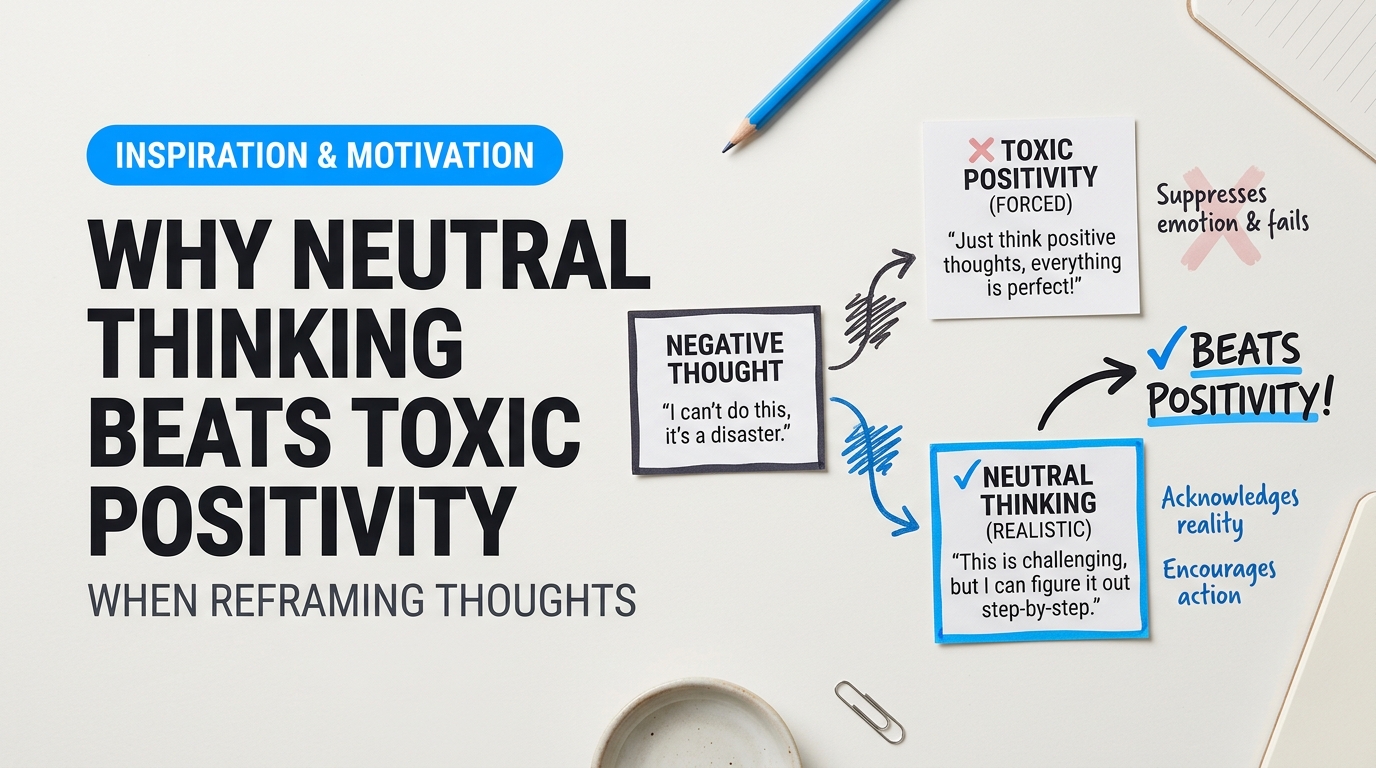
“Look in the mirror and tell yourself you’re an unstoppable superstar.” We’ve all heard advice like this. It sounds uplifting on greeting cards, but when you’re overwhelmed by stress or regret, chanting forced affirmations feels like painting over termite-damaged wood. Your brain detects the mismatch instantly. It rejects the platitude, treats it as a lie, and often responds with an even harsher counterattack.
That friction is why forced optimism often backfires. In honest Reddit self-improvement discussions on deceptive positivity, people regularly express this exact fatigue. They share that trying to “just be positive” leaves them feeling fraudulent, as if they are gaslighting their own valid struggles. Toxic positivity demands cheerfulness at the expense of reality. Neutral thinking, by contrast, grounds you in observable facts.
Neutral thinking removes the emotional charge from an event. It doesn’t ask you to pretend a bad situation is secretly wonderful. Instead, it asks you to describe what happened without judgment or dramatic storytelling. When you strip away the adjectives, your nervous system settles down. Your logical brain stays online.
To see how this works in practice, compare how three different mindsets react to the same common setback:
| Catastrophic Inner Critic | Toxic Positivity | Neutral Reframing |
|---|---|---|
| “I bombed the client call. I’m terrible at this job and everyone knows it.” | “Everything happens for a great reason! I’m destined for greatness no matter what!” | “I stumbled through the pricing section of that presentation. I can follow up with a clarification email this afternoon.” |
| “I skipped the gym three days in a row. I have zero self-discipline.” | “My body is pure light and power! I never fail, I only grow!” | “I didn’t exercise Tuesday, Wednesday, or Thursday. I can pack my gym bag tonight and go tomorrow morning.” |
Neutral statements don’t provoke an internal debate because they’re simply true. They don’t insult your intelligence. Understanding how to stop negative self talk daily isn’t about forcing yourself to feel joyful during hardship; it’s about seeing the landscape as it actually is so you can take your next step.
Applying Cognitive Defusion: How to Stop Negative Self Talk Daily
Most people treat their internal monologue as the voice of objective truth. If your mind says, “You aren’t cut out for this,” you assume you’re getting an accurate status update. Cognitive defusion breaks that illusion. It helps you see thoughts as fleeting mental events rather than absolute facts.
Think of your conscious mind as a computer screen. Thoughts are simply pop-up notifications generated by background software. Some notifications are useful, like calendar alerts. Others are outdated banner ads or bug warnings left over from old programming. You don’t have to click on every pop-up window that appears. You can simply notice it showed up on your screen and let it sit there while you continue your work.
“You do not have to fight your inner dialogue to change its impact. You only need to change your relationship to it.”
Here are two straightforward techniques you can use to put space between your identity and your internal criticism:
- Insert the Observation Buffer: When a harsh judgment appears, add a short preface to the sentence. Shift from “I’m unorganized” to “I notice I am having the thought that I am unorganized.” This subtle shift moves you from being the thought to being the observer of the thought. That microscopic gap keeps the panic response from hijacking your focus.
- Label the Broadcaster: Give your predictable worries a lighthearted identity. You might label recurring imposter feelings as “The Doom Radio Station” or “Channel 4 Anxiety.” When the familiar worry starts, acknowledge it calmly: “Oh, Channel 4 is playing its afternoon playlist again.” You don’t have to argue with the radio; you just let it play in the background while you focus on what’s in front of you.
When you stop treating every harsh thought as an emergency, the inner critic loses its grip. You stop swinging between self-punishing shame and hollow optimism. You stay steady, objective, and capable of dealing with the real world.
Identifying Physical and Digital Triggers That Fuel Negative Self-Talk
Your inner critic rarely attacks out of nowhere. Most of the time, that scathing internal voice isn’t a deep reflection of your character. It is an environmental reaction. When you try to figure out how to stop negative self talk daily, you cannot simply battle the thoughts inside your skull while ignoring the sparks lighting the fire. You have to look at what you feed your mind and body every single hour.
Consider your digital habits. You finish a long workday, collapse onto the couch, and open a social media feed. Within ten minutes of scrolling, you witness exotic European vacations, startup funding rounds, immaculate living rooms, and perfectly curated morning routines. You might consciously know people only post their highlight reels. Your subconscious doesn’t care. It absorbs the gap between your messy reality and their polished snapshot. Instantly, the inner monologue starts: Why am I so far behind? What is wrong with me?
Online forums are full of people feeling this exact drain. In neurodivergent and wellness communities alike, individuals frequently describe feeling like they must “manually fly” their brains through every waking hour, fighting exhaustion just to keep their thoughts steady. Often, that heavy mental turbulence isn’t a flaw in your psychology. It is an overdose of digital overstimulation.
Auditing Inputs: How to Stop Negative Self Talk Daily at the Source
The mind and the body exist in a constant feedback loop. When your physical state deteriorates, your brain scrambles to assign meaning to that discomfort. If your heart races from too much espresso, your brain rarely says, “That second cold brew was a mistake.” Instead, it generates a narrative: Something terrible is about to happen, and you aren’t prepared.
| Hidden Trigger | Physical Sensation | The Inner Critic’s False Story |
|---|---|---|
| Bedtime doomscrolling | Eye strain, spiked cortisol, suppressed melatonin | “I have wasted another day and have no discipline.” |
| Skipped meals + excess caffeine | Jitters, blood sugar dip, racing pulse | “I am falling apart and can’t handle my responsibilities.” |
| Poor posture & screen apnea | Tight chest, shallow breathing, neck tension | “I am trapped under pressure and bound to fail.” |
| Chronic sleep deficit | Impaired prefrontal cortex, sluggish motor skills | “I’m lazy, stupid, and incapable of learning.” |
Notice the pattern. Physical fatigue masquerades as emotional failure. When you starve your body of rest or load it with stimulants, your nervous system interprets that biological stress as an existential crisis. The self-critical voice is just the narrator attempting to explain why your stomach feels knotted up.
Trying to resolve this through pure introspection can actually backfire. A revealing community discussion on excessive inward focus pointed out that spending too much time dissecting your thoughts often escalates depression rather than fixing it. When you rummage through your mind looking for reasons why you feel off, you will always invent an answer. Usually, that answer points a finger at your self-worth.
Learning to catch automatic negative thoughts before they spiral requires understanding this somatic loop. In the video below, licensed therapist Emma McAdam explains how biological fight-or-flight reactions produce automatic mental distortions, and how learning to separate the body’s alarm system from your identity breaks the cycle.
Before you accept a harsh internal judgment as truth, pause and run a biological audit. Ask yourself three simple questions:
- When did I last drink water or eat real food? Blood sugar drops simulate sudden existential dread.
- How long have I stared at screens without a break? Sensory overload drains mental bandwidth, leaving you defenseless against self-criticism.
- Am I actually inadequate, or am I just exhausted? Sleep deprivation robs your brain of its ability to regulate perspective.
“Change your state before you try to change your mind. A glass of water, ten deep belly breaths, or a walk outside will solve problems that an hour of rumination never could.”
You don’t always need complex cognitive reframing to quiet your inner critic. Sometimes, silencing self-criticism starts by closing your laptop, setting your phone in another room, and letting your nervous system remember what safety feels like.
Daily Mental Hygiene Habits to Build Long-Term Cognitive Resilience
You wouldn’t expect your teeth to stay clean for months after brushing them once. Daily mental hygiene works the exact same way. When self-critical thoughts slip past unnoticed, they leave behind an emotional film. Over time, that layer hardens into rigid beliefs about what you can or cannot achieve.
Most people struggle because they wait for a complete emotional breakdown before trying to fix their mindset. In an honest online discussion on how to hard reset your nervous system, forum members shared that sustainable change only happens when you treat your mental habits like daily physical hygiene. You don’t need hours of complicated rituals. You just need three repeatable touchpoints that keep your brain elastic, grounded, and clear.
Morning Protocols: How to Stop Negative Self Talk Daily with a Quick Thought Audit
Your morning sets the baseline. Before you reach for your phone or check your inbox, your brain operates in a semi-suggestive state. This is when your inner critic loves to whisper old worries about your to-do list, your finances, or your perceived shortcomings.
A five-minute morning thought audit catches those stories before they become your mood for the day. Think of it like taking a quick look at the weather radar before you walk outside without a jacket. Grab a scrap of paper and work through three prompt lines:
- The Whisper: What is the first anxious or critical sentence my brain handed me this morning? (Example: “You have too much to do and you’re already behind.”)
- The Reality Check: What part of this statement is verifiable fact, and what part is pure speculation? (Example: “I have four meetings scheduled today. That is a fact. Being ‘behind’ is an interpretation.”)
- The Anchor: What neutral action can I take in the next hour? (Example: “I will review my project notes for twenty minutes over coffee.”)
By treating thoughts as data rather than absolute truth, you take away their sting. Practicing cognitive reframing right after waking prevents unhelpful thought loops from hijacking your morning focus.
Mid-Day Somatic Resets to Interrupt Mental Spirals
Around mid-afternoon, decision fatigue peaks. Your nervous system gets tight, your shoulders creep toward your ears, and your inner dialogue turns sour. You cannot out-think an agitated nervous system with logic alone. When your body senses panic, your mind invents narratives to justify that physical distress.
To break this spiral, step away from your workspace for ninety seconds. Use a physiological sigh: take two quick sips of air through your nose, then follow with a long, slow exhale through your mouth. This simple breath pattern signals your brain that you are safe, instantly lowering your heart rate.
| The Afternoon Friction Point | Automatic Mental Reaction | Somatic Hygiene Reset |
|---|---|---|
| A sharp email from your manager | “I’m going to get fired. I can’t do anything right.” | Two physiological sighs, drop shoulders, unclench your jaw. |
| Midday energy crash | “I’m so lazy. Everyone else is working harder.” | Drink a glass of cold water and walk for three minutes outside. |
| An interrupted workflow | “My entire day is ruined now.” | Press both feet flat on the floor; name five physical objects around you. |
Pairing physical resets with mental awareness keeps your nervous system balanced throughout the afternoon. If you want a visual guide to how physical tension and mental habits lock together, watch this breakdown of practical mindset shifts:
Evening Reflective Logging to Build Neuroplastic Strength
Your brain consolidates memories and reinforces neural pathways while you sleep. If you fall asleep ruminating on your mistakes, you strengthen the neural networks tied to those insecurities. Evening reflection acts as a clean shutdown routine for your brain.
“True mental hygiene isn’t about ignoring difficulty; it’s about making sure your mind doesn’t treat temporary discomfort as a permanent flaw.”
Before bed, open a notebook and complete a simple three-column log. In the first column, write down one moment where your inner dialogue turned harsh. In the second column, identify the cognitive trap you fell into, like catastrophizing or mind-reading. In the third column, write down how you would speak to a friend who experienced that exact moment.
The Mayo Clinic guide to stress relief notes that following one rule transforms your mental health: don’t say anything to yourself that you wouldn’t say to someone you respect. Practicing this shift at night helps prune away chronic worry loops.
Mastering how to stop negative self talk daily doesn’t mean you will never have another critical thought. It means you stop letting those thoughts dictate your choices, your mood, and your self-worth. When you maintain these low-effort habits morning, noon, and night, emotional balance becomes your natural resting state.
Sustaining a Compassionate Inner Monologue for Long-Term Growth
Old habits die hard. The human mind naturally runs toward whatever feels familiar, even when that familiar rhythm is self-sabotage. Many people spend their whole lives treating their thoughts like an enemy in an endless mental wrestling match. They yell back at the mirror. They try to drown out doubt with forced, sugary affirmations that don’t ring true. You can’t bully yourself into real peace of mind. Your inner critic isn’t a villain you must conquer; it’s an overprotective, exhausted survival mechanism trying to shield you from failure.
Mastering How to Stop Negative Self Talk Daily Through Self-Compassion
Cognitive reframing succeeds when you swap perfectionism for genuine self-compassion. In an honest Reddit reflection on self-compassion, one user observed that treating themselves with basic warmth felt like learning an alien language. That initial discomfort is completely normal. Decades of conditioned self-criticism won’t evaporate in an afternoon, nor do they need to. You don’t need a spotless track record to make profound progress.
Practicing self-compassion bridges the gap between harsh judgment and practical clarity. To see how this gentle shift deconstructs everyday self-criticism, watch this practical guide by Dr. Kristin Neff:
Learning how to stop negative self talk daily is never about silencing every negative thought forever. That standard sets you up to fail. Thoughts will bubble up uninvited during stressful deadlines, awkward social encounters, and quiet mornings. The breakthrough happens in what you do next. Instead of buying into the catastrophizing, drop the drama. Speak plainly to yourself. Treat the mistake as data rather than a verdict on your character.
The dialogue you maintain with yourself sets the baseline for your entire life. If you wouldn’t say it to someone you respect, stop saying it to yourself.
Turn your mind into a reliable ally. When the critic screams, listen without panicking, take a slow breath, and answer back with calm, grounded reason. You’re building a supportive mental home you can live in comfortably for the rest of your life.