Habit Stacking vs Time Blocking: Which Routine Works Best?
Habit Stacking vs Time Blocking: Which Routine Works Best?
We’ve all had mornings where our digital calendar looks like a crowded game of Tetris. When weighing habit stacking vs time blocking, you’re really deciding between two distinct paths to organize your day: relying on natural behavioral triggers or locking down explicit hours on a clock. Both promise to help you beat procrastination, conquer daily overwhelm, and build momentum. Discovering which routine works best depends entirely on how your mind handles structure and unexpected life surprises.
Table of Contents
- The Daily Dilemma: Designing Your Life Around Cues or Calendars
- Habit Stacking vs Time Blocking: What Are the Core Operational Differences?
- How Do Habit Stacking and Time Blocking Impact Cognitive Load and Daily Energy?
- Handling Disruption: Which Framework Survives Real-World Chaos Better?
- Best Life Applications: When to Choose Habit Stacking Over Time Blocking
- How to Build a High-Performance Hybrid Model: Stacking Routines Inside Time Blocks
- Designing a Sustainable Rhythm: Choosing Structure Over Self-Judgment
Time blocking gives you complete visual control over your schedule. You reserve dedicated blocks of real estate for deep work, gym sessions, and downtime. It feels empowering to see your entire day laid out with crystal clarity. Rigid calendar grids carry a hidden cost. A delayed morning meeting or an unexpected family errand can instantly shatter your sequence. When one block falls apart, the rest of the day often collapses into guilt and frustration.
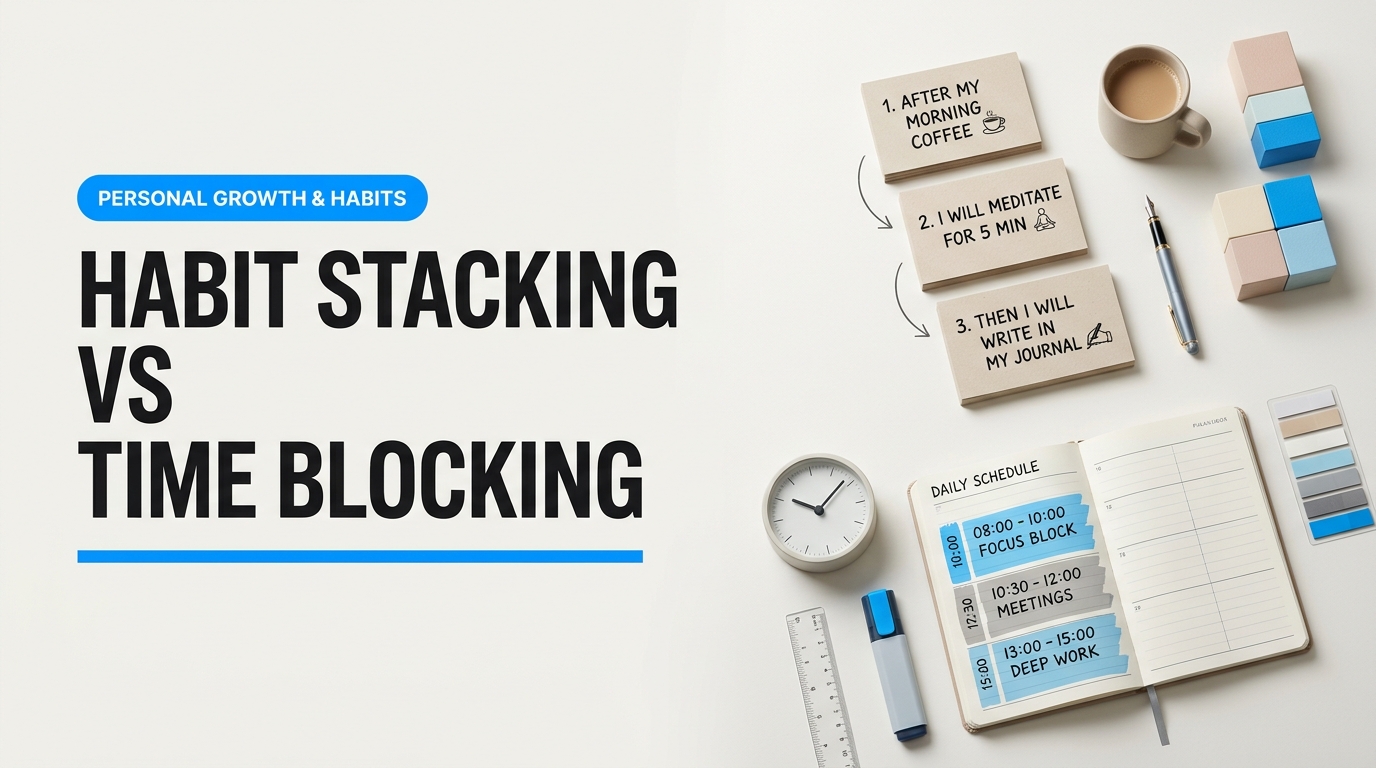
Habit stacking approaches personal growth from the opposite direction. Instead of anchoring actions to a ticking clock, you chain a new behavior onto an existing routine that you already perform without thinking. You might write in a gratitude journal immediately after brewing your morning tea, or stretch for two minutes right after closing your work computer. Momentum builds organically. You don’t need to monitor notifications or shuffle colorful calendar boxes to feel productive.
Many readers turning to productivity community discussions on schedule burnout wonder whether strict scheduling actually provides peace of mind or simply adds another layer of performance anxiety. Looking closely at habit stacking vs time blocking isn’t about picking an arbitrary winner. It is about understanding whether your daily energy flourishes under intentional behavioral cues or structured visual boundaries.
Habit Stacking vs Time Blocking: What Are the Core Operational Differences?
When we examine habit stacking vs time blocking, we’re not just comparing two popular productivity tips. We’re looking at two radically different psychological operating systems. One organizes your actions around physical sensations and muscle memory. The other organizes your attention around the cold, ticking numbers of a clock.
Most people struggle with daily routines because they pick an engine that fights their natural wiring. A person who craves intuitive rhythm will feel suffocated by a calendar grid full of colored boxes. In the same vein, an ambitious professional juggling cross-functional projects might watch a loose chain of habits collapse under the weight of unexpected emails. Understanding how these two frameworks work under the hood helps you choose the right tool for the right moment.
Architectural Foundations: Habit Stacking vs Time Blocking
Habit stacking operates on the principle of cue-based associative chaining. Popularized by behavior researchers and author James Clear, this method piggybacks a desired habit onto an established one. You aren’t creating willpower out of thin air. Instead, you’re plugging a new wire into an electrical circuit that already runs hot in your brain.
Think about your morning routine. You don’t set a calendar notification to brush your teeth at 7:12 AM. You finish your morning coffee, taste the bitter residue in your mouth, and walk straight to the bathroom sink. The sensory cue—the taste, the empty mug resting on the counter—sparks motor memory. The basal ganglia handles the transition without consulting your active decision-making centers. By chaining a new behavior onto that existing loop (for example, doing five pushups the moment the coffee pot clicks off), you bypass mental friction.
Time blocking takes the opposite path through temporal boundary-setting. Pioneered as a disciplined strategy by figures like Cal Newport, time blocking treats your day like a finite set of cargo containers. You map out every hour in advance, assigning a single, dedicated objective to each container.
This model creates artificial scarcity. When you give yourself an open-ended morning to “write a report,” the project swells to fill all available space. When you assign that report a firm boundary—say, from 9:00 AM to 10:30 AM—the ticking clock becomes a commitment device. It forces your prefrontal cortex to engage, locks out shallow distractions, and creates urgency through Parkinson’s Law.
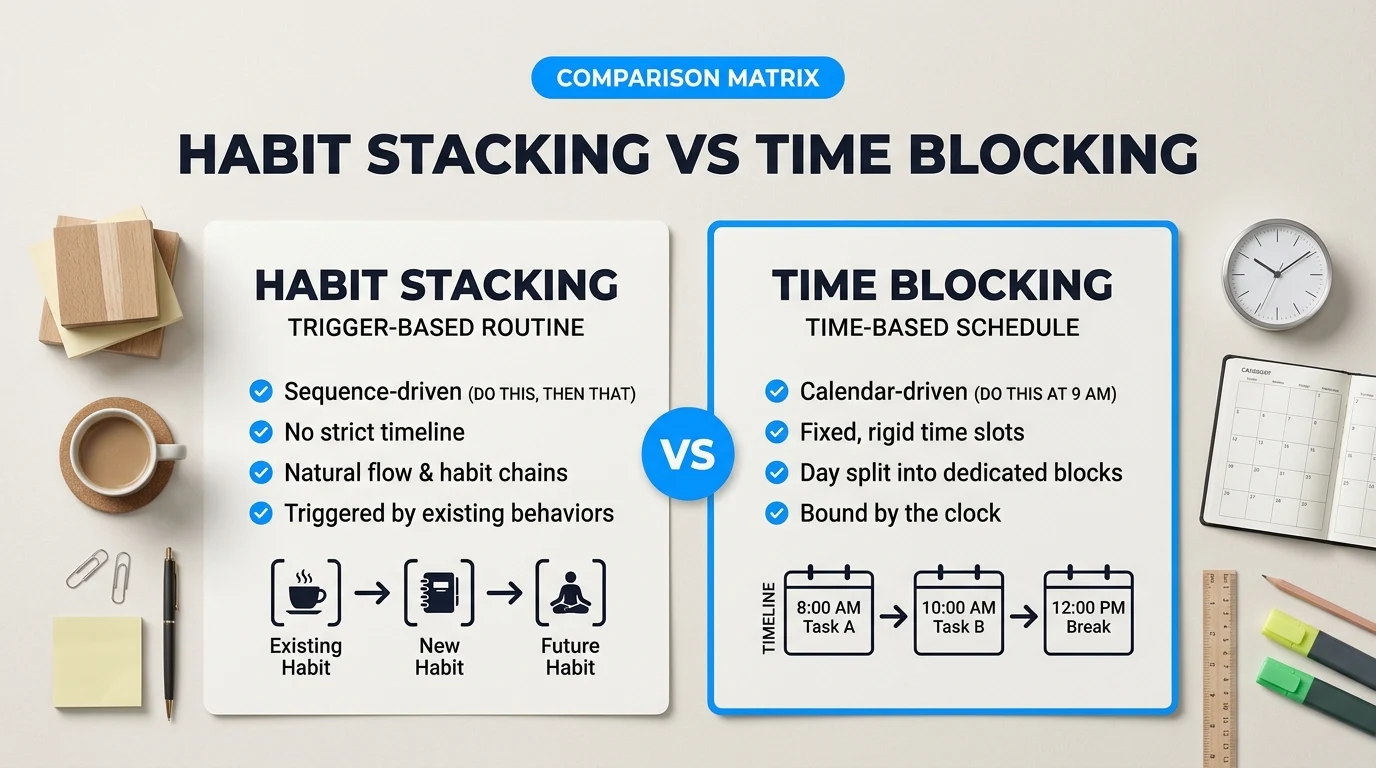
| Operational Dimension | Habit Stacking | Time Blocking |
|---|---|---|
| Core Trigger | Sensory cues, physical environments, and completed actions | Chronological time, calendar alerts, and planned intervals |
| Neurological Engine | Basal ganglia (automaticity, procedural memory) | Prefrontal cortex (executive function, active focus) |
| Daily Flexibility | High: stacks glide forward if you sleep late or shift locations | Low: missed blocks trigger calendar reshuffling and friction |
| Primary Vulnerability | Broken chains when anchor habits are skipped or forgotten | Underestimating task duration and external interruptions |
Online productivity forums often reveal deep frustration with these systems. Beginners frequently ask whether the steep setup time and rigid discipline of digital calendar blocking is truly worth the effort compared to looser, manual routines. When workers try to schedule every minute down to the wire, a single twenty-minute delay from an urgent phone call can derail their entire afternoon. That disruption brings guilt, leading many to abandon the schedule altogether.
“Habit stacking links your body to physical environments. Time blocking links your mind to the clock. Confusing the two is why so many well-planned routines fall apart before noon.”
Choosing between habit stacking vs time blocking comes down to whether your target objective needs automatic flow or hard defense. Habit stacking excels at personal maintenance, wellness, and self-care. Drinking water, stretching, meditating, or journaling benefit from sensory triggers because they require minimal strategic deliberation. You want these actions to run on autopilot without burning mental fuel.
Complex, high-friction work requires the defensive wall of a time block. Deep analytical tasks, creative writing, and high-stakes business strategy will never happen purely on motor memory. They require quiet hours, zero interruptions, and a firm start and finish line. Habit stacking gives your day its personal rhythm, while time blocking protects your most ambitious work from the noise of the world.
How Do Habit Stacking and Time Blocking Impact Cognitive Load and Daily Energy?
Your brain consumes roughly twenty percent of your daily energy despite making up only two percent of your body mass. Every micro-decision you make—from answering an email to choosing when to stretch—draws down this finite reservoir of mental stamina. When evaluating habit stacking vs time blocking, the central question isn’t just about productivity output. It’s about how much neurological fuel each framework burns to get you across the finish line.
Every productivity routine places demands on your prefrontal cortex, the control center for willpower, planning, and focus. Understanding how these tools affect your mental bandwidth helps you build a lifestyle that supports deep focus without inviting afternoon burnout.
Habit Stacking vs Time Blocking: Mental Energy and Willpower Demands
Habit stacking conserves your energy through automaticity. Instead of asking your brain to invent motivation from scratch, you latch a new behavior onto an established neural pathway. Neuroscientists call this process procedural memory consolidation, managed primarily by your basal ganglia. Think of your basal ganglia as the brain’s cruise control. Once an action enters cruise control, it operates with almost zero friction.
Consider a simple morning sequence. You pour your morning tea, sit down at your kitchen table, and write three gratitude bullet points. Because making tea is already automatic, you don’t pause to deliberate. You don’t negotiate with yourself. The sensory cues—the whistle of the kettle, the warmth of the mug—spark the next action instantly. Willpower stays completely untouched.
Time blocking manages your mental load through pre-commitment. Unlike habit stacks, scheduling demands an upfront cognitive tax. Sitting down with your calendar to map out two-hour focus windows requires intense executive planning. You must estimate project lengths, weigh competing priorities, and commit to difficult trade-offs.
That upfront investment pays off in real-time clarity. During a chaotic workday, the biggest drain on your focus isn’t the work itself. It’s the constant, agonizing question: What should I work on right now? A well-structured calendar eliminates that real-time friction. When 10:00 AM arrives, your sole job is to execute the designated task. Your calendar protects your attention by keeping decision fatigue at bay during cognitive sprints.
| Cognitive Metric | Habit Stacking | Time Blocking |
|---|---|---|
| Primary Brain Center | Basal ganglia (automatic reflexes) | Prefrontal cortex (executive planning) |
| When Energy Is Spent | Distributed evenly in tiny, low-friction micro-actions | Heavily frontloaded during scheduling sessions |
| Decision Fatigue Impact | Removes friction through physical environment cues | Removes mid-day choices by pre-allocating time |
| Best Used For | Lifestyle maintenance, health habits, mindful routines | Complex creative projects, analytical problem solving |
Many professionals share frustrations in personal growth forums about running out of steam mid-week when their calendar feels like an interrogation room. Rigid appointments can create ambient stress if you underestimate how long a task takes. When a single meeting overruns, an entire block cascades into chaos, spiking cortisol and draining your battery.
“The real goal of any organizational system isn’t to cram more hours into your calendar. It’s to protect your peace of mind so you can bring genuine vitality to the things that matter.”
Habit chains gently guide you through baseline self-care routines without testing your resolve. Time blocks establish firm boundaries around high-value work so you don’t drift into mindless multitasking. Matching the right tool to your personal energy patterns keeps your ambition high and your cognitive load manageable.
Handling Disruption: Which Framework Survives Real-World Chaos Better?
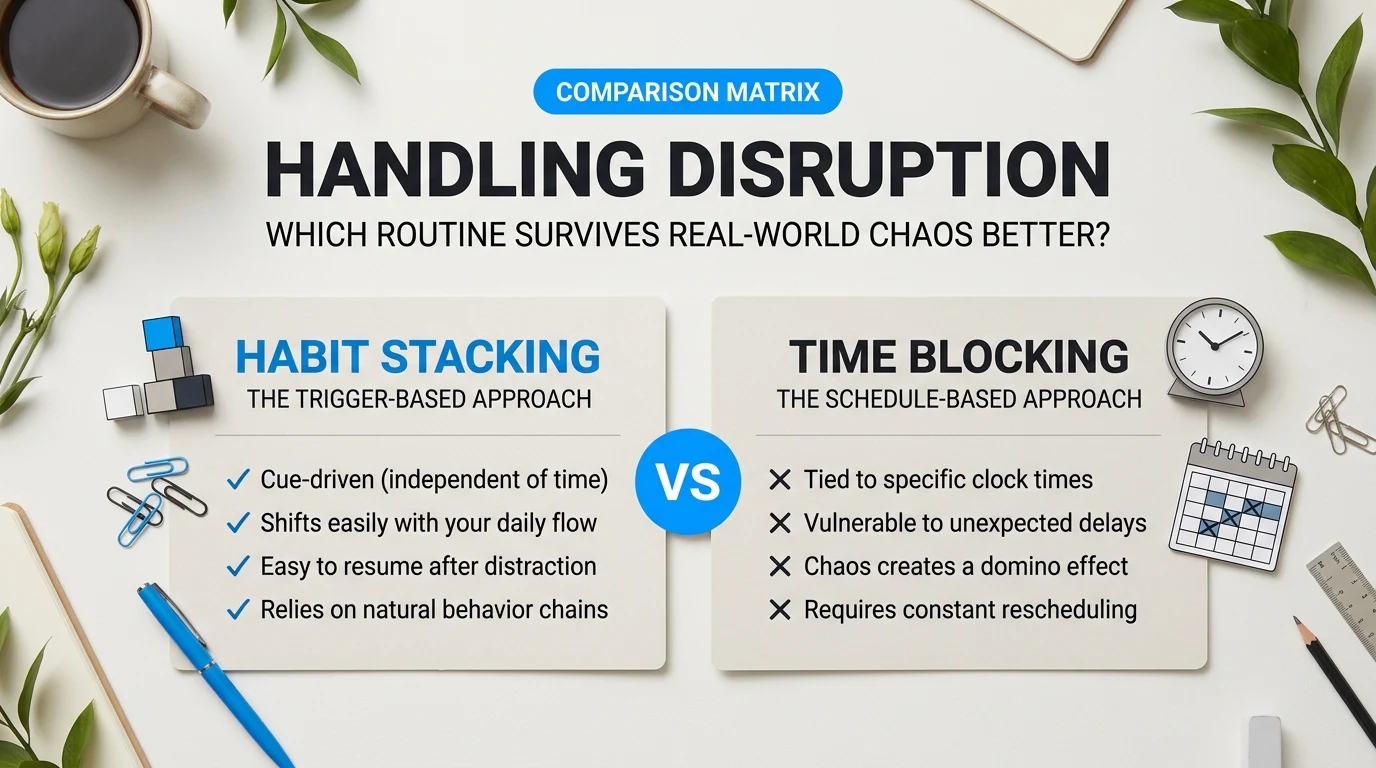
Life rarely sticks to a clean script. A child wakes up with a sudden fever, an unexpected message throws your morning into disarray, or an emotional slump drains your drive before noon. In the quiet calm of a Sunday evening, any organizational system looks brilliant. The true test of habit stacking vs time blocking only happens when real-world chaos crashes into your day.
Testing Habit Stacking vs Time Blocking Under Real-World Stress
Time blocking treats your day like real estate: rigid, finite, and strictly divided. When you reserve 9:00 AM to 11:00 AM for focused work, you fence off that territory. But what happens when an emergency call runs forty minutes over? The domino effect starts immediately.
A single delayed block shoves your gym workout into your lunch break. Your afternoon admin time collides with an existing commitment. By mid-afternoon, your neatly colored calendar looks like a wreck, triggering an avalanche of guilt and decision fatigue. Many people simply abandon their schedules altogether once the first few blocks collapse. When a rigid calendar breaks, personal motivation usually goes down with it.
“When a strict timeline gets derailed before noon, the psychological urge to surrender the entire day takes over. Contextual routines bypass that all-or-nothing trap.”
Habit stacking operates on a completely different engine. Instead of tying your intentions to the hands of a clock, you anchor them to existing sensory cues and physical behaviors. You don’t commit to stretching at 7:15 AM; you stretch right after you set down your morning mug. The trigger is an established event, not a timestamp.
This design makes stacked habits remarkably resilient. If a morning fire drill delays your routine until late morning, the chain remains intact. The moment you brew that cup of coffee, the anchor fires. The behavior adapts to your circumstances rather than demanding that your circumstances yield to a clock.
| Chaos Trigger | Time Blocking Performance | Habit Stacking Performance |
|---|---|---|
| Unexpected Meeting | Causes calendar collisions; forces instant rescheduling and guilt. | Unaffected; the routine waits patiently until the previous cue occurs. |
| Severe Energy Slump | Staring at an intimidating, rigid block spikes task friction. | Existing physical anchors pull you forward using procedural momentum. |
| Travel or Location Shifts | Fragile; time zone shifts and commute changes shatter static slots. | Highly portable; cues rely on universal human actions like eating or waking. |
Mental slumps expose an even deeper contrast between these two approaches. When your energy hits rock bottom, looking at an aggressive calendar block labeled “Deep Creative Output” feels paralyzing. The barrier to entry is simply too high. Habit stacking lowers that barrier by borrowing velocity from something you already do without thinking. By tying a new, small action to an effortless baseline—like opening your journal immediately after closing your laptop lid—you eliminate the friction of starting from a cold stop.
If your days are stable and predictable, calendars offer wonderful boundaries. But when life gets messy, unpredictable, and demanding, contextual habit anchors will keep you moving forward long after rigid time blocks fall apart.
Best Life Applications: When to Choose Habit Stacking Over Time Blocking
You wouldn’t use a sledgehammer to tune a violin. Productivity methods demand that same sense of proportion. Forcing every personal ritual into a rigid calendar grid crushes spontaneous joy. Yet relying purely on gentle habit cues to finish complex, multi-layered deliverables invites delay. Deciding between habit stacking vs time blocking comes down to the friction level and emotional nature of the work in front of you.
Personal wellness thrives on somatic cues, not digital alerts. When you attach a positive action to an existing physical trigger, your brain bypasses internal debate. You don’t need a loud calendar alert to remind you to drink a glass of water, step into the sunlight, or take five slow belly breaths. Those actions belong to the body. They belong to who you are becoming, not to an external clock.
Choosing Habit Stacking vs Time Blocking for Daily Demands
Consider how habit stacking transforms identity-based rituals. When you anchor a new habit to an established behavior, you eliminate decision fatigue before it starts. The old behavior acts as an automatic runway for the new one.
| Life Domain | Winning Strategy | Operational Trigger | Why It Works |
|---|---|---|---|
| Morning Grounding | Habit Stacking | Pouring your morning tea or coffee | Removes friction. Keeps the morning calm and free from rigid timer pressure. |
| Deep Strategic Work | Time Blocking | A 90-minute locked calendar window | Creates a defensive fortress against notifications, meetings, and mental drift. |
| Physical Mobility | Habit Stacking | Closing the laptop lid at workday end | Uses a physical transition to signal to your nervous system that it is time to unwind. |
| High-Stakes Projects | Time Blocking | Start and end timestamps on your planner | Forces prioritization. Prevents work from expanding endlessly into your personal life. |
Many people run into trouble when they treat restorative habits like corporate meetings. If you put “meditate and journal” on your calendar for 6:30 AM, you set a trap. Wake up twenty minutes late, and the entire block shatters. The mind senses failure before the day even begins.
“I spent months feeling defeated because my calendar looked like a color-coded wall of broken promises. The moment I stopped putting meditation on a schedule and simply stacked it onto brewing my coffee, my consistency clicked.”
When you brew your morning blend, use those three minutes to stretch your back or jot down three things you appreciate. No alarms go off. No calendar pop-up demands compliance. Your environment carries the weight of the reminder. The rhythm feels natural, fluid, and forgiving.
High-friction output requires the exact opposite environment. Creative writing, client deliverables, tax reviews, and strategic analysis require intense mental energy. If you try to habit-stack a high-resistance project by saying, “After I clear my coffee mug, I will draft the quarterly pitch deck,” your brain will dodge the assignment. It will find dishes to scrub, emails to sort, or files to organize.
Hard tasks need the hard perimeter of a time block. Think of a time block as a physical room with a locked door. For two hours, that room contains only you and the single problem you chose to solve. It removes the ambiguity of “when will I find time?” by turning your commitment into an immovable appointment with yourself. If an incoming message arrives, it waits outside the door. If a random thought hits you, write it down on a scratchpad and return to the main task.
Use habit stacking when you want to build effortless lifestyle momentum. It belongs in your home life, your wellness practices, your mindset shifts, and your evening recovery. Reserve time blocks for your professional craft, your deep research, and your big creative leaps. When you match each tool to the right side of your life, you stop fighting your daily schedule and start flowing with it.
How to Build a High-Performance Hybrid Model: Stacking Routines Inside Time Blocks
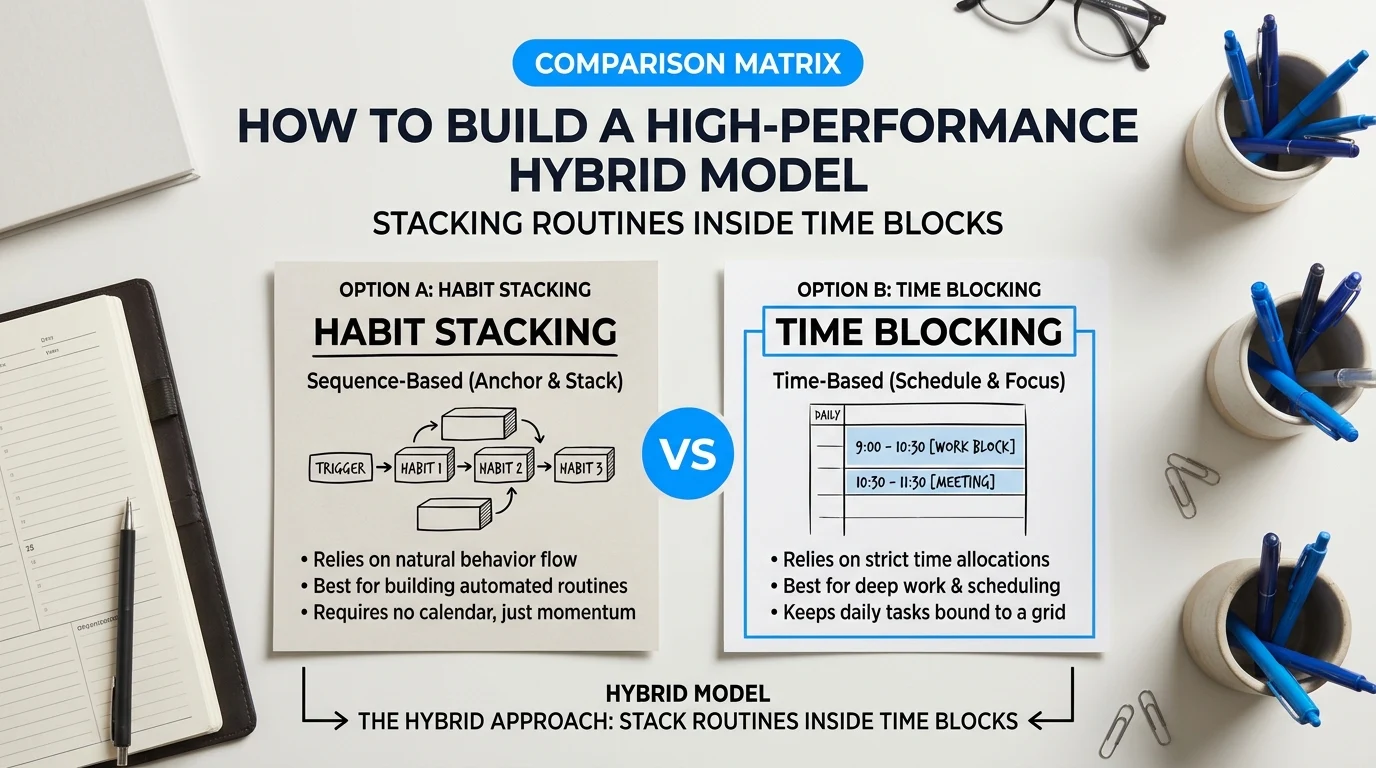
Rigid calendars break the moment real life interrupts them. Freeform habit lists tend to drift away when your inbox catches fire. The secret to an energized, peaceful day isn’t choosing between rigid schedules and loose routines. It’s nesting them together.
Think of time blocking as the foundation and walls of your home. It establishes physical boundaries and defends your energy against incoming demands. Habit stacking is the interior flow—the warm, natural sequence of moving from room to room without having to read an instruction manual. When you stop viewing habit stacking vs time blocking as an either-or rivalry, you unlock an adaptable framework that protects your mental peace.
Merging the Frameworks: A Habit Stacking vs Time Blocking Blueprint
Many productivity seekers in productivity community discussions on routine design ask if running a hybrid model creates double the administrative overhead. They worry about spending more time tweaking calendars than getting things done. The reality is quite the opposite. By grouping small micro-habits inside broad macro-windows, you eliminate the exhausting need to schedule every single fifteen-minute increment.
Here is how to set up this unified lifestyle system step by step:
Step 1: Carve Out Three Macro-Blocks
Start by claiming large, protected chunks of time on your calendar. Don’t label them with tiny tasks like “open email” or “stretch hamstrings.” Instead, assign broad, themed containers that signal your mindset for that window:
- The Morning Launch (60–90 minutes): A protected runway before opening messaging apps or client requests.
- The Deep Creation Block (90–120 minutes): An isolated window dedicated purely to your highest-leverage goal.
- The Evening Decompression (45–60 minutes): A deliberate off-ramp to disconnect your brain from work.
Step 2: String Habit Chains Inside Each Fortress
Once your time block shields you from external meetings, let behavioral cues carry the load. You won’t need to check the clock to know what to do next. One completed action immediately triggers the next micro-movement.
“A calendar block creates the space, but an automated habit stack fills that space with effortless momentum.”
Consider how natural your morning feels when linked by physical cues rather than alert tones:
- After my feet touch the floor, I will drink a tall glass of water.
- After I finish that water, I will put on my workout shoes.
- After my shoes are tied, I will step outside for ten minutes of sunlight.
- After I step back inside, I will sit down with my journal and write three intentions.
Notice how easy that flows. You aren’t glancing at a calendar at 7:15 AM wondering if you’re behind. You simply let each physical action tug the next one into place.
| Macro Time Block | Internal Habit Stack | Mental Outcome |
|---|---|---|
| Morning Launch (7:00 AM – 8:30 AM) | Hydrate → Walk in sun → Journal → Review top priorities | Calm alertness without sensory overload |
| Focus Sprint (9:30 AM – 11:30 AM) | Fill water bottle → Turn phone on silent → Launch primary project document | Rapid immersion into deep work |
| Evening Reset (5:00 PM – 5:45 PM) | Clear digital desktop → Jot tomorrow’s top 3 → Shut laptop lid → Change clothes | Clear psychological boundary between labor and rest |
Step 3: Insert Generous Buffer Margins
Life stays unpredictable. A child wakes up with a fever, or a client meeting runs over by twenty minutes. When your calendar looks like a tightly packed game of Tetris, a single delay ruins your entire day. That creates guilt and frustration.
Leave thirty minutes of open space between your macro-blocks. Treat this margin as shock absorption for your spirit. If a morning delay eats ten minutes of your launch window, your core habits remain intact because your routine relies on sequencing, not an unyielding stopwatch.
This hybrid approach lets you adapt without quitting. You keep the boundary-setting power of a calendar while enjoying the smooth, automatic grace of natural habits.
Designing a Sustainable Rhythm: Choosing Structure Over Self-Judgment
Refining Your Daily Flow: Habit Stacking vs Time Blocking for Real Life
Productivity systems often turn into silent weapons of self-criticism. When an unexpected crisis knocks out a clean calendar block, guilt settles in fast. When a missed morning cue derails an entire behavior sequence, it is easy to assume personal discipline failed. Deciding between habit stacking vs time blocking isn’t an all-or-nothing productivity referendum. You aren’t auditioning for a machine role. Your life brings unpredictable energy, creative spurts, and sudden obligations. The framework you pick needs to serve your peace of mind, not an imaginary standard of algorithmic perfection.
Look honestly at your personal wiring before locking down your daily routine. If you manage attention differences like ADHD or struggle with time blindness, rigid calendar grids often trigger paralysis rather than focus. A strict block from 2:00 PM to 4:00 PM can feel intimidating when executive function drops. In those seasons, anchor cues provide gentle guardrails. Tying your deep focus session directly to finishing a fresh mug of tea lets you initiate action through sensory context rather than clock pressure. Conversely, if your role demands intense stakeholder communication and constant meetings, temporal boundaries are your best defense against boundary creep.
True discipline isn’t measured by whether your day matched a predetermined grid down to the minute. It reveals itself in how gracefully you recover when real life breaks the plan.
Give yourself permission to treat your schedule as a series of low-stakes experiments. What works during an intense career push won’t match what you need during a season of healing, family transitions, or creative exploration. Focus on building sustainable forward momentum. When a tool stops supporting your focus and starts manufacturing anxiety, strip it down. Choose simple structures that give your brain breathing room, practice radical self-compassion when plans fall apart, and remember that intentional living grows from consistent, patient practice.