Evening Reset Routine Checklist for Calmer Mornings
Evening Reset Routine Checklist for Calmer Mornings
Waking up rushed turns your early hours into survival mode. Committing to a simple evening reset routine checklist shifts your mindset from frantic scrambles to calmer mornings before your head hits the pillow. Most of us collapse onto the sofa after long workdays, mistaking numbing screen time for real physical and nervous system recovery. Passive exhaustion leaves your brain spinning through unfinished tasks. Taking twenty deliberate minutes tonight creates breathing room tomorrow, transforming how you wake, move, and focus.
Table of Contents
- Why Tomorrow's Success Begins Tonight: The Power of an Evening Reset
- What Is the Difference Between a Night Routine and an Evening Reset?
- Phase 1: The Environmental Reset to Eliminate Visual Friction
- Phase 2: Mental Decompression and the Strategic Brain Dump
- The Step-by-Step Evening Reset Routine Checklist
- Phase 3: Somatic Wind-Down and Sensory Boundary Setting
- How to Adapt Your Reset Checklist on Low-Energy Nights
- Waking Up Grounded: Transforming Nightly Closure into Lasting Alignment
Your morning mindset is built the night before. When you wake up to unwashed mugs, missing keys, and an overflowing inbox, your nervous system triggers an instant threat response. That spike in baseline cortisol happens because your brain must tackle dozens of micro-decisions before breakfast. What should you wear? What task takes priority today? Where is your notebook? Decision fatigue drains your willpower reserves long before your workday starts. An evening reset quietly eliminates that cognitive tax while you sleep.
Real rest requires closure. Scrolling social feeds feels easy, but it keeps your nervous system on high alert. You aren’t resting; you’re just stalling. Proactive recovery means closing open operational loops so your mind feels safe enough to enter deep, restorative sleep. When you clear your physical workspace and dump your mental to-do list onto paper, you signal to your brain that the day is complete. That clean boundary protects your nighttime rest and frees up mental space for personal growth.
Many people question whether setting aside evening energy is actually worth the effort when they’re already depleted. In habit communities across Reddit's productivity forums, people openly debate whether nightly preparation delivers a real return on energy or just creates another rigid chore. The trade-off is clear: fifteen minutes of light evening prep buys two full hours of morning serenity. You aren’t working overtime. You’re shifting small logistical choices to a quiet window when the stakes are low.
Following a practical evening reset routine checklist isn’t about chasing rigid lifestyle aesthetics. It’s about designing an environment that supports your future self. Tomorrow’s calm focus begins with tonight’s closure.
What Is the Difference Between a Night Routine and an Evening Reset?
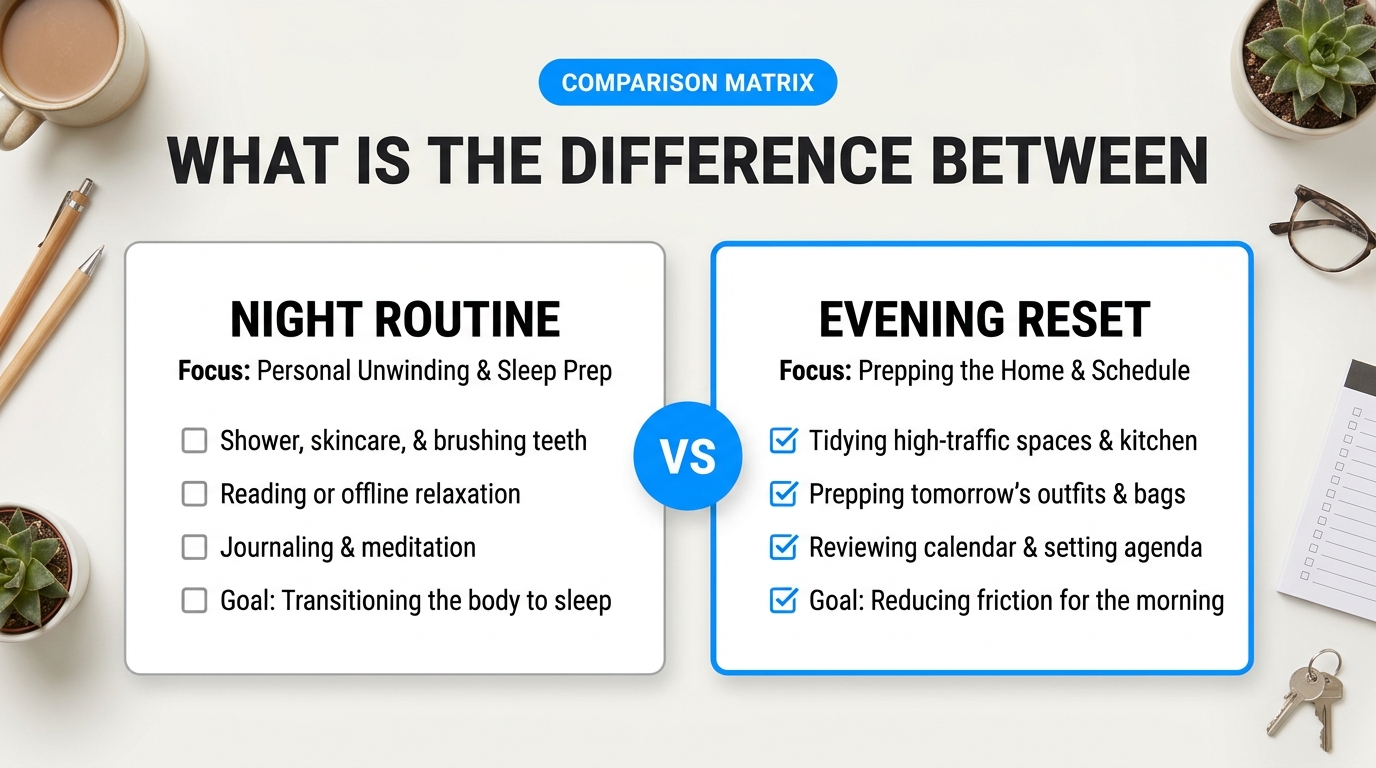
Most people confuse winding down with truly finishing the day. You wash your face. You slip under the covers with a book. That is a traditional night routine. While personal hygiene and gentle reading soothe your senses, they do nothing to address the unresolved projects and visual clutter quietly demanding your attention from the next room.
A night routine prepares your body for sleep. An intentional evening reset prepares your life for tomorrow.
Think of your brain like a laptop at the end of a long workday. A conventional night routine simply dims the screen brightness and turns down the volume. An evening reset actually closes out the forty open browser tabs, saves your documents, and safely quits the heavy background applications. If you do not close those background programs, they silently drain your processing power all night long.
When readers share their real-world struggles in community discussions on nightly routine design, the core frustration is almost always the same: “I spent an hour relaxing in bed, so why did I still wake up feeling behind?” That lingering anxiety happens because passive rest cannot fix an active mess.
| Focus Area | Traditional Night Routine | Intentional Evening Reset |
|---|---|---|
| Primary Goal | Somatic relaxation and physical hygiene | Cognitive closure and environmental alignment |
| Typical Actions | Skincare, herbal tea, dimming lights, reading fiction | Clearing counters, packing bags, brain dumping tasks |
| Timing Window | Final 30 minutes directly before bed | 1 to 2 hours before bed (the workday-to-home shift) |
| Morning Result | Waking up to yesterday’s dishes and scattered notes | Waking up to a clear runway and zero friction |
Why an Evening Reset Routine Checklist Outperforms Passive Wind-Downs
Passive wind-downs leave mental loops open. Psychologists call this pattern the Zeigarnik effect, which explains how our minds cling stubbornly to incomplete tasks. If your kitchen sink is piled with plates or your inbox holds three unanswered messages, your nervous system registers those sights as active threats. It stays on guard.
True rest is not just the absence of work. It is the presence of order.
Working through a structured evening reset routine checklist breaks that cycle. The process doesn’t demand hours of grueling labor. You only need fifteen to twenty minutes of focused, proactive setup. You wipe down the main kitchen counter. You jot down your top three priorities for the morning. You stage your water bottle and workout gear by the door.
These actions create a firm psychological boundary between today’s efforts and tomorrow’s possibilities. By deliberately handling environmental clutter and mental overflow before you touch your pillow, you give your mind genuine permission to power down.
Phase 1: The Environmental Reset to Eliminate Visual Friction
Visual friction is silent stress. Every stray coffee mug, pile of unopened mail, and unwashed pan acts like an open browser tab in your mind. You might not consciously dwell on them, but your nervous system registers every single unfinished detail. When you wake up to a chaotic room, your morning starts in triage mode. You’re already playing defense before you’ve taken your first sip of water.
Eliminating physical friction isn’t about deep-cleaning your home until it looks like a showroom. It’s about setting boundaries between your space and your attention. You’re creating an effortless runway for tomorrow morning. When people ask whether dedicating fifteen minutes to an environmental reset is worth the return on investment, the answer lies in your morning cortisol levels. Investing ten to fifteen minutes before bed buys back your peace of mind the moment your eyes open.
“Clutter is not just physical stuff. It’s unmade decisions calling out for your energy when you need it most.”
Tactical Zones on Your Evening Reset Routine Checklist
Focus strictly on three high-impact zones. If an action takes longer than three minutes, save it for the weekend. Keep these micro-habits light and mechanical.
1. The Kitchen Shutdown
The kitchen sets the tone for your morning hydration and breakfast. A dirty sink creates instant dread. Run the dishwasher, even if it isn’t completely full. Wipe down the main prep counter with a quick swipe of an all-purpose spray. Fill the kettle or set up the coffee maker with fresh water and grounds so that making your morning brew requires pressing exactly one button.
2. The Desk and Workspace Boundary
If you work from home, leaving your laptop open invites anxious thoughts into your living space. Close all active software windows and shut the laptop lid. Stack loose papers into a single neat pile, throw away empty snack wrappers, and tuck your chair under the desk. This physical action acts like a psychological punch clock, confirming your workday is officially over.
3. The Morning Launchpad
Decision fatigue hits hardest right after waking up. Set out your clothes for the next day, right down to your socks and shoes. Place your keys, wallet, sunglasses, and work badge in a small entryway bowl. If you plan to exercise, position your gym shoes right next to your bed where you can see them. As highlighted in community productivity habit discussions on Reddit, removing physical hurdles before bed makes following through on morning intentions almost automatic.
The 15-Minute Launchpad Audit
People often burn out on evening resets because they turn a quick sweep into a two-hour marathon. That defeatist mindset leads straight to inconsistency. Use this simple benchmark to keep your physical reset rapid and sustainable:
| Area | The 3-Minute Micro-Action | The Morning Payoff |
|---|---|---|
| Kitchen | Clear sink, run dishwasher, stage morning mug. | Zero cleanup required for breakfast. |
| Desk | Close laptop, trash clutter, align notepad. | Instant focus without yesterday’s baggage. |
| Entryway / Wardrobe | Hang tomorrow’s outfit, pack daily carry bag. | No scrambling or frantic searching for essentials. |
| Living Room | Fluff sofa pillows, clear cups from coffee table. | A calm visual field to sip water and wake up. |
Setting up your space tonight is an act of self-respect for your future self. Integrating these quick physical boundaries into your evening reset routine checklist stops decision fatigue before it starts. Once your physical environment is calm and clear, your mind is finally ready to unpack its own weight.
Phase 2: Mental Decompression and the Strategic Brain Dump
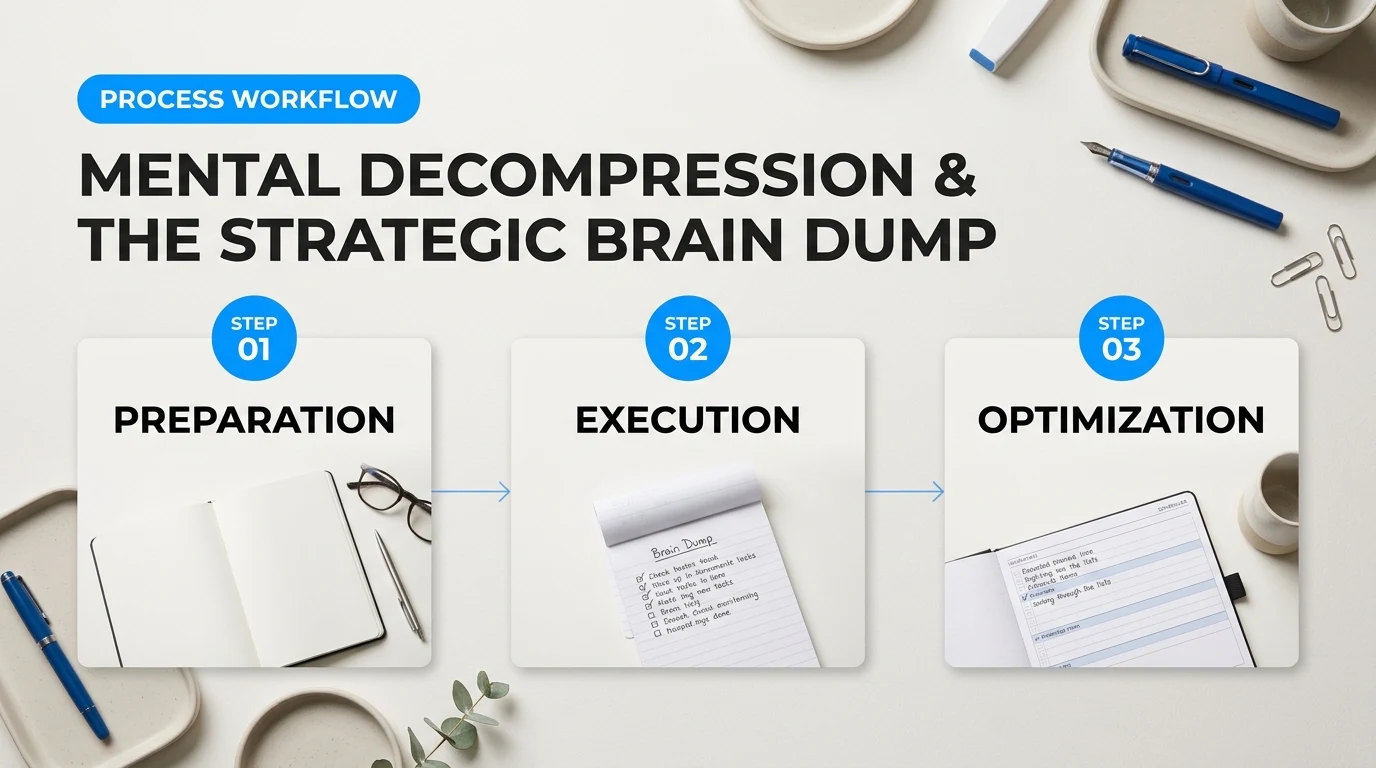
Tossing and turning at night rarely happens because your body is not tired. It happens because your brain is still trying to solve problems in the dark. Unfinished emails, forgotten chores, and upcoming meetings bounce around your head like loose marbles. When tasks remain incomplete, your mind treats them as active emergencies. You end up staring at the ceiling, mentally rehearsing conversations you will not have for weeks.
Your brain is like a computer running thirty heavy programs in the background. It drains battery life. The fan spins loudly. Everything slows down. Emptying your mental cache onto a physical page gives your nervous system explicit permission to shut down for the night.
Closing Open Cognitive Loops with an Evening Reset Routine Checklist
To stop bedtime racing thoughts, you must externalize your worries. Keeping tasks trapped inside your head forces your working memory to juggle them endlessly. Moving those thoughts to paper builds a reliable safety net. Once a thought is inked on paper, your subconscious mind finally believes it will not be lost forever.
Skip digital apps and laptops for this step. Bright screens stimulate cortisol production and trick your biology into thinking it is noon. Pick up a cheap notebook and an ordinary pen. Write without filtering or organizing. Did you forget to reply to an invoice? Write it down. Need to schedule an oil change? Put it on the paper. Adding this five-minute unloading habit to your evening reset routine checklist ensures you create a clear border between today’s responsibilities and tonight’s recovery.
“Your mind is designed for having ideas, not for storing them. The second you trust your paper, your nervous system stops sounding the alarm.”
People often wonder if taking time to write things out is actually worth the effort after an exhausting workday. In online productivity workflow discussions, professionals frequently debate whether spending ten minutes on a deliberate mental shutdown beats simply collapsing straight into bed. The return on energy is undeniable. Investing seven minutes with a pen regularly saves you forty-five minutes of tossing, turning, and nighttime panic.
The Three-Part Psychological Shutdown
A scattershot list of worries can leave you feeling overwhelmed rather than relieved. Use this simple sequence to turn scattered panic into peaceful focus:
- The Unfiltered Purge: Set a timer for three minutes. Write down every nagging thought, anxiety, errand, and random idea rattling inside your skull. Do not worry about neat handwriting. Just empty the tank.
- The Gratitude Reframe: Our brains have an ancient survival bias that fixates on what went wrong during the day. Counter this by listing three tiny wins. You made a delicious cup of coffee, resolved a sticky client issue, or took a brisk walk. Acknowledge your forward momentum before you sleep.
- The Tomorrow Anchor: Scan your brain dump and highlight exactly one major task for tomorrow morning. Do not pick five. Choose the single most valuable action that moves your goals forward.
Morning exhaustion often stems from decision fatigue, not lack of sleep. When you wake up without a clear agenda, your brain immediately panics as it tries to prioritize a dozen competing tasks. By deciding your primary focus tonight, you eliminate morning friction. You will slide out of bed with direction, wake up grounded, and reclaim your peace of mind.
The Step-by-Step Evening Reset Routine Checklist
Most evening routines collapse under their own weight. We plan an ambitious two-hour ritual with journaling, candlelit meditation, stretching, and a ten-step skincare routine, only to abandon it by Wednesday because we feel completely exhausted. A successful reset doesn’t demand hours of your night. It relies on a few predictable, low-friction habits that clear your physical space and your head before you crawl into bed.
When you rush through your morning searching for car keys or staring blankly at your wardrobe, your day starts in defense mode. You’re already playing catch-up before your first cup of coffee. Setting up a dedicated evening reset routine checklist solves this problem. It acts as a bridge between the noise of today and the focus of tomorrow, delivering the calm mornings you deserve without turning your evening into a chore.
A Practical Evening Reset Routine Checklist Built for Real Life
Think of your reset as a relay race. Your nighttime self is handing the baton directly to your morning self. If that handoff is sloppy, your morning starts with friction and stress. When the handoff is smooth, you hit the ground running with absolute clarity.
To keep the process painless, divide your evening reset into three compact blocks that take thirty minutes or less from start to finish.
| Time Block | Core Focus | Target Actions | Morning Payoff |
|---|---|---|---|
| Block 1: 10 Minutes | Physical Staging | Wipe kitchen counters, run dishwasher, pack your work bag, set out your outfit. | Zero visual clutter; effortless exit out the front door. |
| Block 2: 5 Minutes | Mental Offloading | Check tomorrow’s calendar, jot down your top three priorities, close open computer tabs. | No midnight panic about forgotten meetings or loose ends. |
| Block 3: 15 Minutes | Sensory Downshift | Dim overhead lighting, plug phones into another room, wash up, take slow breaths. | Deeper sleep cycles and a grounded nervous system. |
People often wonder if setting aside time for an evening reset routine checklist is worth the effort when you’re already drained at the end of a shift. The answer comes down to mental math. Spending twenty focused minutes at night saves an hour of panicked scrambling the next day. It stops the cycle of starting your day behind schedule.
“When your physical space is clean and your next steps are chosen, your brain stops scanning the environment for threats. You sleep deeply because there is nothing left to solve.”
Run through this quick template step by step:
- Reset the kitchen to zero: Clear the sink and start the dishwasher. Waking up to yesterday’s crusty plates sets an immediate tone of defeat. A clear sink gives you instant breathing room.
- Stage your launchpad: Place your keys, wallet, water bottle, and bag right beside the entryway. Decide on your clothing down to your shoes. You make dozens of decisions at work every day; don’t waste your limited willpower choosing a shirt at 6:30 AM.
- Log your top three non-negotiables: Pull out a plain paper notebook. Write down the three essential tasks that will move the needle tomorrow. Once they’re on paper, close the notebook. Your workday is officially over.
- Enforce a digital sunset: Shut down work apps and dock your phone across the room. Blue light tells your brain the sun is rising, which delays the release of natural melatonin. Give your nervous system a chance to register the dark.
Keep your checklist flexible. On nights when your energy feels bottomed out, trim each block down to two minutes. Wipe just one counter. Write down just one priority. The magic isn’t in perfection; it’s in protecting the rhythm of closing the day with purpose.
Phase 3: Somatic Wind-Down and Sensory Boundary Setting
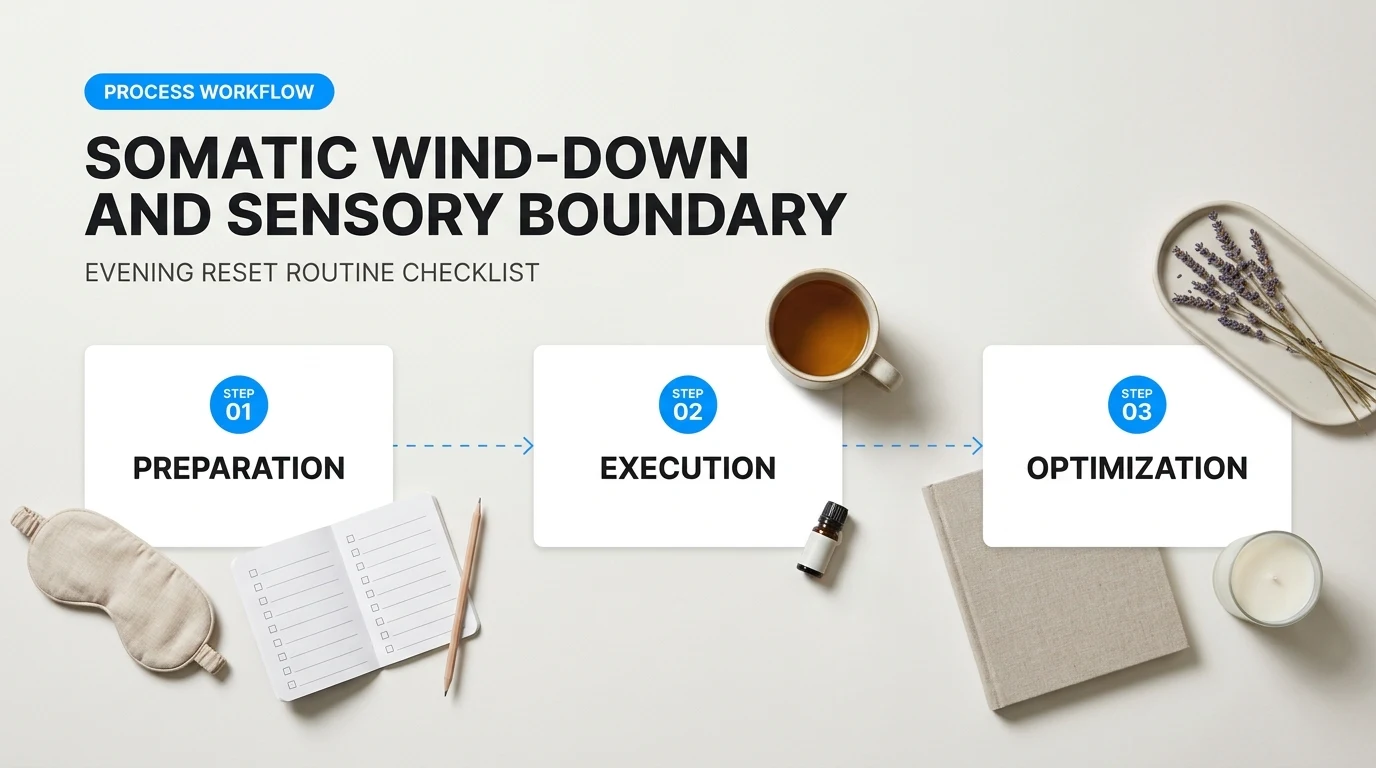
Your brain cannot fall asleep on command. When you spend twelve hours answering urgent emails, making high-stakes decisions, and scrolling through endless feeds, your nervous system gets locked into high gear. You might close your laptop, brush your teeth, and jump into bed, only to find your heart pounding and your thoughts racing at full speed.
Tension settles quietly into your muscles. Many ambitious professionals wonder if dedicating twenty minutes to somatic grounding is worth the personal investment when their to-do lists are overflowing. Skipping this descent phase is like yanking an airplane throttle straight down to zero at thirty thousand feet. You need a gentle glide path. Shifting your biology from the alert “output mode” to deep restoration requires deliberate physical cues that tell your primal brain that you’re safe.
Calibrating Your Evening Reset Routine Checklist for Nervous System Recovery
Completing physical chores and clearing off your desk clears away external friction. Somatic regulation clears away internal friction. When you anchor your evening reset routine checklist with somatic physical cues, you give your body permission to step out of survival mode and slip into rest-and-digest recovery.
Somatic wind-down isn’t about rigid meditation. It’s about tuning into bodily sensations and systematically removing sensory friction. By consciously altering what you see, hear, and feel in the final hour before bed, your heart rate slows and your core temperature begins to drop, laying the physical foundation for calmer mornings.
| Sensory Channel | Daylight Output Mode | Somatic Reset Mode |
|---|---|---|
| Vision | Overhead LEDs, blue-spectrum screens, bright alerts | Low-angle amber lamps, salt lamps, warm candlelight |
| Sound | Phone rings, fast-paced podcasts, notifications | Brown noise, ambient soundscapes, or intentional silence |
| Breath | Shallow chest breathing, rapid autonomic rhythm | Extended-exhale breathwork, slow nasal cycles |
| Physical Body | Clenched jaw, raised shoulders, seated compression | Floor-based gentle stretches, unweighted spinal relief |
Sensory Gating: Shifting Your Senses from Output to Inflow
Setting sensory boundaries is the quickest shortcut to dial down internal stress. Start by dimming your home’s lighting sixty minutes before you plan to sleep. Overhead lights trick your eyes into believing it’s still noon, which suppresses the release of melatonin. Turn off the ceiling fixtures and turn on warm, low-wattage side lamps. This mimics the setting sun and triggers natural drowsiness.
Your auditory space needs equal care. We rarely notice how much low-grade anxiety comes from background chatter, video auto-plays, and pinging group chats. Put your phone in another room or switch it to airplane mode. If total silence feels uncomfortable, try soft acoustic music or low-frequency brown noise to mask distracting household sounds.
“Rest is not the reward for completing your work; it is the prerequisite for doing your life’s best work with clarity.”
Your body holds onto posture patterns from the workday. When you sit at a desk, your hip flexors tighten and your chest collapses inward. Take five minutes to reverse this posture right on the rug beside your bed:
- Legs-Up-The-Wall Pose: Lie on your back and swing your legs straight up against a wall. This gentle inversion drains pooling fluid from your lower legs, lowers your resting pulse, and relieves lower back pressure without any athletic strain.
- Reclined Butterfly: Lie back with the soles of your feet pressed together and your knees falling open to the sides. Place one hand on your belly and one on your heart to instantly reconnect with your breathing.
- Slow Neck Rolls: Drop your chin toward your chest and roll your head slowly from side to side to release subconscious clenching built up from hours at your keyboard.
Finish your somatic sequence with the physiological sigh. Take two quick sniffs in through your nose—one deep breath to fill your lungs, followed immediately by a sharp second sip of air to pop open the tiny air sacs in your chest. Then, release a long, slow sigh out through your mouth. Doing this just three times flips your internal breaker switch, steering you out of fight-or-flight mode and guiding you into genuine, restorative stillness.
How to Adapt Your Reset Checklist on Low-Energy Nights
You walk through the front door with zero battery left. Your head throbs, your feet ache, and the thought of running through a comprehensive multi-step system feels completely impossible. On days like this, rigid self-improvement habits snap under pressure. You skip the whole routine, crawl under the covers in defeat, and wake up to a messy sink, missing keys, and frantic stress. That all-or-nothing mindset destroys positive habits faster than a busy schedule ever could.
Real personal growth requires elasticity. Think of your nightly habits like a smartphone battery. When power drops below ten percent, your phone doesn’t just shut off out of spite. It enters low-power mode. It dims the screen and halts background downloads, keeping essential communication lines open until morning. Your evening habits need that exact same emergency setting.
Streamlining Your Evening Reset Routine Checklist During Exhaustion
When high stress hits, drop your standard expectations and deploy a Minimum Viable Reset (MVR). An MVR takes roughly five minutes, preserving your forward momentum without draining the tiny bit of energy you have left. You aren’t aiming for aesthetic perfection here. You are simply eliminating tomorrow morning’s biggest friction points so you can wake up grounded.
| Area | Standard Reset (25–30 Mins) | Low-Energy Reset (5 Mins) |
|---|---|---|
| Kitchen | Wash every dish, wipe down countertops, run dishwasher, pack fresh lunch. | Stack dirty dishes neatly in the basin, run hot water over them, and put away one item. |
| Planning | Review calendar, journal about the day, balance weekly schedule, list five priorities. | Write your single non-negotiable priority for tomorrow on a sticky note. |
| Environment | Tidy living room, fold throw blankets, prepare tomorrow’s complete outfit. | Drop your keys, wallet, and bag by the front door in your launchpad area. |
| Wind-Down | Take a hot bath, read twenty pages of a book, complete a somatic stretch. | Wash your face, brush your teeth, and slip straight into bed with the lights off. |
People often ask how to maintain consistency when life gets overwhelming. Many struggle with feeling like a short routine is a waste of time if it isn’t done completely. They wonder whether cutting corners ruins the psychological benefit of the habit. The truth is quite the opposite. Showing up for just five minutes proves to your brain that you don’t abandon yourself when things get tough.
Consistency isn’t about performing at peak capacity every single night. It is about protecting your baseline so you never drop down to zero.
Adapting your evening reset routine checklist on exhausting nights protects your peace. Start by asking yourself one simple question: what single chore will make tomorrow morning painful if I ignore it tonight? For some, it is searching for work keys in a panic. For others, it is walking into a kitchen covered in open food containers. Handle that solitary trigger, leave the rest without apology, and let your body rest.
Give yourself permission to scale down. A stripped-back, five-minute version of your evening reset routine checklist keeps the habit chain unbroken while honoring your natural human limits. You protect your momentum, avoid late-night burnout, and still grant yourself the gift of calmer mornings.
Waking Up Grounded: Transforming Nightly Closure into Lasting Alignment
Peace doesn’t happen by accident. When you take deliberate ownership of your final waking hour, you stop waking up in a defensive crouch and start greeting calmer mornings with steady confidence. Nightly closure isn’t just about crossing chores off a list. It is about drawing a clean boundary between the demands of the day you just lived and the promise of the day ahead.
Building Lasting Alignment with Your Evening Reset Routine Checklist
People often wonder if setting aside fifteen minutes every night is truly worth the effort, especially when fatigue sets in. You might ask yourself whether simple habits like clearing the counter, logging your open tasks, or dimming the lights really move the needle. The answer shows up the moment your alarm rings. When you step into a tidy kitchen and check a clear plan of action, your nervous system relaxes immediately. You aren’t playing catch-up. You’re already ahead.
Consistency always outperforms rigid perfection. You don’t need a ninety-minute luxury ritual to experience genuine peace of mind. Some nights you’ll glide through every item on your evening habits for daily wellness without missing a beat. Other nights you’ll manage only the bare minimum: wiping down the sink, staging tomorrow’s clothes, and jotting down three urgent thoughts before turning out the lamp. That isn’t failure. That is real life.
True discipline is not self-punishment; it is self-protection. Preparing tonight for tomorrow morning is the quietest, most effective form of self-respect you can practice.
Think of your evening intentionality as an investment in your personal evolution. Every time you power down screens early or clear visual clutter, you cast a vote for the person you want to become tomorrow. Your future self deserves to wake up unburdened by yesterday’s lingering chaos. Treating yourself with that level of care shifts your entire mindset from survival mode to sustained growth.
Keep your expectations honest. As you refine your personalized evening reset routine checklist, let go of the pressure to execute every step flawlessly. Focus instead on the feeling of going to sleep with nothing left unresolved. When tonight ends with quiet closure, tomorrow starts on your own terms.