Why the 21-Day Habit Rule Fails and How Long It Really Takes
Why the 21-Day Habit Rule Fails and How Long It Really Takes – how long to form a new habit
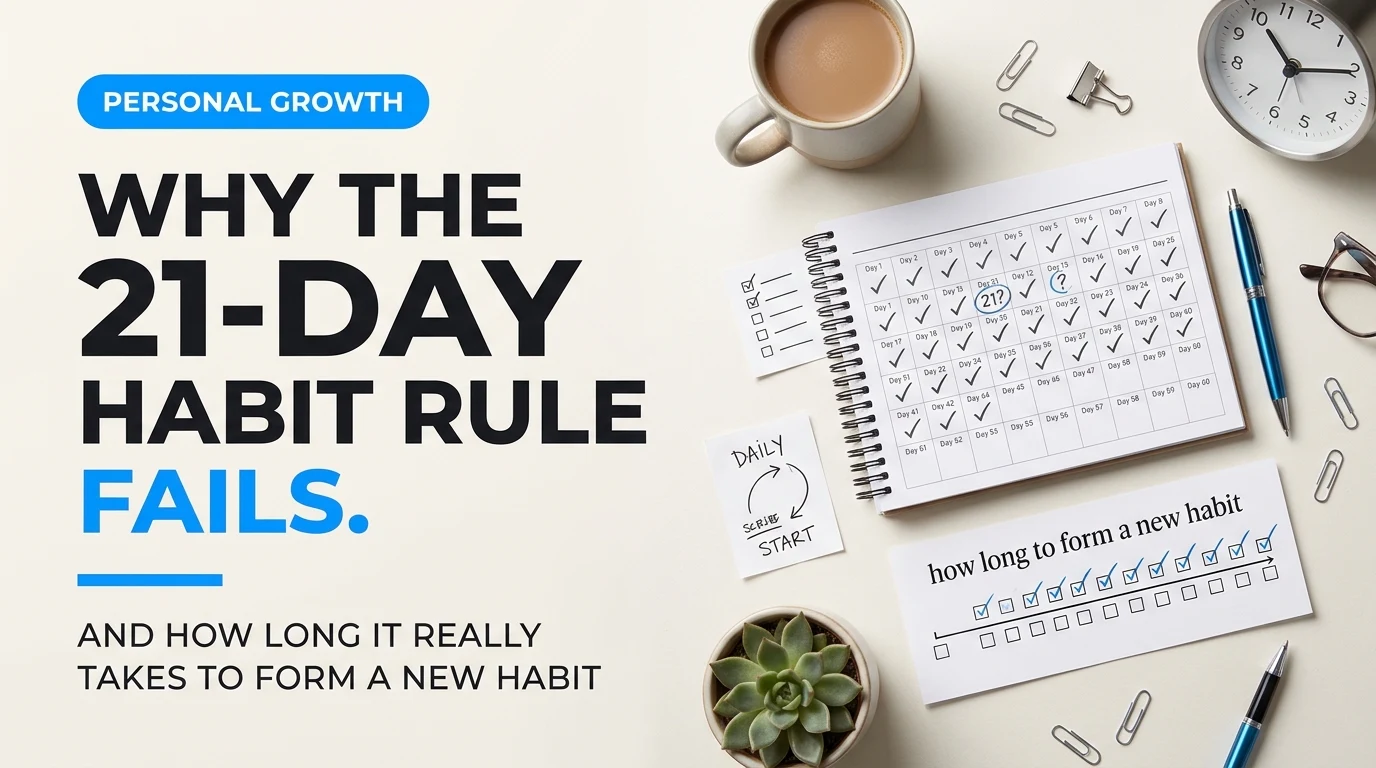
Almost everyone has heard the classic self-help pledge: give something three weeks, and you will transform your life. But when you ask real people how long to form a new habit, that neat three-week window falls apart. We watch calendar days tick past, waiting for morning workouts or clean eating to become effortless. When day 22 arrives and the behavior still feels like an agonizing uphill struggle, self-doubt rushes in. Understanding why the 21-day habit rule fails and how long it really takes to lock in lasting lifestyle changes is the only way to break free from chronic frustration.
Our culture loves speed. We buy into 21-day fitness challenges, three-week productivity sprints, and rapid mindset resets. They promise a clear finish line. After all, twenty-one days sounds manageable. It feels bite-sized. Anyone can suffer through three weeks of cold showers or journal entries if automaticity is waiting on the other side. Yet when life gets messy, that artificial milestone does more harm than good.
Table of Contents
- The 21-Day Promise: Why Habit Timelines Are Fundamentally Misunderstood
- Where Did the 21-Day Habit Rule Actually Come From?
- Why Universal Habit Timelines Fail in Real-World Conditions
- What Science Actually Says About Habit Formation
- What Key Factors Influence Your Personal Habit Formation Speed?
- The Right Approach: Shifting From Calendar Deadlines to Sustainable Systems
- Why Missing a Single Day Does Not Reset Your Progress
- Redefining Success: From a Day-Count Finish Line to Identity-Based Growth
When expectations clash with reality, self-blame follows quickly. You miss a session on day twenty-four, and your brain tells you that you lack discipline. You assume everyone else mastered the routine while you stumbled. In online wellness communities, people openly share how these rigid timelines spark guilt, leading many to drop their routines completely after missing a single milestone. Treating personal growth like a short sprint creates fragile behavior loops.
Determining how long to form a new habit requires looking past commercial marketing and examining real human behavior. Change doesn’t operate on a countdown timer. Real change is uneven, context-driven, and personal. If you want to build lasting consistency without burnout, you have to let go of the three-week illusion and look at what makes routines stick.
Where Did the 21-Day Habit Rule Actually Come From?
Almost everyone trying to change their routine bumps into the same magic number: 21 days. We see it printed across habit journals, repeated by fitness influencers, and built into productivity apps. You commit to three weeks of drinking two liters of water, journaling at dawn, or skipping evening sugar. Day 22 arrives, yet you still have to drag yourself across the finish line with sheer willpower. You assume your willpower is broken. In reality, the math was flawed from the start.
Dr. Maxwell Maltz and the Truth Behind How Long to Form a New Habit
The entire 21-day rule traces back to a single 1960 book titled Psycho-Cybernetics, written by Dr. Maxwell Maltz. Maltz was not a behavioral scientist. He did not run controlled laboratory experiments on human routines or track dopamine pathways in the brain. He was a reconstructive plastic surgeon working in New York.
In his surgical practice, Maltz noticed a distinct psychological pattern among his patients. When he performed a nose job or reshaped a patient’s cheekbones, it took roughly three weeks for that person to get used to their new face in the mirror. He saw the same timeline with amputees. Patients who lost an arm or a leg often felt phantom sensations for about 21 days before their minds updated to match their new body.
“These, and many other commonly observed phenomena tend to show that it requires a minimum of about 21 days for an old mental image to dissolve and a new one to jell.”
— Dr. Maxwell Maltz, Psycho-Cybernetics
Maltz made a simple observation about passive adaptation. He never claimed that three weeks could lock in an active life habit. Yet the burgeoning self-help movement of the late 20th century turned his casual observation into absolute gospel.
Motivational speakers and sales trainers played an enormous game of telephone with Maltz’s words. First, they dropped the qualifying phrase “a minimum of about.” Then, they swapped “adjusting to a mental image” with “building any habit.” The message transformed from a humble clinical note into a snappy marketing pitch. Twenty-one days felt accessible. It was short enough to feel doable, yet long enough to sound like serious work. A three-week challenge sells books and training seminars far better than telling people that real change takes months.
Getting used to your reflection is passive. Your brain updates its internal map simply through daily exposure without any extra sweat or focus from you. Learning to run every morning at 6:00 AM is active. It demands physical energy, uncomfortable friction, and constant conscious choices. Confusing a cosmetic adjustment with behavioral rewiring created an unrealistic benchmark that has caused countless people to quit when asking how long to form a new habit under real-world pressure.
Why Universal Habit Timelines Fail in Real-World Conditions
Most calendar-based habit rules treat your brain like an automated factory. The logic assumes that if you repeat an action twenty-one days in a row, the behavior magically locks into place forever. Real life doesn’t happen on an assembly line. When everyday chaos hits, fixed calendar rules collapse almost immediately.
Rigid timelines fail because they treat every single action as if it requires the exact same effort. Drinking a glass of water at your desk does not demand the same mental energy as dragging yourself out of bed for a brutal 5 AM gym session. The question of how long to form a new habit cannot be answered with a single number because behaviors don’t share the same emotional weight or physical friction.
How Long to Form a New Habit Depends on Behavioral Complexity
Think of your mental energy as a phone battery. Simple habits consume a tiny fraction of a percent. Complex lifestyle overhauls drain half the charge before your day even starts. When personal growth advice ignores this difference, people end up feeling broken when their new routine does not stick on schedule.
Three invisible forces determine whether a routine feels easy or impossible:
- Behavioral Complexity: The physical number of steps required to complete the task. Pouring water involves two steps. Going to the gym involves packing gear, driving, warming up, lifting weights, cooling down, and showering.
- Emotional Friction: The internal resistance you feel before starting. Gulping down water creates zero fear. Heavy barbell squats trigger anxiety, self-doubt, and physical discomfort.
- Cognitive Load: The mental bandwidth needed to execute the routine. If you are already exhausted from handling difficult family obligations or intense work projects, your brain refuses to spend extra power on difficult new tasks.
Your brain is wired for self-preservation. Whenever life gets overwhelming, it immediately defaults to the path of least resistance. Trying to force a complex habit into an arbitrary three-week window is like trying to shove a massive boulder up a muddy hill using only your fingertips.
“We don’t fail because we lack willpower. We fail because we demand that our brains treat running a marathon with the same ease as flipping a light switch.”
A simple breakdown reveals why universal timeframes fall apart under real-world pressure:
| Behavior Type | Required Steps | Emotional Discomfort | Daily Mental Energy Needed |
|---|---|---|---|
| Micro-Action (e.g., Drinking morning water) | 1–2 low-effort actions | Virtually zero | Nearly imperceptible |
| Compound Routine (e.g., 5 AM intense workout) | 8–12 coordinated choices | High physical strain and fatigue | Massive willpower reserve required |
People often share deep frustration in community discussions exploring real-world habit pitfalls, wondering why thirty days of pure grit still leaves them dreading their morning alarm. That lingering hesitation is not a personal defect. It is basic biology.
When you attempt a high-friction routine, your nervous system registers the physical exhaustion and mental strain as a cost. It takes far longer for your mind to accept that cost as a normal part of your identity. Expecting an intense lifestyle redesign to become effortless on the same schedule as an afternoon stretch sets you up for disappointment. Real progress begins the moment you trade rigid day-counts for realistic awareness of what each habit truly demands.
What Science Actually Says About How Long to Form a New Habit
If you’ve ever tried building a daily routine and felt like a failure by day 22, take a deep breath. You aren’t broken, lazy, or lacking discipline. You’re just working against an artificial calendar rule that has zero grounding in human biology.
Human neurology doesn’t run on three-week timers. When you try to hardwire a fresh behavior into your daily life, your brain undergoes physical rewiring. That process doesn’t finish just because three calendar weeks flipped past.
The UCL Study: How Long to Form a New Habit in Real Life
To cut through pop psychology, Dr. Phillippa Lally and her research team at University College London tracked 96 participants over a 12-week period. Each participant chose one simple health-related behavior they wanted to turn into an unconscious daily habit—such as drinking a glass of water after breakfast or going for a 15-minute run before dinner.
The findings, documented in the landmark UCL habit formation study published in the European Journal of Social Psychology, permanently broke the idea of a universal timeline. The research proved that knowing how long to form a new habit depends on a broad realistic spectrum: anywhere from 18 to 254 days.
Across all participants, the median timeline was 66 days. It took just over two full months for a behavior to reach maximum automaticity—the point where an action happens smoothly without deliberate mental effort.
| Habit Complexity | Common Example | Observed Range |
|---|---|---|
| Low Complexity | Drinking a glass of water with morning coffee | 18 – 30 days |
| Moderate Complexity | Eating a piece of fruit with lunch; 10-minute walk | 40 – 70 days |
| High Complexity | 50 sit-ups after waking; 30 minutes of vigorous cardio | 100 – 254+ days |
A simple action locks in fast. A complex physical workout requires months of consistent practice before your brain stops fighting you on it.
The Automaticity Curve and Your Brain on Autopilot
Dr. Lally’s research revealed something fascinating about how our brains learn: habit growth isn’t a straight line. It follows what scientists call an asymptotic curve.
Think of it like blazing a trail through a dense patch of overgrown woods. On day one, you must hack away tall weeds and push branches aside with both hands. It’s exhausting. Your prefrontal cortex—the conscious, energy-hungry executive control room of your brain—has to direct every step.
“Early repetitions yield the biggest leaps in automaticity. As the physical trail clears, the brain spends progressively less energy walking it.”
In the first few weeks, each repetition clears significant brush. The initial gains feel noticeable. Over time, your brain creates a physical groove in your basal ganglia, the region responsible for routine patterns and automatic behaviors. Once that trail is fully worn down, your feet naturally follow it without conscious steering.
The curve eventually levels off. It never hits 100% robotic automation—you still need to initiate the act. But it reaches a threshold where doing the habit requires far less willpower than skipping it. When people ask how long to form a new habit, the honest scientific answer isn’t a fixed date. It’s the number of smooth repetitions required for your brain to trade deliberate friction for subconscious ease.
What Key Factors Influence Your Personal Habit Formation Speed?
Two people can commit to the exact same morning routine on January first. One breezes through it on autopilot by mid-February. The other still battles fierce internal resistance every single dawn in April. When you look at how long to form a new habit, calendar days only tell part of the story. Your nervous system doesn’t read calendars. It reads energy expenditure, emotional payoff, and safety.
Automaticity—the point where an action requires almost zero deliberate willpower—arrives at varying speeds depending on specific internal and external levers. Understanding these variables gives you control over the process. Instead of blaming your willpower when a routine fails to stick, you can pinpoint the exact gear that needs oiling.
| Variable | Friction Multiplier (Slows You Down) | Catalyst (Speeds Up Automaticity) |
|---|---|---|
| Task Complexity | Multi-step setup, heavy physical or mental strain | Micro-steps, clear starting point under two minutes |
| Environment | Cluttered spaces, competing digital distractions | Dedicated space, visual prompts directly in your path |
| Reward Timing | Delayed results (weight loss, investment returns) | Immediate sensory pleasure or mood elevation |
| Stress Levels | High cortisol, poor sleep, executive exhaustion | Regulated nervous system, consistent baseline recovery |
| Self-Concept | “I have to do this, but I hate it” | “This action reflects who I am becoming” |
Five Drivers That Dictate How Long to Form a New Habit
Habit adoption is not a flat road. It is an obstacle course shaped by five distinct psychological and biological drivers.
1. Task Friction and Physical Resistance
Friction is anything that stands between you and starting the behavior. Drinking a glass of water every morning carries tiny friction; you turn the tap and swallow. Prepping a five-course organic breakfast carries massive friction; you chop, sauté, season, and wash pans. The higher the activation energy, the more mental resistance your brain throws up. If a task requires six distinct decisions before you even begin, your brain will choose conservation over creation almost every time.
2. Environmental Cues and Context Architecture
We like to believe we run on conscious choice. In reality, our surroundings run us. The brain is an efficient pattern-matching organ that anchors behaviors to physical locations and visual triggers. When you try to meditate in the same desk chair where you answer stressful client emails, you force your mind to fight the ambient tension already baked into that furniture. When you design dedicated zones with visible, unambiguous cues, you strip away the need to remember. The environment does the heavy lifting.
3. The Dopamine Feedback Loop
Dopamine is not the molecule of pleasure. It is the molecule of anticipation and reinforcement. When an action provides immediate emotional or sensory satisfaction, your basal ganglia records that sequence as valuable. Behaviors with delayed gratification—like saving money or doing core workouts—take significantly longer to automate because the brain cannot feel tomorrow’s reward today. You speed up automaticity by tying an immediate, genuine spark of enjoyment to the front end of the routine.
4. Baseline Stress and Cognitive Bandwidth
Your prefrontal cortex governs willpower, focus, and self-restraint. It is also the first system to shut down when you are sleep-deprived or chronically stressed. Under acute pressure, your nervous system retreats to default mode, relying on primitive, deeply rooted reflexes to save energy. When life gets chaotic, trying to install a demanding new ritual feels impossible. It is not a moral failing. Your system simply lacks the biological budget to fund new neural pathways.
5. Emotional Alignment and Identity Resonance
Behaviors that clash with your underlying identity will never feel natural. If you force yourself to run because you feel guilty about your body, every mile is an uphill fight against self-resentment. When an action aligns with who you believe you are, cognitive dissonance disappears. Groundbreaking behavioral research on habit automaticity shows that simple routines stick in as few as 18 days, while demanding or emotionally disconnected ones can take over 250 days. The difference is rarely the clock—it is how deeply the action fits your life.
“Automaticity does not come from suffering through a fixed number of days. It comes from stripping away resistance until the right choice becomes the easiest path in the room.”
Stop asking whether you have passed an arbitrary 21-day or 66-day milestone. Look at your friction points. Fix the environment, lower the complexity, give yourself a real reason to enjoy the moment, and watch how quickly your brain embraces the shift.
The Right Approach: Shifting From Calendar Deadlines to Sustainable Systems
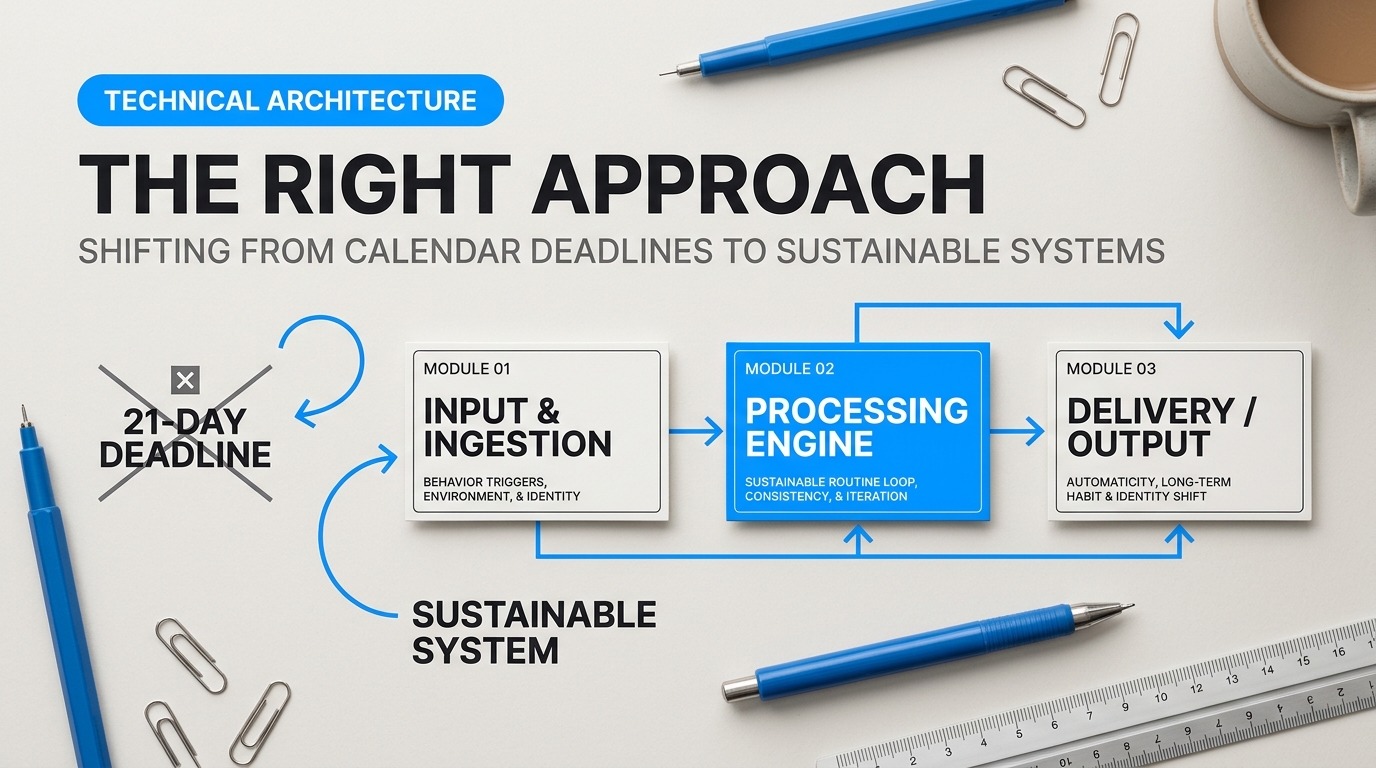
Willpower runs out quickly. When you rely solely on white-knuckling your way through a grueling month of changes, your energy plummets the second real life introduces stress, fatigue, or unexpected friction. Setting an arbitrary calendar deadline creates an imaginary finish line. You grit your teeth until Day 21 or Day 66, only to collapse back into baseline comfort once the countdown ends.
Sustainable change never happens by watching calendar squares disappear. It happens by constructing an environment where your desired behavior becomes the path of least resistance. You do not rise to the level of your motivation. You sink to the level of your daily setup.
Why Systems Dictate How Long to Form a New Habit
Instead of obsessing over how long to form a new habit on a calendar, focus your attention on the conditions that make repetition painless. When people ask whether redesigning their routine is worth the initial effort, they often worry about overcomplicating things. A common debate among individuals seeking peak performance, echoed in community discussions regarding structured personal systems, centers on whether building deliberate behavioral frameworks actually holds up better than simple, manual willpower. The verdict is always the same: willpower burns out, but automated architecture endures.
Forget the target finish line. When you fall in love with the operating system rather than the arbitrary deadline, consistency takes care of itself.
Four proven behavioral levers replace sheer grit with automatic momentum:
- Implementation Intentions: Pre-decide your future actions. The brain hates ambiguity. If your goal is simply to “exercise more,” you force your brain to make hundreds of micro-decisions: When should I go? What should I wear? How long should I train? Remove the mental debate by using an “If/When [Trigger], Then [Action]” formula. “When I shut my laptop at 5:30 PM, I will immediately put on my running shoes.” The trigger acts as an external prompt, eliminating decision fatigue before it starts.
- Habit Stacking: Anchor the unfamiliar to the established. Your brain already possesses dense neural pathways for actions you perform on autopilot, like pouring morning coffee, brushing your teeth, or setting your keys on the counter. Ride those existing waves. Pair your new action directly onto the back of an ingrained anchor: “After I pour my morning brew, I will write one sentence in my journal.”
- Micro-Commitments: Lower the activation energy to zero. When a target looks intimidating, your brain senses threat and retreats into procrastination. Shrink the requirement until it feels laughably easy. Don’t commit to meditating for thirty minutes; commit to closing your eyes for three deep breaths. Don’t commit to reading a chapter; commit to reading a single paragraph. You can always do more, but you are never permitted to do less than your microscopic floor.
- Deliberate Environment Architecture: Redesign your surroundings so discipline becomes unnecessary. Humans are profoundly lazy creatures ruled by visual cues. If you want to drink more water, place a full glass on your desk before bed. If you want to stop scrolling late at night, charge your phone across the room. Make good choices effortless and bad choices inconvenient.
Every repetitive action alters your neural wiring. The true answer to how long to form a new habit has nothing to do with day counts and everything to do with frequency of completion. Two weeks of frictionless daily repetitions will lock in automaticity faster than six months of sporadic, exhausting bursts fueled by willpower alone.
Why Missing a Single Day Does Not Reset Your Progress
You hit the gym for twelve straight days. Your habit tracker glows with an unbroken chain of checkmarks, and you feel unstoppable. Then Tuesday hits. A late meeting runs over, the kids need help with dinner, and you collapse onto the couch exhausted. You miss your workout.
For most people, that single blank square triggers a familiar downward spiral. A quiet voice whispers that the streak is dead, the momentum is ruined, and all that hard work went down the drain. Psychologists call this reaction the what-the-hell effect. Once you break an arbitrary rule of perfection, your mind decides that you might as well abandon the plan entirely. One missed Tuesday turns into a missed week, which turns into quitting altogether.
The Science of Lapses: How Long to Form a New Habit When Life Interrupts
Here is the truth: habit building is not a fragile house of cards. Missing an individual day does not erase the neural pathways you spent the last two weeks carving into your brain.
When Dr. Phillippa Lally conducted her landmark research at University College London, her team tracked volunteers as they established healthy daily routines. The study uncovered something liberating about automaticity and habit development in real-world settings. Missing a single opportunity to perform the behavior had zero measurable impact on the overall habit trajectory. The participants who skipped a day here and there reached automaticity at roughly the same pace as those who executed the behavior every single day without fail.
“Missing one day does not derail the process. Habit formation is driven by consistency over time, not absolute perfection.”
Think of building a new behavior like walking across an overgrown meadow. Every time you repeat the action, you tamp down the tall grass. A visible trail starts to form. If rain keeps you indoors for one afternoon, the path doesn’t suddenly vanish under waist-high weeds by sunrise. The dirt is still packed down. The route remains cleared. You simply step right back onto the trail the next morning.
Streak Mindset vs. Trajectory Mindset
Many habit-tracking apps reinforce an all-or-nothing mentality. They celebrate 30-day streaks, but the second you miss a day, your score resets to zero. That zero feels like a punishment, even though your brain retains nearly all the progress you earned.
| The Streak Mindset | The Trajectory Mindset |
|---|---|
| Measures success by unbroken chains. | Measures success by overall direction. |
| Treats a single lapse as a total failure. | Views a slip as normal human variance. |
| Causes guilt and binge lapses. | Encourages immediate, calm recovery. |
| Demands 100% perfection to stay motivated. | Thrives on an 80% batting average. |
When you calculate how long to form a new habit, the answer depends far less on unbroken perfection than on your ability to bounce back without drama. Perfectionism is fragile. Resilience is durable.
A simple operating rule can protect you from the perfection trap: never miss twice. One missed session is an accident caused by life. Two missed sessions begins the groundwork for a counter-habit. Give yourself grace when an unexpected crisis disrupts your day, let go of the guilt, and focus entirely on showing up tomorrow.
Redefining Success: From a Day-Count Finish Line to Identity-Based Growth
Counting days creates a dangerous trap. When you anchor your daily behavior to an arbitrary finish line, your brain secretly prepares to stop the moment you reach that final calendar square. That is why the classic 21-day habit rule fails so many ambitious people. You force yourself through three weeks of cold showers, morning runs, or clean eating, only to collapse on day twenty-two because your willpower ran dry.
Real personal transformation doesn’t work like a thirty-day fitness challenge. It doesn’t care about a neat, circular date on your wall calendar. Behavior solidifies when your daily actions stop feeling like an external assignment and start feeling like an expression of who you are.
Beyond the Numbers: How Long to Form a New Habit for Real Life
Every action you take is a vote for the person you want to become. If you run around the block once, you aren’t suddenly an athlete. But when you lace up your shoes three mornings in a week, even when it’s raining, you cast three distinct votes for an athletic identity. Over time, those votes accumulate. You stop asking whether you feel like running today because running is simply what you do.
Whenever you wonder how long to form a new habit, remember that you are not running toward a finish line where you get to quit. Lasting behavior change happens in the quiet, unremarkable moments of routine alignment. The goal isn’t to read thirty books in thirty days. The goal is to become a reader. The goal isn’t to survive a rigid morning routine for a month. The goal is to become someone who greets the day with intention.
True progress isn’t marked by how many consecutive days you can grit your teeth. It is marked by how naturally you return to your core standards after life knocks you off course.
Drop the countdown. Put away the red marker. Give yourself the grace to build slowly, mess up occasionally, and immediately step back into rhythm. When your habits reflect your values instead of a calendar deadline, you stop worrying about how long the road takes. You simply enjoy the person you become along the way.