9 Micro-Habits for Mental Clarity You Can Do in 2 Minutes
9 Micro-Habits for Mental Clarity You Can Do in 2 Minutes – micro habits for mental clarity
You sit down to tackle your most important project, but within twenty minutes, your thoughts feel like thick sludge. Between persistent notification pings, dozens of open browser tabs, and competing daily demands, cognitive fatigue quietly drains your creative energy. Practicing intentional micro habits for mental clarity can rapidly reset your focus before mental exhaustion takes over. You don’t need a weekend retreat or an unrealistic schedule overhaul to think clearly. In fact, adopting simple routines you can do in two minutes protects your attention far better than sweeping lifestyle overhauls.
Table of Contents
- The Silent Cost of Cognitive Fatigue: Why Tiny Shifts Outperform Massive Overhauls
- 1. The Two-Minute Brain Dump: Foundational Micro Habits for Mental Clarity
- 2. The 'Tab Tidy' Digital Reset: Reducing Working Memory Strain
- 3. The Sixty-Second Box Breathing Pause: Regulating the Nervous System
- 4. The Single-Surface Declutter: Cultivating Visual and Mental Stillness
- 5. Five-Minute Device-Free Pacing: Harnessing Attention Restoration Theory
- 6. The Hourly Alignment Prompt: Breaking Free from Mental Autopilot
- 7. The Three-Task Evening Shutdown: Eliminating Nighttime Rumination
- Sustaining Everyday Calm: Compounding Small Wins into Enduring Mental Sharpness
Your working memory functions much like a phone battery. If you leave fifty heavy applications running in the background, your battery drains fast and your screen freezes. We often wonder why small daily habits matter more than big goals when trying to fix persistent burnout. Massive productivity programs fail because they require heavy willpower from an already exhausted mind. Tiny behavioral shifts bypass that resistance entirely. They deliver quick, low-effort cognitive resets that sweep away mental clutter without eating into your busy workday.
Cognitive science shows that regular micro-pauses help your prefrontal cortex clear out decision fatigue. Instead of forcing yourself through hours of continuous strain, brief moments of deliberate calm restore your natural processing power. In the Moonshots Podcast series on mindset and performance, high performers regularly highlight how small, repeatable personal rituals consistently outperform rigid routines when protecting everyday focus.
Integrating these bite-sized actions keeps your energy balanced across morning, afternoon, and evening. Weaving practical micro habits for mental clarity into natural pauses across your day gives your brain the breathing room it needs to stay sharp, calm, and fully present.
1. The Two-Minute Brain Dump: Foundational Micro Habits for Mental Clarity
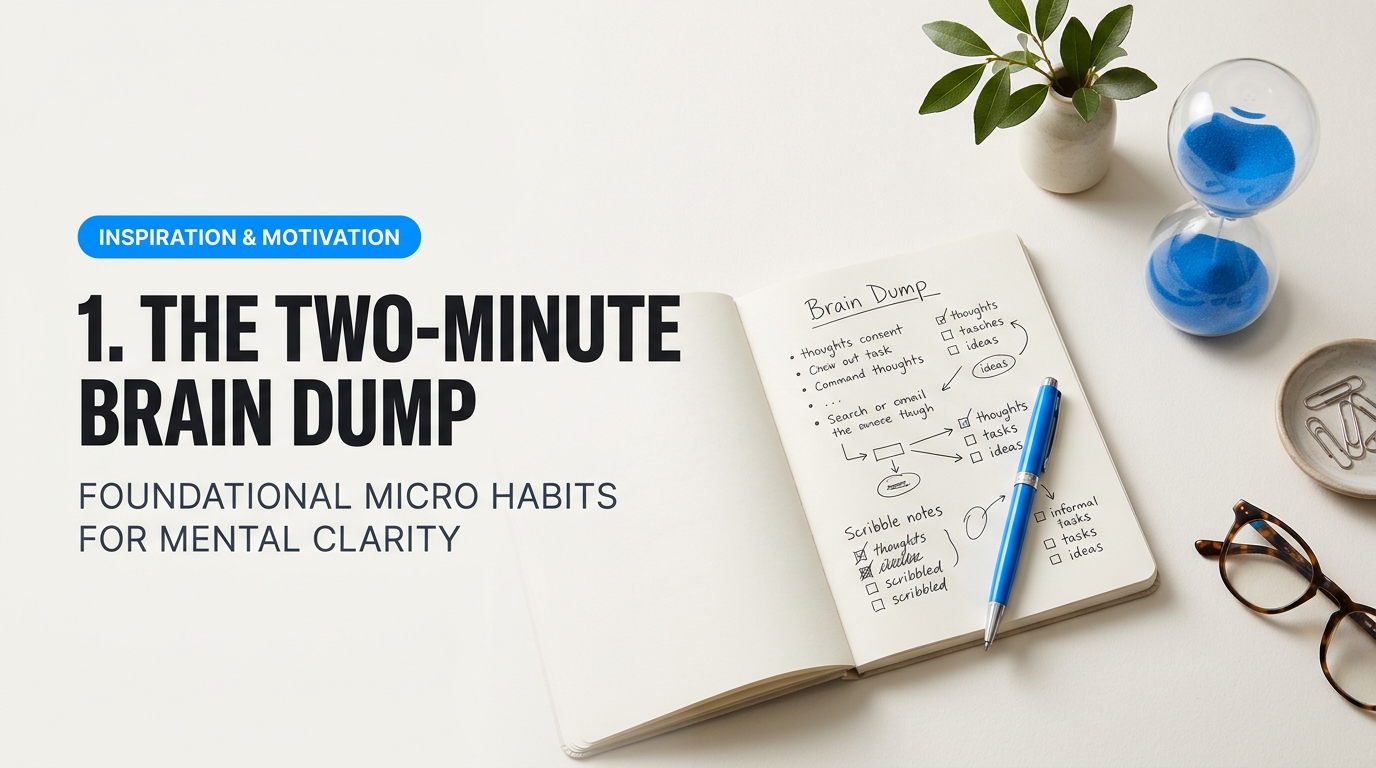
Your alarm sounds. Before you even throw off the covers, a dozen loose thoughts rush in at once. You remember an unanswered client message, a forgotten dentist appointment, and the pile of laundry waiting in the hall. When your mind tries to hold all these items simultaneously, it stalls out. Think of your working memory as a small whiteboard with limited space. Trying to cram every tiny chore, worry, and task onto that tiny board leaves no room to think straight.
Adopting simple micro habits for mental clarity starts with recognizing that your brain is designed to generate ideas, not store them like a filing cabinet. When you keep unresolved tasks locked in your head, psychologists call these open loops. They quietly siphon away your energy, creating an undercurrent of low-grade morning panic.
Offloading Mental Loops: Micro Habits for Mental Clarity in Practice
The two-minute brain dump is the fastest way to wipe that whiteboard clean. The process is deceptively simple: grab a blank piece of paper, set a timer for 120 seconds, and write down everything rattling around in your skull without filtering, editing, or judging the contents.
Many people searching through Reddit productivity discussions on two-minute habits ask which daily routines actually stick long-term. The reason this unfiltered dump survives real-world chaos is its low friction. You aren’t building a master project management board. You aren’t organizing tasks by priority. You are simply performing a fast mental purge onto paper.
Writing your thoughts by hand engages neural circuits differently than typing on a glass screen, helping settle nervous system agitation while organizing chaotic feelings into concrete reality.
“When thoughts stay trapped inside your skull, they feel enormous. The moment they hit physical paper, they shrink down to their real size.”
To get the most out of your two minutes, follow three straightforward guidelines:
- Keep it analog: Use a physical pen and notebook. Screens pull you toward email notifications, badges, and calendar alerts that trigger dopamine loops before you’ve even started your morning.
- Write phonetically if needed: Don’t correct spelling, organize by category, or write in complete sentences. If you only jot down fragments like “groceries, tax form, call Mom, car noise,” you succeed.
- Stop when the timer rings: The strict two-minute limit keeps the habit painless. When you know an exercise takes almost no time, your brain rarely puts up resistance to doing it.
Once those thoughts are captured on paper, your brain finally believes the information is safe. You’ve eliminated the background anxiety that comes with trying not to forget things. That fast release frees up your prefrontal cortex, giving you the calm mental room required to pick your real morning priority and execute it with calm focus.
2. The 'Tab Tidy' Digital Reset: Reducing Working Memory Strain
Your browser tab bar probably looks like a crowded parking lot right now. Dozens of tiny icons squished together. No visible titles. Just a blur of unread articles, half-written emails, and abandoned research from three days ago. We tell ourselves we’ll get back to them later. In reality, they sit there quietly sapping our mental energy.
Think of your working memory as a small kitchen counter. You only have room to chop one vegetable or roll out one piece of dough at a time. Every open browser tab is a dirty mixing bowl left on that counter. Even if you aren’t using it, you still have to look past it, reach around it, and remember why it’s there. Psychologists call this attention residue. A small part of your brain stays glued to every unfinished page, leaving less brainpower for the job right in front of you.
This struggle is widespread. In online productivity forums, thousands of people share the anxiety of curbing a 1,000-tab browsing habit, worried that closing a window means losing an idea forever. Digital hoarding masquerades as preparedness. Yet hoarding tabs doesn’t preserve knowledge. It paralyzes focus.
Building Micro Habits for Mental Clarity Through Screen Hygiene
Practicing reliable micro habits for mental clarity doesn’t mean overhauling your entire operating system. It means building tiny transition rituals between deep focus blocks. The “Tab Tidy” is a 45-second digital sweep you run before shifting tasks or stepping away from your desk. It clears your working memory and gives your mind a clean slate.
| Digital State | Working Memory Strain | Immediate Feeling |
|---|---|---|
| 30+ open tabs, slack pings, minimized windows | High attention residue; fractured focus | Scattered, hurried, low-grade dread |
| 1 active tab, background apps shut down | Zero residual clutter; direct attention flow | Grounded, calm, ready to create |
Here is how to run the Tab Tidy in under a minute:
- Save the essentials: If an article is genuinely worth reading later, send it to a read-it-later bookmark folder. If you haven’t opened it in 48 hours, be honest and hit delete.
- Wipe the window: Close the entire browser window in one stroke using
Cmd+Shift+Won a Mac orCtrl+Shift+Won Windows. Watching forty tabs vanish all at once delivers a surprising burst of relief. - Quit background apps: Right-click and quit messaging apps, music players, and heavy software running quietly in the tray.
- The transition pause: Take one full breath before launching the single window you need for your next session.
“Closing a tab isn’t throwing away value; it’s buying back working memory for the work that matters now.”
Breaking the trance of endless browsing sometimes requires an intentional sensory reset. Pairing your screen cleanup with an upbeat auditory track can snap your nervous system out of passive scrolling mode and re-energize your workspace.
Treat your computer screen like a physical workbench. You wouldn’t leave power tools and sawdust scattered everywhere while trying to sketch a new blueprint. Running this micro reset between tasks ensures you enter every work sprint with crisp intention instead of leftover cognitive exhaustion.
3. The Sixty-Second Box Breathing Pause: Regulating the Nervous System
Your brain doesn’t lose focus in a vacuum. When a sudden flood of emails or a looming deadline spikes your stress, your body quietly kicks into survival mode. Your heart beats faster. Your breathing turns shallow. Cortisol floods your system, shutting down deep analytical thinking to prioritize rapid threat detection. You can’t think straight because your biology won’t let you.
Why Box Breathing Works as One of the Quickest Micro Habits for Mental Clarity
Think of your nervous system as a speeding car. When sudden stress steps on the gas, box breathing acts as your physiological brake pedal. Known as 4×4 or square breathing, this technique regulates your autonomic nervous system by equalizing four distinct phases: a four-second inhale, a four-second hold, a four-second exhale, and a four-second empty hold. As documented in the Cleveland Clinic guide on box breathing, slow, rhythmic breathing stimulates the vagus nerve. This sends an unmistakable chemical message directly to your brainstem: the danger has passed.
People often ask online how to regulate your nervous system without spending hours meditating on a cushion. Box breathing takes less than two minutes. A common frustration discussed on wellness forums is that forced breath holds can sometimes trigger a feeling of “air hunger” or panic. If holding your breath for four seconds makes your chest feel tight, dial it down. Drop the count to two or three seconds per side. The magic lies in the balance of the cycle, not the stopwatch.
Watching visual demonstrations helps keep your rhythm steady if you tend to rush your counts when feeling stressed. The video above breaks down simple pacing patterns that eliminate guesswork.
The 60-Second Sequence (Four Cycles):
1. Inhale (4s): Fill your lower lungs through your nose without straining.
2. Hold (4s): Keep your throat soft and open. Avoid clamping down.
3. Exhale (4s): Empty your lungs steadily through pursed lips or your nose.
4. Hold Empty (4s): Rest in that quiet space before the next breath begins.
Four rounds take exactly sixty seconds. In that single minute, your heart rate dips, blood pressure settles, and oxygen returns to your prefrontal cortex. That thick fog behind your eyes begins to lift. You aren’t forcing your mind to calm down through sheer willpower; you’re using your lungs to command your brain to stand down. Among all the practical micro habits for mental clarity, this breath pause provides the fastest physical reset you can use anywhere.
4. The Single-Surface Declutter: Cultivating Visual and Mental Stillness
Look past your monitor for a second. If you see an unwashed coffee mug, three scattered pens, and a loose pile of receipts, your brain is working harder than it should. Your visual cortex—the brain region responsible for processing visual information—treats every physical object in your sightline as a live input. Research from the Princeton Neuroscience Institute shows that multiple visual stimuli compete for neural representation in your brain. When items crowd your view, they pull at your limited processing capacity like apps running silently in the background.
One professional describing this constant friction on Reddit noted how visual overload feeds persistent mental exhaustion: "This is sustained pressure. The background refuses stillness." That restless feeling isn’t a lack of discipline. It’s your nervous system responding to continuous visual noise.
When surfaces are overloaded, your brain has to process every stray item in view. Clearing physical space gives your mind immediate breathing room.
Building Micro Habits for Mental Clarity Around Your Workspace
Most productivity advice tells you to overhaul your entire room or adopt extreme minimalism. That approach usually fails. Big cleaning projects spark heavy resistance when you’re already low on energy. You don’t need a four-hour marathon with storage bins. You only need three minutes and a single flat surface.
Integrating tiny physical resets into your daily routine is one of the most reliable micro habits for mental clarity because it produces an instant sensory payoff. As detailed in Hartford HealthCare's report on cognitive visual clutter, reducing the number of objects your brain must actively filter out spares mental energy for higher-level thinking.
| Trigger Point | The Old Habit | The 3-Minute Shift |
|---|---|---|
| Scattered desk tools | Ignoring the mess until Friday | Return pens and accessories to one dedicated tray. |
| Piles of paper notes | Filing and sorting every page | Stack papers into a neat, squared pile out of direct view. |
| Visual fatigue | Attempting a full room cleanup | Clear only the 18-inch perimeter around your keyboard. |
Pick one boundary: the immediate surface around your mouse and keyboard. Set a timer for three minutes. Remove anything that isn’t essential to the single task in front of you. Toss the trash, put the empty mug in the kitchen, and set loose papers into a single closed drawer.
Notice how your shoulders drop once that small perimeter is bare. By creating an island of physical order, you remove competitive inputs from your visual cortex. The external calm invites internal quiet, giving your thoughts room to breathe.
5. Five-Minute Device-Free Pacing: Harnessing Attention Restoration Theory
Your screen glares back at you. You reread the exact same paragraph four times without absorbing a single phrase, completely stalled on a problem that should take five minutes. Many people experiencing daily brain fog describe this exact wall; in ADHD community discussions on overcoming study paralysis, users often vent about getting stuck on a single line of text despite desperately wanting to make progress. When your brain locks up like this, gritting your teeth and staring harder at the glowing pixels will never fix it.
Your prefrontal cortex operates like a smartphone battery running high-drain apps with the screen brightness turned all the way up. In cognitive psychology, this direct effort is called directed attention. It demands voluntary mental energy to block out distractions and hold complex data in your short-term memory. Over time, that reservoir runs dry. Stepping away from your chair to pace for five minutes without your phone allows your mind to slip into what neuroscientists call “diffuse mode.”
Unlocking Diffuse Thinking: Micro Habits for Mental Clarity on the Move
Diffuse thinking is the background processing system of your brain. Think of directed focus as a tight spotlight examining a tiny patch of ground. Diffuse focus is a floodlight. When you turn off the harsh spotlight, the floodlight reveals how surrounding objects link together. This phenomenon forms the heart of Attention Restoration Theory, which explains that brief exposures to undemanding environments restore voluntary attention capacity.
Look at how a typical rest break compares to genuine cognitive restoration:
| Action | Mental State | Cognitive Outcome |
|---|---|---|
| Scrolling social feeds at your desk | Direct attention remains active | Continued mental strain and sensory fatigue |
| Device-free pacing down a hall or outdoors | Diffuse mode engages automatically | Direct attention restores; spontaneous insights surface |
Leaving your phone behind is non-negotiable. If you pull out your phone while pacing, you trade one intense spotlight for another. Your working memory continues churning through incoming data, text messages, news alerts, and social triggers. Pacing empty-handed gives your optic nerve and prefrontal cortex a true break. As documented in research on brief movement breaks for brain health, short bursts of walking stimulate peripheral blood flow, delivering oxygen and glucose straight to fatigued neural circuits.
Adopting physical movement as one of your go-to micro habits for mental clarity allows subconscious circuits to organize disparate pieces of a puzzle. While your feet rhythmically trace a path down your hallway or across your living room floor, your thoughts wander without an agenda. You stop wrestling with the problem. Suddenly, the answer appears effortlessly.
When physical pacing combines with grounding techniques, your autonomic nervous system steps down from high-alert stress mode into a state of steady balance. The video above illustrates how physical disengagement eases racing thoughts and physical restlessness. When you walk, let your eyes drift loosely toward the horizon, out a window, or along the floorboards. Keep your pace relaxed. Notice the contact of your heels on the ground.
“In diffuse mode, the brain connects distant concepts that focused attention keeps apart. Stepping away is not procrastination; it is the silent engine of problem-solving.”
Try setting a simple timer on your kitchen microwave or a non-digital watch for five minutes. Walk away from every monitor, tablet, and phone in your workspace. Do not force yourself to think about your project. If work thoughts pop up, let them pass without latching on. When the chime sounds, return to your seat. The stubborn sentence that looked impossible five minutes ago will usually read with clear, simple sense.
6. The Hourly Alignment Prompt: Breaking Free from Mental Autopilot
You unlock your phone to glance at a calendar invite. Forty minutes vanish. You snap back to reality three levels deep into a random comment section, wondering how your afternoon slipped away.
Most of our daytime exhaustion does not stem from heavy physical work. It comes from unconscious drifting. A behavioral study shared on Reddit noted that roughly two-thirds of our daily behaviors happen completely on autopilot. Our brains love routine shortcuts. When fatigue sets in, the subconscious takes the wheel, steering straight toward low-resistance distractions like refreshing social feeds or organizing desktop folders that do not matter right now.
The Five-Second Reset: Micro Habits for Mental Clarity in Real Time
Snapping out of that trance takes seconds. The hourly alignment prompt relies on a gentle, recurring chime. Set a quiet repeating vibration on your smartwatch, a soft bell on your phone, or an unobtrusive desktop timer set for 60-minute intervals. When the cue sounds, you do not drop everything or start a long meditation. You just pause for two seconds and ask yourself one plain question:
“Is what I am doing right now serving my actual priorities?”
Be honest with the answer. You are not judging yourself. You are simply shining a flashlight into a dark room so you can see where you actually stand.
Practicing micro habits for mental clarity does not require giant lifestyle overhauls or hour-long morning rituals. It works through small friction points that disrupt passive consumption. If your chime goes off while you are writing a key client proposal, great—nod, smile, and keep typing. If it rings while you have spent twenty minutes reading forum debates about someone else’s vacation drama, the prompt gives you permission to close the tab without self-criticism.
Think of your mental energy like a phone battery on a cold day. Every unconscious task and digital detour sips power in the background. By breaking that autopilot cycle once an hour, you protect your decision-making bandwidth for the tasks that truly move the needle.
7. The Three-Task Evening Shutdown: Eliminating Nighttime Rumination
Your head hits the pillow. The room goes quiet. Suddenly, your brain decides it is time to solve every dilemma from the last five years and plan out the next five weeks.
Many of us fall into this trap. As someone noted on a Reddit community thread on calming nighttime thoughts, your nervous system feels fried at night while racing thoughts make sleep feel impossible. You try to force relaxation, but open loops keep firing. Psychologists call this tendency the Zeigarnik effect. Your brain hates unfinished business. If you leave your desk without a plan, your subconscious keeps running background programs all night, churning through worry to ensure you don’t drop the ball tomorrow.
You can turn off those background programs in two minutes flat.
Anchoring Micro Habits for Mental Clarity into an Evening Ritual
Think of your mind like a restaurant kitchen at closing time. If the cooks simply walk out the door, leaving dirty pans on the counters and hot burners running, the kitchen stays in chaos. Someone has to wipe the prep line and shut off the pilot lights. The Three-Task Evening Shutdown acts as your mental pilot light switch.
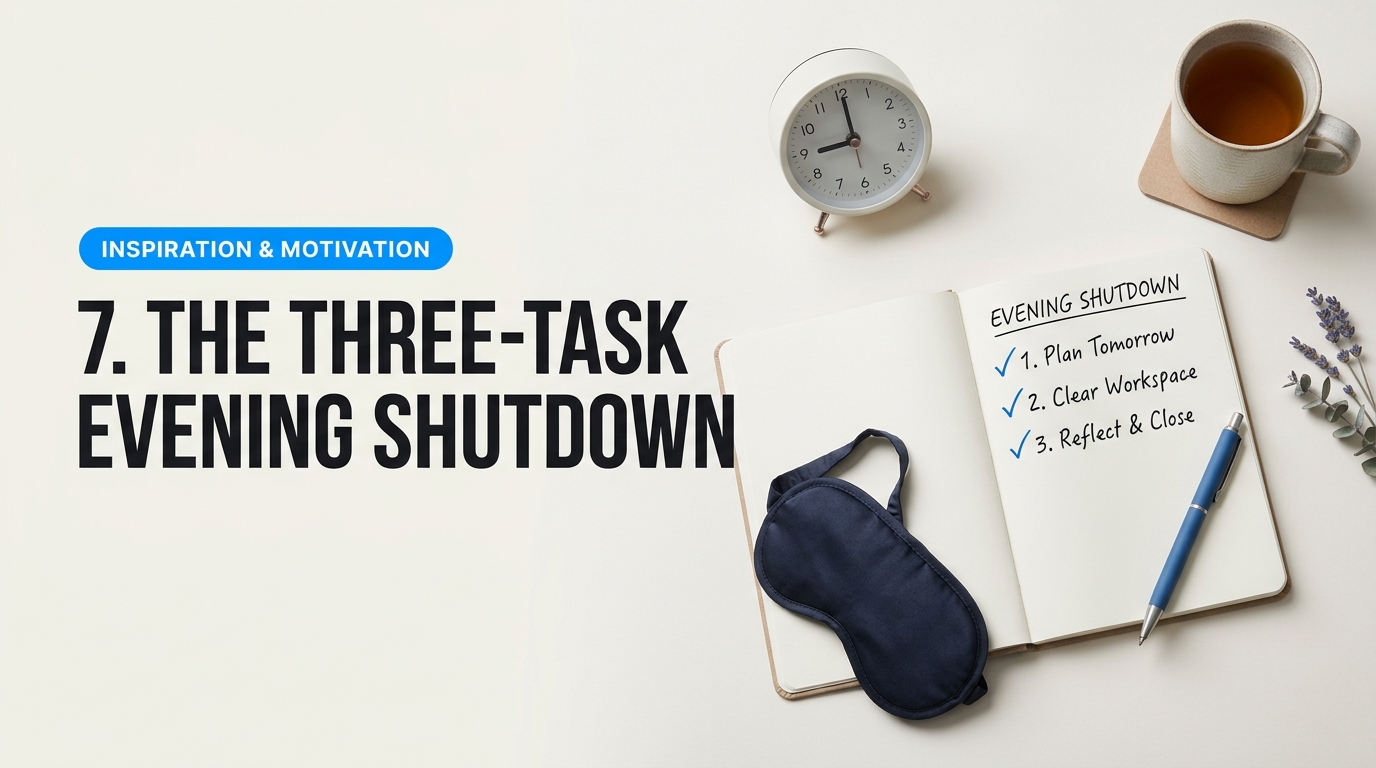
Here is how to run this simple closure ritual right before leaving your workspace:
- Review the day (30 seconds): Glace at your calendar and today’s messy notes. Acknowledge what got done. Cross off completed items to give your brain a visual win.
- Select tomorrow’s three needle-movers (60 seconds): Look at what remains. Ask yourself: If I could only accomplish three things tomorrow to feel satisfied, what would they be? Write those three tasks down on a physical index card or sticky note.
- Declare the shutdown (30 seconds): Close your planner or shut your laptop lid. Say a short verbal cue out loud, such as “Work is done for today,” or simply push your chair into your desk.
Keeping the list to three items is the secret. Long to-do lists trigger anxiety. They create dread before morning even arrives. Restricting yourself to three priorities forces realistic boundaries. It tells your brain: We have a clear, achievable plan for sunrise. There is nothing left to solve right now.
In the video above, licensed therapist Emma McAdam outlines practical tools to reset when your nervous system freezes or loops under mental pressure. Pairing those somatic resets with clear end-of-day boundaries breaks the cycle of bedtime panic.
“Your mind will not relax until it trusts that you have captured what matters.”
Passive Drift vs. The Intentional Shutdown
Small behavioral differences at the end of the day make a massive impact on your sleep quality:
| Habit Element | Passive Drift | The Three-Task Shutdown |
|---|---|---|
| Work Stopping Point | Work bleeds into dinner and bedtime checks. | Hard stop marked by a physical ritual. |
| Next-Day Planning | Unorganized thoughts spin in bed. | Three priorities written down on paper. |
| Mental Status at 10 PM | Tense problem-solving and worry loops. | Quiet release; work is formally parked. |
Adopting deliberate micro habits for mental clarity during your twilight hours signals to your nervous system that you are safe to disengage. You don’t have to carry tomorrow’s burdens into tonight’s sheets. Give your thoughts a trusted home on paper, pack your tools away, and allow yourself the deep, unbroken sleep you earned.
Sustaining Everyday Calm: Compounding Small Wins into Enduring Mental Sharpness
You don’t need an intense lifestyle overhaul to reclaim your peace of mind. Radical life resets often sound inspiring on paper, but they tend to collapse under the pressure of real life. In candid burnout recovery discussions on Reddit, people who successfully reclaimed their energy often point out that stepping back from daily pressure for just a few minutes every single day does wonders through a gradual, compounding effect.
Real change happens quietly. When you stop chasing overnight transformations, you remove the heavy performance pressure that fuels cognitive fatigue in the first place.
Anchor One Practice: Building Micro Habits for Mental Clarity That Last
The biggest trap is trying to adopt every technique at once. If you try to overhaul your entire routine by morning, your nervous system will push back with resistance. Choose just one shift. Pick the single action that feels easiest to finish right now, whether that is a sixty-second breathing reset or clearing your desk surface at lunch.
Tether this small action to an existing routine you never skip. Habit stacking removes the need for brute willpower:
- Take your sixty-second breathing pause right while your morning coffee brews.
- Perform your two-minute brain dump immediately after closing your work computer for the day.
- Do your single-surface tidy directly before sitting down for lunch.
When you consistently claim two quiet minutes to release mental baggage or align your focus, your nervous system learns that it is safe to slow down, process information deeply, and reset.
In this talk, Simon Sinek breaks down how committing to tiny, incremental adjustments reshapes your trajectory over time far better than sporadic leaps of effort ever could:
Clear thinking is a daily practice. It isn’t something reserved for weekend retreats or vacations that always seem months away. By leaning on intentional micro habits for mental clarity, you trade frantic reacting for calm, purposeful momentum. Pick your single two-minute reset right now, protect it tomorrow, and let the quiet power of steady compound growth handle the rest.