

How to Build Original EEAT Content for Lifestyle Blogs
How to Build Original EEAT Content for Lifestyle Blogs – eeat content optimization for lifestyle blogs
Years ago, you could publish a breezy diary entry about your morning coffee, drop a few affiliate links, and watch search traffic roll in. That era is gone. Mastering eeat content optimization for lifestyle blogs now marks the clear difference between thriving independent publications and sites quietly wiped out by core updates. To understand how to build original EEAT content for lifestyle blogs, you have to recognize what shifted behind the scenes. Search engines no longer treat personal sites as casual journals. They treat them as media businesses that must prove their worth on every single URL.
Table of Contents
- Why Quality Rater Guidelines Reshaped the Modern Lifestyle Blog
- How Do Lifestyle Bloggers Document Authentic First-Hand Experience?
- Establishing Credibility in Wellness, Decor, and Personal Styling Niches
- Implementing Practical EEAT Content Optimization for Lifestyle Blogs
- Why Lifestyle Creators Must Identify Hidden YMYL Risk Triggers
- Constructing Non-Negotiable Trust Signals Across Your Editorial Workflow
- Using Schema Markup and Entity Mapping to Validate Creator Identity
- Sustaining Long-Term Search Visibility Through Genuine Creator Value
Google’s Search Quality Rater Guidelines act like building code manuals for the web. The thousands of human raters reviewing search results don’t directly flip ranking switches on individual sites. Instead, their evaluations provide report cards that engineers use to refine ranking algorithms. When those guidelines introduced the extra “E” for Experience alongside Expertise, Authoritativeness, and Trustworthiness, the ground moved beneath lifestyle creators. Casual musings about skincare routines or weekend home makeovers suddenly faced scrutiny designed for professional publishers.
Algorithms favor proof. If you write about renovating a mid-century kitchen, an algorithm wants to see original photography, detailed cost breakdowns, and signs that you actually held a paintbrush. Anyone can rewrite a top-ten list of decor ideas using automated software, but only a real person deals with warped drywall and paint drying times. When sites rely solely on recycled web advice, raters flag them as low-effort. Over time, algorithmic filters push those pages down into obscurity.
This shift has sparked heavy debate in creator groups. In recent marketing discussions around editorial compliance pitfalls, solo publishers frequently question whether the heavy lift of rebuilding their sites to meet these standards justifies the investment. Many creators wonder if spending money on grading tools like Clearscope's content optimization suite or Surfer SEO makes sense when their budget is tight. While automated software helps spot missing topical entities and surface search intent, software alone cannot fabricate hands-on authority. The real payoff comes from restructuring your editorial process so every post shows verifiable work.
Turning a blog into an authoritative publication doesn’t mean stripping away your personality. Your voice is what hooks your audience. The change lies in how you back up your claims. When you weave structured evidence, transparent sourcing, and authentic personal findings directly into your stories, you make your site resilient against future algorithm changes. Thoughtful eeat content optimization for lifestyle blogs turns everyday personal discoveries into lasting search equity.
How Do Lifestyle Bloggers Document Authentic First-Hand Experience?
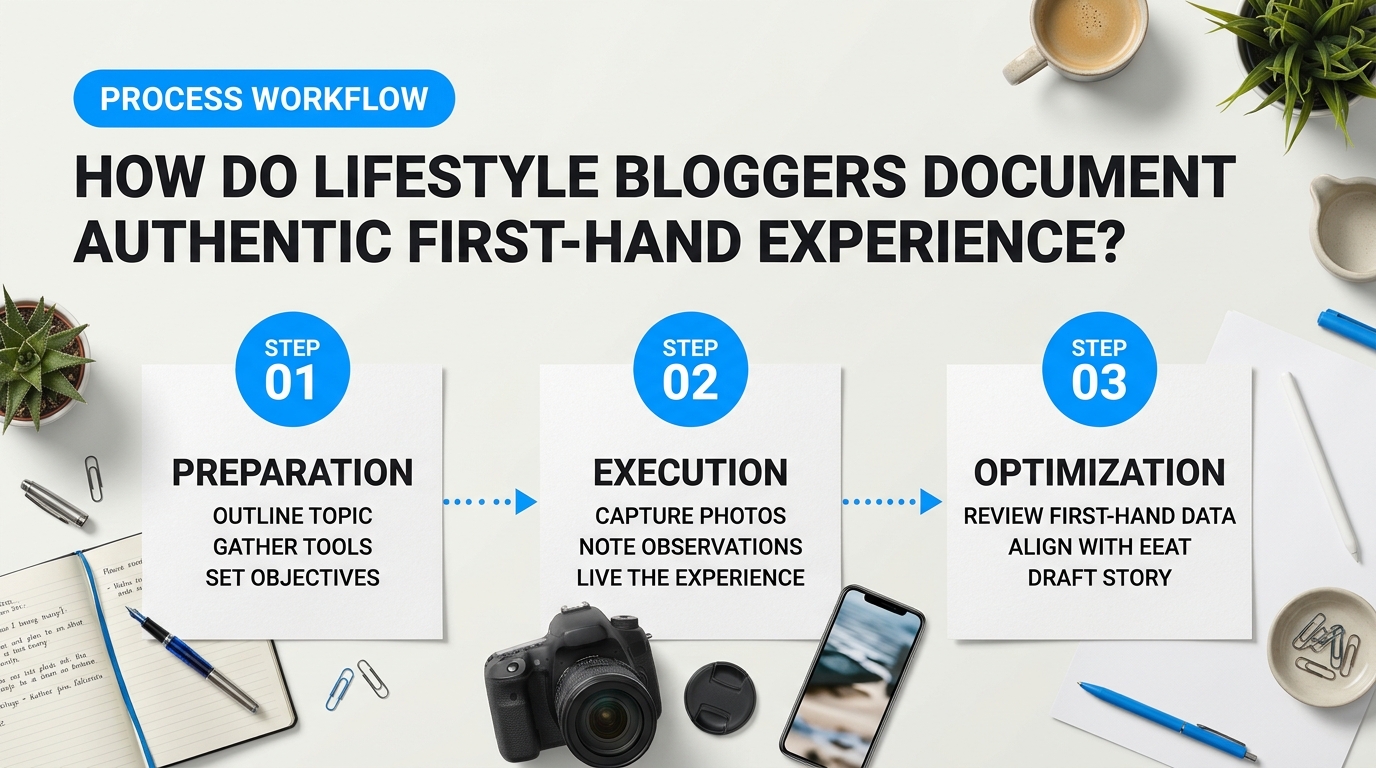
Search engines and human readers share a common superpower: they can spot a phony review in seconds. If your lifestyle blog relies on stock photos, paraphrased product descriptions, and generic praise, your rankings will slip. Building genuine trust requires receipts, messy countertops, and real trial runs.
Real experience is not tidy. It is imperfect. When you test a slow cooker, dinner might burn on the low setting. When you test a linen duvet, it might wrinkle into a ball after twenty minutes in the dryer. Documenting those exact moments turns a forgettable post into a trusted resource.
Capturing Proof: EEAT Content Optimization for Lifestyle Blogs
Stock photography signals that you never actually held the product. To pass modern search quality thresholds, your imagery must show clear personal ownership. Take photos in natural, imperfect environments. Show your living room rug with dog hair on it, or display the skincare serum bottle with a sticky cap.
High-end cameras are unnecessary. An iPhone or Google Pixel produces images with authentic metadata that search engines parse for authenticity. Readers respond strongly to unedited close-ups. Snap pictures of fabric seams, zipper teeth, ingredient labels, and scuffed soles after a rainy walk. These micro-details prove you spent time living with the item rather than pulling talking points from a press release.
“Readers on forums like Reddit often complain that modern lifestyle reviews feel like sponsored ads disguised as editorial advice. Overcoming that skepticism takes unvarnished visual evidence.”
A frequent trap creators face is over-polishing their media. As highlighted in a candid Reddit discussion on documenting experience pitfalls, readers frequently abandon sites when lifestyle imagery looks too sterile or staged. Keep shadows natural. Leave minor smudges on mirror selfies. That raw aesthetic validates your hands-on evaluation far better than an airbrushed studio shot.
Timelines, Purchase Proof, and Testing Logs
How long did you test the product before writing? If you reviewed an anti-aging cream after forty-eight hours, nobody will take you seriously. Authentic reviews require structured testing windows with explicit milestone check-ins.
- The Purchase Snapshot: Include a redacted screenshot of your store receipt, shipping box, or order confirmation email. Block out personal addresses, but leave the order date visible.
- The Unboxing Baseline: Record your immediate impressions on Day 1. Mention setup headaches, confusing instructions, or chemical smells right out of the plastic.
- The Mid-Point Hurdle: Note what changed by Day 14. Did the workout tights start rolling down at the waist? Did the espresso machine develop a leak?
- The Final Verdict: Summarize long-term durability at Day 30, 60, or 90. Long-tail search traffic gravitates toward creators who update old reviews with long-term wear patterns.
Managing multiple reviews across several lifestyle categories gets chaotic without a central tracking system. Many bloggers try to keep these details in their heads, but data gets lost. Tracking your testing variables systematically preserves the nuanced details that make reviews authoritative.
| Documentation Tool | Best Use Case | Key Strength | Drawback |
|---|---|---|---|
| Notion | Personal wear-testing journals & daily diary entries | Flexible layout for embedding quick mobile snaps and raw notes | Can get messy without a disciplined relational database setup |
| Airtable | Structured product benchmarking across multiple brands | Exceptional field sorting for price, date tested, and wear ratings | Steeper learning curve and higher subscription cost for solopreneurs |
Notion works well if you prefer writing casual diary entries while sitting on your couch with a mug of tea. Airtable is superior if you benchmark twenty ceramic pans against identical heat tests. Whichever software you pick, log observations while they happen. Don’t wait until drafting day to recall how a face wash felt two weeks ago.
Highlighting What Went Wrong
Flawless reviews feel fraudulent. Every consumer product has tradeoffs, and finding those tradeoffs is your primary job as a creator. Did a luxury wool sweater shed all over your white shirt? Say so directly. Did a minimalist dining table scratch when your child dropped a plastic fork? Include a close-up photo of the scratch.
Mastering eeat content optimization for lifestyle blogs means embracing these negative observations. Critical remarks provide contrast that makes your positive recommendations believable. When you explain exactly who should avoid an item, your target audience trusts your judgment implicitly when you suggest a better alternative.
Establishing Credibility in Wellness, Decor, and Personal Styling Niches
You don’t need a medical degree to write about bedtime routines. You don’t need an interior design license to teach someone how to choose the right rug size for a small living room. Readers don’t expect you to hold a doctorate. They want honest, field-tested guidance from someone who has already solved the problem they’re facing.
When you build original EEAT content for lifestyle blogs, your personal experience serves as your primary credential. Search engines recognize this concept as everyday expertise. It separates hands-on creators from generic content farms that repackage product descriptions. Proving that expertise requires making your research, testing methods, and industry connections obvious on every page.
Proving Everyday Authority in Visual and Personal Topics
Credibility looks different depending on what you write about. In personal styling, credentials aren’t diplomas; they are your measuring tape, fabric knowledge, and tailoring receipts. Anyone can say a coat fits true to size. A credible stylist explains that the coat features a 100% double-faced wool weave, measures 42 inches across the chest, and pulls slightly across broad shoulders unless you size up.
Home decor follows the same logic. Readers trust recommendations when you show the wear-and-tear of everyday life. Show them how that velvet armchair handled three cats over eighteen months. Give them the Martindale rub count for upholstery fabric so they understand its durability before buying. When you demonstrate that you understand how materials age, you provide value that product spec sheets cannot match.
Wellness demands the tightest boundaries. You cannot diagnose conditions or prescribe cures without medical credentials. You can, however, document personal habits while anchoring claims to credible science. If you write about sleep habits or magnesium supplements, point readers toward clinical trials on PubMed rather than generic wellness roundups. Quoting registered dietitians or physical therapists gives your content an extra layer of professional verification.
| Lifestyle Niche | Low-Trust Approach | Verified Field Proof |
|---|---|---|
| Home Decor | “This sectional couch is super comfortable and stylish.” | Documents foam density ratings (2.0 lb high-resiliency), frame joinery photos, and a six-month stain removal test. |
| Personal Styling | “These denim jeans look great on all body shapes.” | Lists fabric blend percentages, raw inseam measurements, stretch recovery rates, and tailoring notes across three body heights. |
| Wellness Habits | “Drinking celery juice cures morning brain fog instantly.” | Tracks a 30-day hydration log, details personal digestion changes, and links to peer-reviewed hydration studies. |
Practical EEAT Content Optimization for Lifestyle Blogs
Credibility falls apart if your coverage is scattered everywhere. Search engines evaluate your site based on topical focus. If you publish a recipe on Monday, a crypto review on Tuesday, and a nursery remodel on Thursday, your authority dilutes. Algorithms struggle to categorize your site as a trusted entity.
Pick a specific lane and build depth through connected topic clusters. If you write about mid-century interior styling, cover everything from finding authentic thrift pieces to restoring walnut veneer. Link those guides together logically so both readers and crawlers can trace your knowledge base.
Tools can speed up this process, but they can’t replace personal testing. Software like Semrush helps you spot search intent and content gaps across your niche, showing you where competing guides leave questions unanswered. When reviewing technical topics or wellness studies, tools like Consensus search peer-reviewed papers to surface scientific findings quickly.
“Automating your content outlines is fine for speed, but readers spot generic advice instantly when you skip hands-on testing.”
This balance between automated planning and manual verification sparks debate among creators. Creators frequently discuss workflow shortcuts, but relying purely on automated drafts creates blind spots. As experienced writers pointed out in a discussion on lifestyle EEAT compliance pitfalls, skipping manual validation in wellness and decor often leads to factual mistakes that harm your search rankings.
Stay involved in your community to keep your authority fresh. Mention local trade shows you attend, like High Point Market for decor or regional fashion weeks for styling. Interview local makers, upholsterers, or nutritionists in your posts. These ongoing connections prove that you aren’t an anonymous publisher sitting behind a keyboard. You’re an active participant in your field.
Implementing Practical EEAT Content Optimization for Lifestyle Blogs

Many independent publishers wonder whether structured editorial workflows are worth the extra labor. On forums like Reddit, creators frequently debate whether marketing discussions on compliance pitfalls justify abandoning quick, informal drafting routines. The reality is simple: search engines no longer reward casual diary entries disguised as helpful guides. To build original EEAT content that holds top rankings, your lifestyle site needs an airtight, repeatable on-page framework.
Think of this framework as a restaurant health inspection checklist. It guarantees that every dish leaves the kitchen meeting the exact same high standard. You don’t need a sprawling media team to pull this off, either. You just need four foundational systems embedded into your publishing pipeline.
A Modular System for EEAT Content Optimization for Lifestyle Blogs
Every post you publish should pass through four distinct layers before going live. This modular approach protects your site against algorithmic volatility while providing genuine utility to your readers.
1. Category-Specific Dynamic Bios
A single static bio at the bottom of every post hurts your credibility. If you publish a clean-eating recipe, your readers care about your culinary training or nutritional certifications. If your next article reviews nursery furniture, they want to know you’re a parent who actually assembled and tested cribs. Dynamic author boxes solve this problem by swapping the creator’s credentials based on the post category. Tools like Simple Author Box or custom WordPress blocks make this automatic. State your hands-on background in the first two sentences of the bio, and link directly to a comprehensive “About the Author” page.
2. Transparent Sourcing Methodologies
Lifestyle writing often falls into the trap of echoing what other websites say. Break that cycle by citing primary sources. If you discuss the sleep benefits of linen bedsheets, don’t link to another home decor blog. Link straight to textile lab studies or clinical sleep trials. Weave attribution naturally into your prose:
“We washed these sheets five times at 40°C following the manufacturer’s care tag before measuring shrinkage with a standard fabric tape measure.”
That single sentence shows the reader—and search raters—that you did the actual work. It separates genuine field experience from summarized press releases.
3. Structured Fact-Checking Protocols
Before hitting publish, run every post through a verification pass. Check ingredient safety, dimensions, warranty periods, and scientific claims. If you recommend a natural skincare remedy, verify that your ingredient ratios won’t cause chemical burns. Maintain a shared fact-checking sheet in your editorial software to log every checked claim alongside its primary source.
4. Uncompromising Commercial Boundaries
Blurring the line between an honest review and a paid promotion destroys user trust faster than almost anything else. Always use clear, unambiguous labels. Place sponsored disclaimers above the fold, before the first paragraph of body copy. Clearly distinguish between gifted items, affiliate links, and paid brand partnerships.
| Post Element | Outdated Lifestyle Approach | Optimized EEAT Standard |
|---|---|---|
| Author Context | “Coffee lover and mom sharing life’s little moments.” | “Interior stylist with 8 years of residential design experience, testing small-space layouts.” |
| Testing Claims | “This blender feels very sturdy and works great!” | “We timed how long it took to crush 200g of ice cubes: 14 seconds flat on the highest pulse setting.” |
| Sponsorship | Tiny “#ad” hidden beneath five affiliate widgets at the footer. | Clear notice at top: “Brand X sent this jacket for testing; our opinions remain 100% independent.” |
Evaluating Tools: Manual Checklists vs. Dedicated Software
How much does running this system cost? That depends on your setup. Independent bloggers often worry that enterprise-grade optimization software will drain their budget before generating meaningful returns.
Manual workflows built around free Notion templates cost nothing but time. However, human error creeps in when you produce multiple posts each week. Creators often skip sourcing checks or forget to update tags when deadlines loom.
On the software side, platforms like Surfer SEO and MarketMuse give you real-time feedback on topical completeness and semantic depth. Surfer SEO plans typically start around $89 per month, while MarketMuse targets larger teams with premium pricing tiers. These tools analyze the top-ranking pages across the web to show you which entities your draft is missing. They don’t replace your firsthand experience, but they act like a spell-checker for topical authority.
If you run a solo lifestyle blog, start lean. Build a strict four-step manual checklist in your content calendar. Once your monthly revenue supports it, introduce an on-page tool like Surfer to handle entity mapping. Mastering eeat content optimization for lifestyle blogs isn’t about buying expensive software suites; it’s about holding your published work to a standard that readers and search engines can rely on every single week.
Why Lifestyle Creators Must Identify Hidden YMYL Risk Triggers
Most lifestyle creators think Google’s “Your Money or Your Life” (YMYL) rules only apply to doctors and financial planners. That assumption is dangerous. Google treats any web page that could influence someone’s health, happiness, or financial stability as high-risk territory. You might think you’re just blogging about your favorite morning routine. Search crawlers see it differently.
Think of YMYL like a smoke detector in a kitchen. You might just be making toast. If you burn the bread by claiming a herbal tincture “cures chronic fatigue,” the alarm blares. Once the alarm goes off, Google lowers the visibility of your whole site. Rebuilding original EEAT content across your lifestyle blog means learning how to walk right up to these sensitive topics without setting off alarms.
Managing YMYL Boundaries in EEAT Content Optimization for Lifestyle Blogs
How does a simple lifestyle blog cross the line into YMYL? It happens through accidental medical, psychological, and financial claims. The shift is subtle. It usually hinges on whether you write as an observer sharing a personal story or an authority giving direct advice.
| Topic Area | Harmless Lifestyle Frame | Hidden YMYL Risk Trigger |
|---|---|---|
| Morning Wellness | “Here is the green smoothie recipe that helps me feel energized before my 9 AM calls.” | “Drink this celery blend every morning to flush toxins, lower cortisol, and reverse thyroid sluggishness.” |
| Mental Health & Self-Care | “Five mindfulness apps I use when I feel overwhelmed by my weekly inbox.” | “How to overcome panic attacks and treat clinical anxiety naturally without prescription medication.” |
| Household Budgeting | “My weekly grocery haul and how our family saves $50 using local coupon apps.” | “Why you should move your emergency fund into high-yield dividend stocks to beat inflation.” |
When you cross into the right column, your page gets judged against medical literature and certified financial advice. If you lack medical degrees or formal accreditation, your page rank will tank. We see this happen constantly during broad core updates. Creators run into unexpected edge cases where benign personal habits get flagged as unlicensed medical direction, a dilemma frequently echoed in marketing discussions on creator compliance pitfalls.
Real eeat content optimization for lifestyle blogs requires drawing a thick, visible line between personal anecdotes and unqualified professional advice. You don’t need to stop writing about wellness or thrifty shopping. You just need to change how you frame your experience.
Never tell your readers what they should do for their body or bank account. Tell them what you did, explain what your experience felt like, and urge them to speak with certified specialists.
Practical Guardrails to Protect Your Site from Algorithmic Downgrades
Fixing hidden triggers doesn’t mean watering down your personality. It means using smarter editorial routines that signal safety to automated search evaluators. Here’s how to safeguard your content:
- Swap prescriptive terms for descriptive storytelling: Search engines look for instructional words paired with health conditions. Strip out phrases like “you should take,” “this will heal,” or “guaranteed way to invest.” Replace them with “what worked for me,” “in my own experience,” and “my personal routine.”
- Link out to primary scientific consensus: When you mention a supplement, herb, or financial concept, never cite another lifestyle blog. Link directly to peer-reviewed studies on PubMed, official guidance from the CDC, or disclosures from government agencies. Show algorithms that your opinions are anchored in vetted facts.
- Run topical audits with specialized software: Modern content tools help spot when your writing veers into high-risk medical or financial entity clusters. Running your drafts through platforms like Surfer SEO or Clearscope lets you see which secondary entities Google expects to see in top-ranking pages. Clearscope is particularly helpful for spotting if your article inadvertently borrows technical medical jargon that confuses search bots into thinking you’re publishing a diagnostic manual.
- Build a visible medical or editorial review loop: If you regularly cover natural health or mental wellbeing, consider bringing on a registered dietitian (RD) or certified mental health counselor to review your cornerstone pieces. Display a “Medically Reviewed By” badge beneath your byline with a link to their active credentials. That single trust signal changes your entire risk profile.
Algorithms reward honesty. They punish unearned certainty. When you write about everyday lifestyle topics, your greatest asset is your own life. Lean hard into your perspective. Leave the clinical diagnoses and financial forecasting to licensed professionals, and your organic search traffic will stay protected.
Constructing Non-Negotiable Trust Signals Across Your Editorial Workflow
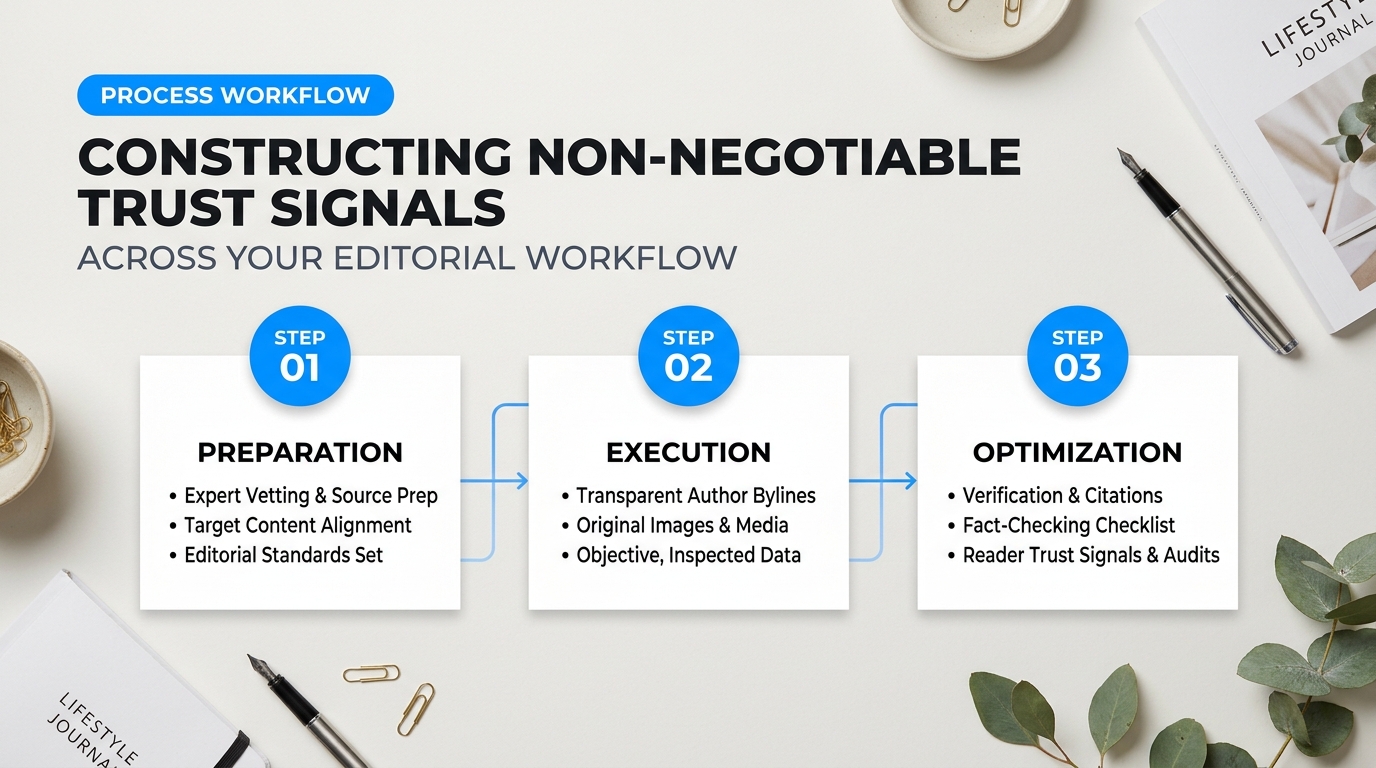
Trust isn’t an abstract feeling in search evaluation. It’s a collection of concrete, visible features on your website. Readers visit lifestyle blogs for quick inspiration, whether finding a weeknight pasta recipe or choosing non-toxic crib mattresses. Search raters and algorithms, however, look behind the curtain. They want to know who runs the site, how products get selected, and what happens when an author makes a mistake.
Executing thorough eeat content optimization for lifestyle blogs means treating operational disclosures as foundational site architecture rather than legal chores. If you bury your contact info or disguise paid brand deals, your rankings will slip. Building transparent editorial safeguards protects your traffic against future algorithm updates.
Applying EEAT Content Optimization for Lifestyle Blogs to Daily Publishing
Most independent creators treat disclosures as a single checkbox during theme setup. They paste a generic snippet into the footer and never look back. That approach doesn’t cut it anymore. Search engines look for unmistakable proof that your business acts in good faith toward every reader.
Every lifestyle publication needs four permanent trust anchors:
- Unambiguous Affiliate Disclosures: Place your statement above the fold, before the first affiliate link appears. Use plain words. Instead of “We may earn a commission,” say: “We independently test every rug we recommend. If you buy through our links, we earn a commission at no extra cost to you.”
- Multi-Channel Contact Access: Kill anonymous web forms. List direct email addresses for editorial inquiries, press outreach, and corrections. Include a real physical mailing address or registered business agent location in your footer.
- Public Editorial Independence Standards: Explain how your team chooses products. Do you accept free review units? Do sponsors get guaranteed positive coverage? Spell these rules out on a dedicated policy page.
- Visible Correction Notices: When an author misstates a fabric blend or a brand updates an ingredient list, fix it publicly. Don’t quietly edit the copy and pretend the error never happened.
“Readers don’t expect perfection from lifestyle creators. They expect honesty. When you hide a sponsorship or stealth-edit an outdated recipe measurement, you break that contract.”
Evaluating Compliance Tools Against Manual Workflows
Small teams often wonder whether automated compliance software beats handling disclosures manually. As creators noted in Reddit's marketing community discussions on compliance pitfalls, running blanket automated scripts often leads to strange rendering bugs or generic statements that fail manual quality checks.
| Workflow Factor | Manual Editorial Checks | Affilimate (Specialized Affiliate Tracking) | Termageddon (Dynamic Policy Generator) |
|---|---|---|---|
| Setup Time | Zero software setup; high ongoing writing time. | 2 to 4 hours for script setup and link mapping. | Under 30 minutes to generate compliant policy pages. |
| Ongoing Cost | Free, but consumes creator hours every week. | Starts around $29/month based on site traffic. | Flat $12/month or $99/year per license. |
| Contextual Accuracy | Very high. Disclosures match the post voice. | High. Flags broken affiliate attribution and link status. | Moderate. Keeps privacy policies updated when laws shift. |
| Best Fit For | Solo lifestyle bloggers writing 1–2 posts weekly. | Mid-to-large lifestyle sites running hundreds of product links. | Publishers needing automated legal compliance across US and EU laws. |
For solo creators, manually adding customized disclosures to each post works well. You keep full control over your brand voice. Once your site grows beyond 200 articles, tracking affiliate links manually becomes a mess. A dedicated dashboard like Affilimate tracks link performance and flags missing merchant disclosures across your catalog. Pairing that tool with Termageddon takes the headache out of changing privacy regulations.
Building an Honest Correction Architecture
Mistakes happen. A boutique skincare company changes a lotion’s preservative formula, or an interior design tutorial lists an incorrect drill bit size. How you handle these errors proves your site’s integrity to search engines and human raters alike.
A functional correction log doesn’t need complex coding. It just needs consistency. Place a small update box directly beneath the post title or at the bottom of the article. Record the exact date, the detail altered, and why the change occurred.
Here is what an effective update note looks like in practice:
Update (October 14, 2025): This guide previously stated that the Everlane Day Glove runs true to size. After six months of long-term wear across our editorial team, the leather stretched substantially. We now recommend sizing down a half size for narrow feet.
That level of detail shows real-world experience. It turns an honest mistake into proof of ongoing editorial care. When automated systems scan your page, those timestamped notes show active maintenance rather than neglected, decaying content.
Common Questions About Editorial Trust Signals
Is formalizing editorial guidelines worth the effort for a solo lifestyle blogger?
Yes. Search raters evaluate independent sites using the same core standards they apply to major digital magazines. Documenting your testing methods signals that you take reader safety seriously.
How much does implementing a full trust framework cost?
It can cost nothing. Writing your own editorial charter, setting up a public correction protocol, and listing real contact addresses costs zero dollars. If you decide to pay for automated policy updates and link tracking tools, expect to spend $15 to $40 per month.
Does a standard sidebar affiliate disclaimer fulfill search engine guidelines?
No. Sidebars disappear on mobile devices or drop below the article body. The Federal Trade Commission and search engine quality guidelines require disclosures to be placed where readers will see them before they click any monetized link.
Using Schema Markup and Entity Mapping to Validate Creator Identity
Search engines don’t read your lifestyle blog the way humans do. They don’t immediately appreciate your aesthetic photo styling or your warm writing voice. Instead, crawlers see raw text, code strings, and unverified claims. When you write about morning wellness routines on Monday and DIY kitchen tiling on Thursday, algorithms can easily become confused. Are you an interior designer? Are you a licensed esthetician? Or are you simply pulling together unvetted advice from secondary sources? Structured data cuts through this confusion. Think of schema markup as a digital passport stamped with your credentials. It shows machines exactly who created the content and links your site directly to authoritative databases across the web.
Mastering technical schema markup is a foundational step in eeat content optimization for lifestyle blogs because it translates your lived experiences into machine-readable facts. Without it, generative search systems have to guess who you are. Usually, they guess wrong.
Structuring Technical Data for EEAT Content Optimization in Lifestyle Niches
To establish unmistakable creator identity, you need four specific schema types working together across your lifestyle site:
- Person Schema: This lives on your author profile and links your name to external proof of your existence, such as your social accounts, professional licenses, and author pages on other publications.
- Author Property (within Article Schema): This nests inside your individual lifestyle posts, explicitly connecting the article back to your global
Personentity rather than a generic site admin handle. - ItemReviewed Schema: When you test beauty serums, walking shoes, or linen sheets, this markup identifies the exact product, brand, and your specific rating. It differentiates hands-on product reviews from general shopping roundups.
- HowTo Schema: Perfect for craft guides, home staging steps, and styling tutorials. It outlines materials, tools, steps, and original instructional images so search engines can feature your step-by-step methods directly in rich results.
The secret weapon here is the sameAs array inside the Person schema. It tells crawlers: “This creator named Jane Doe on this domain is the exact same Jane Doe found on Wikidata, LinkedIn, and Muck Rack.”
{
  "@context": "https://schema.org",
  "@type": "Person",
  "@id": "https://yourlifestyledomain.com/#author-jane-doe",
  "name": "Jane Doe",
  "jobTitle": "Interior Decorator & Living Editor",
  "url": "https://yourlifestyledomain.com/about/",
  "sameAs": [
    "https://www.linkedin.com/in/janedoe-decor",
    "https://www.wikidata.org/wiki/Q12345678",
    "https://muckrack.com/jane-doe",
    "https://www.instagram.com/janedoeliving"
  ],
  "knowsAbout": [
    "Interior Design",
    "Sustainable Home Goods",
    "Furniture Restoration"
  ]
}
Notice the knowsAbout attribute. Using this property links your profile directly to recognized topical entities. This helps search crawlers identify your specific areas of expertise.
Addressing Setup Friction and Edge Cases
Many creators ask if configuring schema manually is worth the time, especially when popular CMS platforms offer basic SEO plugins. Discussions in creator circles often center on whether paid automation software is necessary or if free plugins handle the job. A frequent warning highlighted in Reddit marketing discussions on schema deployment pitfalls centers on “schema drift.” Drift occurs when your WordPress theme automatically generates an author markup that contradicts your custom JSON-LD script. When search engines read two conflicting author profiles on the same page, trust drops.
“Our team spent weeks wondering why our lifestyle review snippets weren’t appearing. It turned out our theme outputted an empty author URL while our custom header code outputted our verified entity profile. Search bots flagged the schema as invalid because of the conflicting signals.”
Avoid stacking multiple SEO tools that generate structured data independently. Pick one single source of truth for your technical schema to ensure validation stays clean in Google’s Rich Results Test.
Evaluating Schema and Entity Mapping Tools
You don’t need a massive enterprise budget to establish entity validation, but you do need tools that support custom nesting. Here is how two widely used approaches compare for independent lifestyle sites:
| Tool Solution | Primary Strength | Learning Curve | Typical Cost |
|---|---|---|---|
| Rank Math Pro | Native WordPress integration with simple point-and-click setup for Person, ItemReviewed, and HowTo schemas. | Low; designed for non-technical bloggers. | ~$69 to $199 per year. |
| InLinks | Semantic entity analysis that identifies missing topical concepts and auto-builds internal entity-level schema graphs. | Moderate; requires basic understanding of knowledge graphs. | Starts around $49 per month. |
| Schema App | Enterprise-level custom mapping engine capable of handling dynamic edge cases and complex multi-author setups. | High; built for technical teams and agencies. | Starts around $30 to $100+ per month. |
How do you choose between them? If you run a standard solo blog covering decor, travel, or fashion, Rank Math Pro provides the most straightforward path to valid creator attributes without slowing down page rendering. If your site functions as a multi-topic digital magazine with multiple regular contributors, a semantic tool like InLinks or Schema App helps bridge author names to external knowledge bases far more effectively.
Validating who you are is not a one-time chore. When applying eeat content optimization for lifestyle blogs, review your author schema twice a year. Update external publication links, remove broken social handles, and ensure your sameAs footprint continues to tell a cohesive story about your real-world experience.
Sustaining Long-Term Search Visibility Through Genuine Creator Value
Search algorithms shift without warning. When a core update lands, creators often panic and strip away the very personality that built their readership. That is a mistake. Search engines do not want lifestyle writers to sound like cold reference manuals. They simply want proof that an actual person tried the linen duvet, cooked the sourdough, or styled the thrifted credenza before typing out a review. Many publishers in marketing discussions on creator optimization pitfalls express valid burnout, asking if meticulous compliance ruins the artistic joy of running an independent site. It doesn’t have to.
Future-Proofing EEAT Content Optimization for Lifestyle Blogs
Balancing your artistic voice with technical hygiene requires a realistic workflow. Content scoring platforms like Surfer and the Semrush Writing Assistant help identify missing topical entities, but they cannot manufacture genuine authority. Relying entirely on software scores tends to homogenize creative prose, stripping out your distinctive perspective. True authority feels human. Mastering eeat content optimization for lifestyle blogs means using automated tools only to verify technical readability and schema structure, leaving the narrative voice untouched.
Genuine first-hand experience is the only moat that automated search systems cannot easily replicate or devalue.
Taking original photos, disclosing affiliate relationships, and citing vetted studies takes real effort. We’ve seen countless site owners ask whether this manual labor justifies the time investment when competitors publish dozens of shallow roundups every week. The math changes after a broad quality update. Thin aggregators slide down the rankings, while sites backed by verifiable authorship and transparent methods hold their ground. When you approach eeat content optimization for lifestyle blogs as a sustainable commitment to clear sourcing and firsthand honesty, search updates stop feeling like a threat and start acting as a catalyst for your growth.
