Why Daily Motivation Fails Without Habit Systems
Why Daily Motivation Fails Without Habit Systems – daily motivation vs habit systems
We’ve all experienced that sudden midnight urge to overhaul our entire lives. You plan an ambitious workout routine, organize your task list, and promise tomorrow will be different. Then your alarm rings, and that fiery spark vanishes into thin air. Understanding daily motivation vs habit systems is the key to breaking this exhausting cycle of initial hype followed by total burnout. Daily motivation fails without habit systems because emotional inspiration is a fleeting feeling rather than a predictable execution tool.
Table of Contents
- 1. Why Willpower Fails: Rethinking the Push for Daily Spark
- 2. Why Relying on Daily Motivation vs Habit Systems Backfires
- 3. What Neuroscience Reveals About Human Consistency
- 4. How to Build Frictionless Habit Systems That Run on Autopilot
- 5. When Does Motivation Matter? Using Emotional Sparks Strategically
- 6. Shifting From Emotional Drivers to Sustainable Architecture
Relying on mental grit feels heroic. It rarely works long-term. Willpower acts like a battery that drains rapidly as decision fatigue sets in throughout your workday. When you force execution through raw effort, every action requires heavy internal negotiation. Many entrepreneurs share their frustration over this endless tax in workflow discussions on Reddit, observing how manual self-pushing leads directly to inconsistent quality. Instead of forcing daily sparks, high achievers build environment design tools using apps like Habitify or structured templates in Notion to make healthy choices automatic.
Durable behavioral structures shift your progress away from how you feel on any given morning. Emotional drive gives you the starting energy to launch a new goal. Systems create the predictable track your daily actions run on without friction. When you remove reliance on random sparks, consistency becomes your default operating state. Let’s look at why willpower breaks under pressure and how you can replace fleeting urges with systems built to last.
Why Relying on Daily Motivation vs Habit Systems Backfires
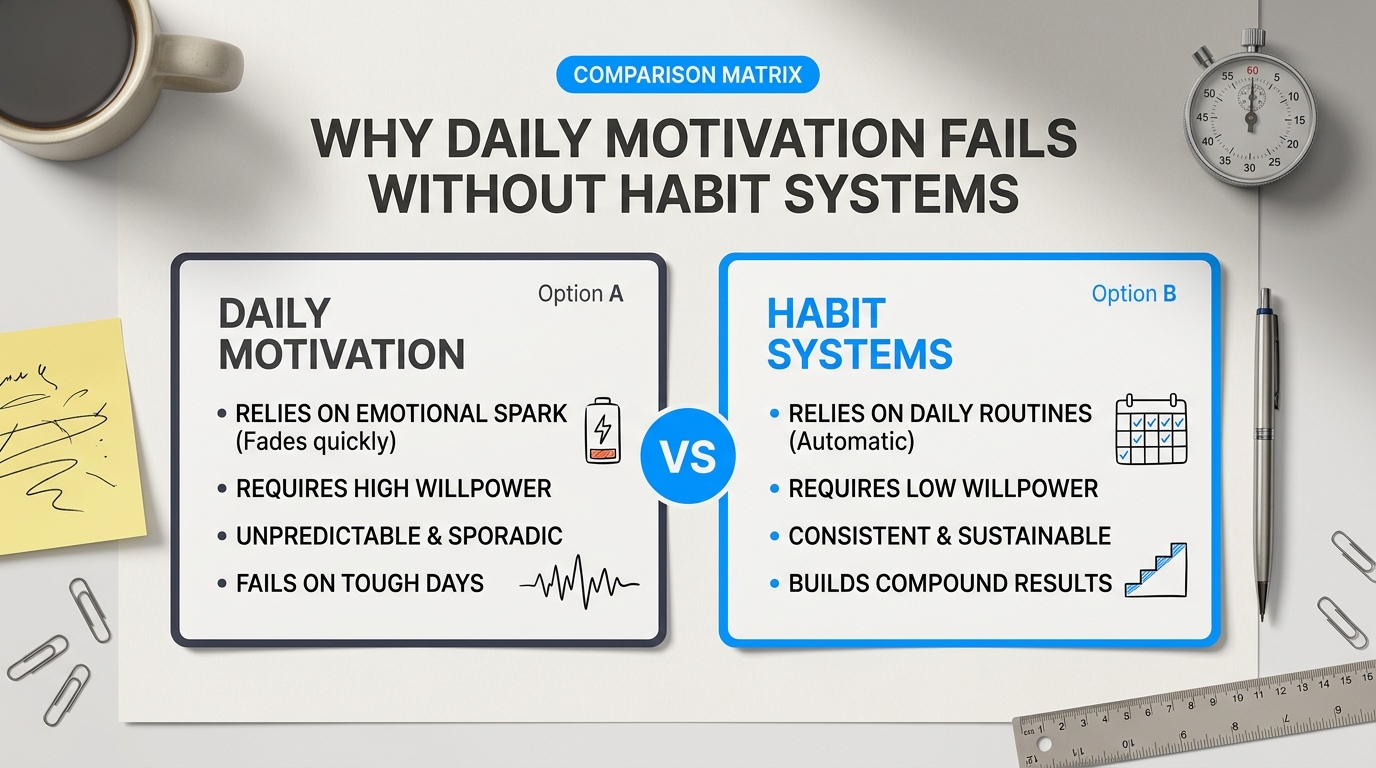
The Hidden Energy Drain of Daily Motivation vs Habit Systems
Most high-performance advice sells a massive lie. It teaches you that high energy and intense desire must happen before you start working. You’ve probably felt this trap yourself. You wake up, check your morning mood, and wait for a spark of inspiration to strike before touching a major project. Motivation is a finicky friend. It betrays you often.
When you depend on feeling inspired before tackling difficult tasks, you hand over your calendar to unpredictable brain chemicals and daily emotional swings. Expecting fresh enthusiasm every morning creates massive cognitive load. Your brain spends precious energy negotiating whether to start. That mental battle happens before you type a single line of code or write one email.
Think of your mental bandwidth like a smartphone battery. Every time you ask yourself, “Do I feel like doing this right now?” you launch a heavy background app. By midday, your battery runs flat. That’s decision fatigue in action. When forced to choose between uncomfortable work and easy distractions without a set structure, a tired brain picks ease every single time.
“Relying on raw drive worked fine when I had zero responsibilities. Once our team scaled, my mood swings ruined our product release timeline.”
We see this breakdown constantly in online communities. Founders often report that relying on emotional energy leads to erratic output and severe burnout. According to user feedback on motivation traps, relying on manual drive leaves projects stranded halfway when the initial high wears off.

Why Emotional Driving Forces Collapse Under Stress
Understanding the difference between daily motivation vs habit systems comes down to operational friction. Motivation requires conscious effort and active decision-making. Habit systems rely on environmental cues and pre-set routines that run with minimal thought.
Q: Why does waiting for inspiration cause operational burnout?
A: Emotion is volatile. External events like bad weather, poor sleep, or an angry client mess with your mood. If your workflow relies on feeling good, your consistency plunges whenever life gets messy.
Q: How do habit systems protect long-term output?
A: Systems lock in the starting action beforehand. They remove choice from the moment. You don’t decide *if* you’ll work; you simply follow the established step.
To fix this, smart teams replace personal grit with workflow infrastructure. Instead of willing yourself to organize tasks each morning, software tools enforce order automatically. Digital task management platforms lower the activation energy required to start.
| Workflow Factor | Motivation-Driven Action | Habit-Based Infrastructure |
|---|---|---|
| Required Mindset | High enthusiasm and mental focus | Neutral state; works on bad days |
| Cognitive Overhead | Severe decision fatigue by noon | Low strain; automated defaults |
| Tool Architecture | Manual daily to-do lists | Automated queues like Todoist recurring task workflows |
| Planning Strategy | Ad-hoc scheduling based on mood | Time-blocked structures using Sunsama guided daily planning |
| Long-term Output | Spiky, unpredictable bursts | Steady, compound output over time |
Habit software like Todoist removes the burden of remembering what comes next by serving recurring tasks on auto-pilot. Dedicated daily planners like Sunsama force you to bound your work within actual hours, preventing over-commitment when your energy is deceptively high. These systems act as external brains. They hold your routines steady even when your personal drive bottoms out.
Relying on daily sparks backfires because inspiration is a terrible engine for long distances. It burns hot and fast, leaving you stranded when the fuel runs dry. Building a rigid, automated system ensures your most important work happens regardless of how you feel when your alarm goes off.
What Neuroscience Reveals About Human Consistency
The Brain’s Two Engines: Prefrontal Cortex vs. Basal Ganglia
Your brain runs on a strict fuel budget. It consumes roughly twenty percent of your body’s energy while making up just two percent of your body weight. When you try to force consistency through willpower alone, you spark a quiet war between two distinct regions of your mind.
The prefrontal cortex sits right behind your forehead. It acts as your brain’s chief executive officer. This control center handles conscious choices, complex planning, and sudden bursts of drive. When you start a fresh project or force yourself to hit the gym early, this area works overtime. But high performance comes at a steep cost. It burns through glucose rapidly. Running your entire day on conscious choice is like keeping your phone screen on full brightness while streaming high-definition video. Your battery dies fast.
Deep inside your brain lies the basal ganglia. Think of this structure as your mind’s automated pattern processor. As a behavior repeats over time, your brain hands off control from the energy-hungry executive center down to the basal ganglia. This transfer creates smooth mental routines. Brushing your teeth, tying your shoes, or navigating your daily commute happens right here. Your brain consumes almost no extra fuel while running these automated scripts.
Daily Motivation vs Habit Systems: Conserving Mental Capital
The real trade-off between daily motivation vs habit systems comes down to basic mental fuel economy. Motivation demands heavy brainpower every single morning. You wake up, check your mood, negotiate with yourself, and attempt to assemble an emotional spark. That constant internal debate drains your mental energy long before you tackle your most critical work.
“When your workflow depends on how you feel each morning, you force your brain’s control tower to re-evaluate decisions you already settled yesterday.”
Habit systems bypass that expensive daily negotiation. Clear environmental cues and predictable routines shift work away from your executive center directly into your automated pattern processor. You stop asking whether you feel inspired. You simply run the script. This structural shift saves your mental capital for complex decisions later in the day.
Many business owners ask whether spending time building systems pays off compared to just pushing harder. As users noted in Reddit SaaS discussions on workflow consistency, relying on personal drive usually fails during high-stress weeks, while built-in routines keep output steady without added stress.
Neurological Energy Usage Breakdown
Here is how these two brain networks compare when you try to get work done.
| Brain Function | Prefrontal Cortex (Motivation) | Basal Ganglia (Habit Systems) |
|---|---|---|
| Main Task | Conscious planning and forced focus | Automatic pattern execution |
| Fuel Consumption | Heavy glucose burn | Ultra-low energy spend |
| Trigger Source | Internal drive or emotional energy | External cues and environment |
| Performance Under Stress | Shuts down when tired | Stays reliable even under strain |
Extending Your Brain’s Habit Network with Software
You don’t need to rely only on internal mental shifts to stay consistent. Modern software tools can act as an external basal ganglia, taking the burden of planning off your brain entirely. The right tools eliminate the friction of figuring out what to do next.
Consider how two top tools handle this mental handoff:
- Motion: Motion uses intelligent algorithms to automatically build your daily schedule around your top priorities. It takes projects out of your head and slots them directly onto your calendar. This automation protects your executive center from decision fatigue because your day is already planned out.
- Todoist: Todoist excels at setting up recurring work queues and simple habit loops. It relies on clean visual lists that prompt you at set times. By configuring automatic recurring tasks, you set up clear visual cues that trigger rapid action without hesitation.
Deciding between these platforms depends on your daily schedule. If your calendar changes constantly due to meetings, Motion offers automatic rescheduling that saves your executive brain energy. If you prefer clear daily checklists to build personal discipline, Todoist gives you an easy, affordable framework. You can read more real benchmark feedback in Reddit ecommerce insights on consistency software alternatives.
Combining external digital tools with automatic habit loops forms an unshakeable base. You stop wasting mental fuel on deciding when or how to start. Your brain simply follows the pattern, keeping your performance steady regardless of how inspired you feel.
How to Build Frictionless Habit Systems That Run on Autopilot
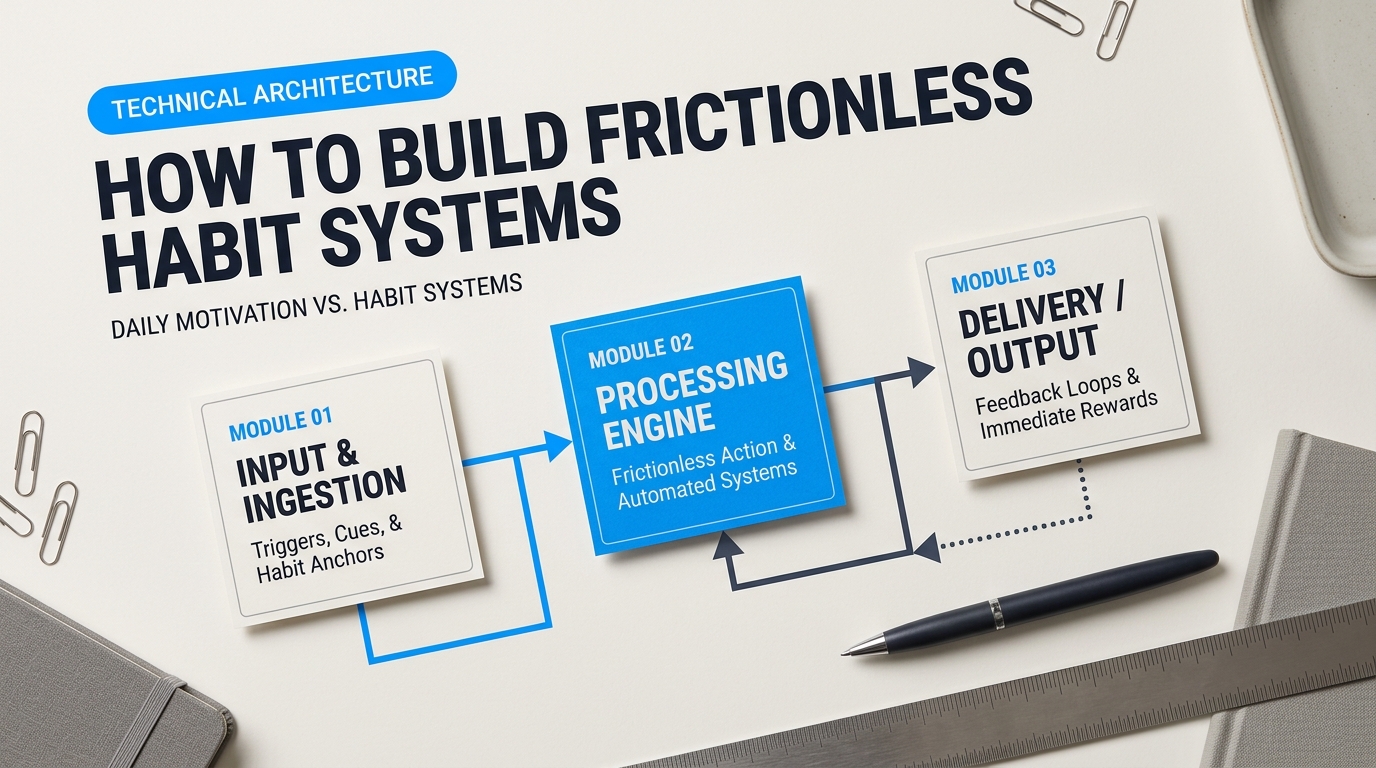
Relying on a morning spark of energy sounds great in theory. In reality, feelings shift constantly. When we look at daily motivation vs habit systems, the fundamental difference lies in architecture. Motivation asks, “Do I feel like doing this right now?” Systems remove the question entirely. If you want consistent output, you must design a routine that executes even on your worst days.
Building an automated routine isn’t about sheer discipline. It’s about clever behavioral design that systematically lowers resistance so progress happens on schedule.
Designing Workflows: Daily Motivation vs Habit Systems
Behavioral psychologists show that habits form through repeating loops: cue, craving, response, and reward. When you design your workspace, you control the cue. If you want to write every morning, don’t leave your desk cluttered. Place your notebook open to the exact page you need before you go to sleep. Your environment triggers the action automatically.
Digital environments work the same way. Set your browser to launch your main project management dashboard immediately upon opening. Keep distraction apps hidden three folders deep. By controlling what you see first, you trigger positive actions without burning brainpower.
The Four-Stage System Framework
To turn inconsistent efforts into repeatable results, follow this simple framework:
- 1. Anchor with Habit Stacking: Attach a new task to an established daily event. Instead of saying “I will review analytics,” say “After I pour my morning coffee, I will review analytics.” The coffee is your anchor.
- 2. Define Implementation Intentions: Use rigid “If-Then” logic to eliminate decision fatigue. Decide exact triggers ahead of time: “If it is 9:00 AM on Monday, then I open my project calendar.”
- 3. Lower Activation Energy: Make the starting friction absurdly low. If a task feels daunting, scale it down to two minutes. Write one sentence. Process one email. Open one file. Starting generates momentum.
- 4. Automate Tracking Mechanics: Stop tracking progress manually on scraps of paper. Use software that reminds you automatically, keeping your brain focused on execution.
“Looking for genuine user experiences with automated habit systems… How does the quality and output hold up compared to manual workflows?”
— User discussion on Reddit SaaS productivity discussions
Many business owners ask if building structured tracking systems is actually worth the investment. As creators point out on community forums, spending weeks building overly detailed setups can become its own form of procrastination. The key is starting small with lightweight software tools rather than over-engineering custom databases from scratch.
Evaluating Software Tools for Operational Routines
Choosing the right tool depends on whether you prefer open flexibility or fast pre-built structure. Here is how two popular software options compare when setting up your daily workflow:
| Feature / Requirement | Notion (Custom Workspace) | Todoist (Recurring Action Triggers) |
|---|---|---|
| Setup Time & Learning Curve | Moderate. Requires building custom database layouts. | Low. Built-in recurring task logic ready out of the box. |
| Activation Friction | Can feel high if dashboard has too many visible widgets. | Very low. Simple view showing only today’s tasks. |
| Best Use Case | Centralizing company wikis alongside habit dashboards. | Fast execution of “If-Then” habit prompts. |
| Typical Cost | Free tier available; Plus plan starts around $8–$10/user/month. | Free tier available; Pro plan starts around $4–$5/user/month. |
If you prefer a visual workspace tailored to your business, adopting Notion workflow dashboards helps combine habit rules, docs, and project boards in one central hub. However, if technical setup stops you in your tracks, an app like Todoist offers instant setup with zero learning curve.

What happens when unexpected disruptions hit your schedule? You get sick, client emergencies happen, or travel disrupts your morning. A resilient system anticipates these moments by building in a minimum baseline rule. On high-stress days, your system rule drops from writing 500 words to writing 5 words. You keep the momentum active without draining your battery. This simple buffer ensures progress continues even when daily motivation fails to strike.
When Does Motivation Matter? Using Emotional Sparks Strategically
Stop trying to burn emotional energy every single morning. Feeling inspired is great, but it makes a terrible engine. Think of motivation like lighter fluid. It creates a quick, bright flash. Without solid wooden logs beneath it, the fire dies out in seconds. Habit systems are those heavy logs. When we evaluate daily motivation vs habit systems, the biggest mistake people make is expecting the flash to keep the room warm all night long.
You don’t need emotional hype to brush your teeth. You shouldn’t need it to open your workspace, organize your priorities, or start your core tasks either. Motivation isn’t meant to fuel your daily work. It exists to serve three distinct moments: starting a new track, checking your roadmap, and upgrading your daily setup during high-energy windows.
When to Harness Sparks in Daily Motivation vs Habit Systems
Sparks of excitement are valuable when used at the right time. Instead of wasting that energy on simple execution, channel emotional surges into building better infrastructure.
“Inspiration is for setting up the track. Systems are for running the train every day without thinking about it.”
Here is how to deploy emotional energy strategically across your workflow:
- System Initiation: When a sudden wave of inspiration hits, don’t just work faster for two hours. Use that energy to eliminate future friction. Set up automated templates, clear your desk, or block out out your calendar for the next month.
- Goal Recalibration: Emotional sparks help you step back and evaluate the bigger picture. Use high-motivation days to review quarterly targets, drop dead projects, and shift your direction.
- Routine Optimization: Energy fluctuates naturally. When you feel a surge of focus, audit your current habits. Redesign your daily triggers so tasks require less brainpower when your energy drops.
Many team leaders burn out because they try to manually generate enthusiasm every morning. In online discussions regarding community feedback on productivity systems, creators frequently point out that relying on raw hustle creates severe performance bottlenecks. When energy drops, output collapses.
Matching Emotional Energy to System Design
Strategic productivity means matching your internal state to the right type of task. The table below shows how to spend emotional sparks compared to relying on automated system architecture.
| Operational Phase | Emotional Sparks (Motivation) | System Architecture (Habits) |
|---|---|---|
| Workflow Setup | Builds new templates and organizes toolstacks. | Runs existing routines automatically. |
| Daily Execution | Fails when energy is low or stress is high. | Delivers consistent baseline output every day. |
| Problem Solving | Provides creative leaps for complex strategy. | Handles routine maintenance without fatigue. |
Turning Inspiration Into Sustainable Software Workflows
How do you convert a sudden burst of motivation into a lasting habit system? You lock it into your digital environment right away.
If you feel inspired on a Sunday afternoon, don’t just grind out extra work. Open a flexible workspace like Notion and map out a clean dashboard template for your team. Notion lets you turn creative sparks into repeatable databases, standard operating procedures, and automated task views. You build the structure once while energy is high. On Monday morning, your team simply follows the system without needing a speech to get started.
To keep daily habits running on low-energy days, pair your structural layout with a lightweight tracker like Habitify. Habitify strips away complex decision-making by showing micro-habits on your phone or desktop. A simple tap registers progress. It keeps your streak alive through clear visual feedback, ensuring you take action even when emotional motivation hits zero.
Shifting From Emotional Drivers to Sustainable Architecture
Relying on daily emotional sparks creates a dangerous rollercoaster. You feel energized on Monday, but by Thursday afternoon, your energy vanishes and your momentum stalls. Swapping emotional drivers for sustainable architecture means you stop asking yourself how you feel before you start working. When evaluating daily motivation vs habit systems, structured environments win every single time. Systems don’t get tired. They carry your goals forward regardless of your mood or energy levels.
To rebuild your daily workflow, start by auditing your current routine for hidden friction. Track where your day breaks down and identify tasks that demand heavy willpower. You can streamline this process by using lightweight task managers like Todoist to automate recurring triggers, or by organizing visual dashboards in Notion to track your progress effortlessly. Many founders sharing community feedback on workflow automation setup report that clear digital routines cut down mental fatigue and dramatically lower onboarding setup time without high cost barriers.
Structure isn’t about restricting your freedom. It’s about preserving your brainpower for the choices that truly count.
Building reliable infrastructure doesn’t require a total life overhaul overnight. Start small by anchoring one micro-habit to an existing trigger you already do automatically every day. As you replace emotional guesswork with mechanical routines, consistent execution becomes your default state. Comparing daily motivation vs habit systems makes the ultimate reality plain: motivation gives you an initial push, but sustainable systems guarantee you cross the finish line. Take ten minutes today to clear out friction from your workspace, lock in your primary trigger, and let your structure handle the push.