How to Build Blog Authority with Low Domain Rating
How to Build Blog Authority with Low Domain Rating – how to build blog authority with low dr
Starting a new website feels like playing a rigged game. You spend weeks writing a detailed guide, only to get buried on page five while an established brand ranks with a 200-word answer. If you want to master how to build blog authority with low dr, you have to stop playing by their rules. Google does not use third-party domain scores to rank your content. It looks for topical depth, clear intent, and immediate utility.
Many new creators believe high Domain Rating (DR) is mandatory for organic growth. Third-party tools like Ahrefs link metrics tracker evaluate backlink profiles, but they don’t control search engine results pages. You can outrank mega-sites by targeting precise customer questions with zero fluff. When learning how to build blog authority with low dr, your strongest asset is hyper-focused relevance.
Table of Contents
- Rethinking Domain Rating: Why New Blogs Can Still Outrank Industry Giants
- Why Search Engines Value Niche Depth Over Raw Domain Authority
- How to Build Blog Authority with Low DR Using Semantic Topic Clusters
- How Do You Identify Low-Competition Keywords That High-DR Sites Ignore?
- Demonstrating First-Hand E-E-A-T Without an Established Brand Presence
- Strategic Internal Linking: Maximizing Equity Flow Across Your Site
- How Can Low-DR Sites Earn High-Quality Backlinks Naturally?
- Building a Sustainable SEO Strategy Beyond Third-Party Metrics
Site builders frequently vent about high-DR monopolies on web forums. In recent SEO growth discussions on Reddit, founders noted that thin content from big brands leaves massive gaps. Small teams win by filling those gaps with real-world expertise and better formatting. Tools like Semrush domain intelligence tools help uncover these openings without requiring thousands of dollars in backlink budgets.
This guide breaks down how search engines measure expertise today. You’ll learn how to structure content clusters, leverage first-hand experience, and build genuine topical authority from scratch—even with a brand-new domain.
Why Search Engines Value Niche Depth Over Raw Domain Authority
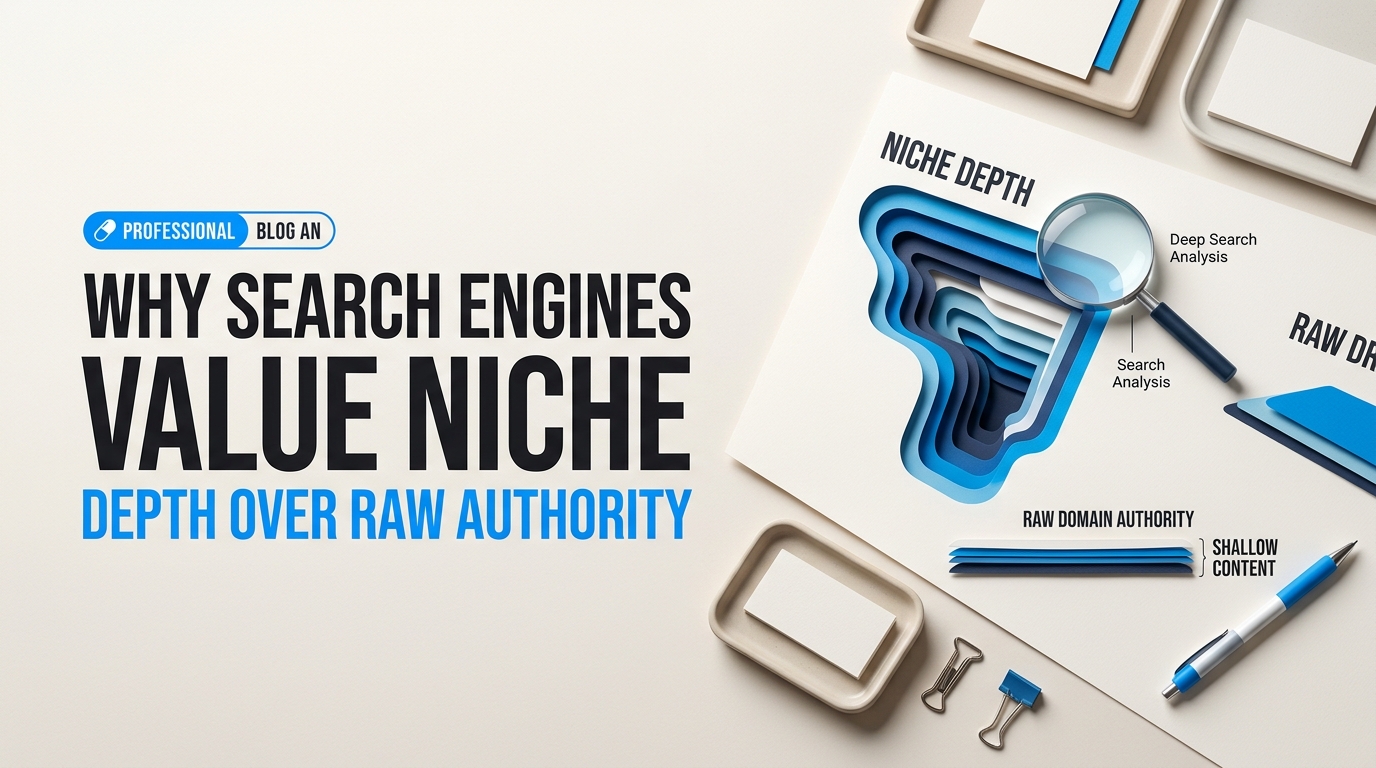
Big websites with high Domain Rating (DR) look scary. They seem to take over every search result page overnight. But search engines don’t just count backlinks anymore. Modern algorithms look for site-wide context. They want to know if your website is a true expert on a single topic. If you own a small blog, this change levels the playing field. Understanding semantic search is the secret behind how to build blog authority with low dr without spending thousands on expensive link building campaigns.
Think of Domain Rating like a megaphone’s volume. A giant news site has a massive megaphone, but it shouts about everything from local sports to stock market tips. Your specialized blog is like a dedicated expert speaking directly to a quiet room. When a user searches for a specific problem, search engines prefer the expert. Google’s algorithms analyze entity relationships across your whole domain. They look at whether your website covers all the subtopics around a core theme. If your site answers every follow-up question a reader might have, search engines treat your domain as a primary source for that specific subject.
Understanding Semantic Search: How to Build Blog Authority with Low DR Through Specialized Context
For years, site owners focused entirely on getting external links. Many creators on Reddit threads on niche depth strategy express frustration when manual link building fails to boost traffic. They ask if spending weeks pitching guest posts is worth the output compared to writing hyper-focused content. The short answer is clear. Search engines now evaluate whether a site provides complete, end-to-end answers rather than broad surface-level summaries.
When you publish deep content hubs, search bots index your pages as an interconnected network of knowledge. Content planning software like MarketMuse helps measure this topical coverage by auditing your pages against top competitors to spot missing subtopics. Another budget-friendly option, LowFruits, helps small teams spot long-tail queries that generalist sites completely miss. By filling these content gaps, your lower-DR site proves its reliability faster than broad media sites can update their shallow articles.
| Evaluation Factor | Broad High-DR Generalist | Hyper-Focused Low-DR Publisher |
|---|---|---|
| Content Depth | Shallow articles across dozens of unrelated industries. | Exhaustive guides dedicated to a single, tightly defined topic. |
| Internal Architecture | Fragmented links across disconnected categories. | Tight content clusters with natural, contextual cross-links. |
| Search Intent Alignment | Generic advice that often misses specific user pain points. | Tailored solutions answering exact edge cases and follow-ups. |
| Ranking Persistence | Ranks fast on raw authority but loses ground to specialists. | Gains stable rankings on niche keywords as semantic trust builds. |
“Search engines no longer reward broad blogs that cover everything poorly. They reward small blogs that cover one tiny slice of the internet perfectly.”
Small business owners often ask if hyper-focused content strategies are worth the setup time. When you run an e-commerce store or a specialized service, you don’t need millions of random visitors. You need qualified buyers who want exact answers. High-DR competitors might write a brief 500-word overview on your product category. You can write a detailed resource network covering setup steps, troubleshooting tips, and direct comparisons. When search engines compare the two, your complete coverage wins the top spot. You can check a comprehensive guide to semantic content clustering to see how mapping intent beats backlink volume every single time.
How to Build Blog Authority with Low DR Using Semantic Topic Clusters
Think of your website as a specialized reference library. If you only stock one book on coffee roasting, visitors won’t consider you an expert. If you stock fifty distinct manuals covering bean origins, roast levels, grind sizes, and water temperatures, you become the definitive source. Search engines work the exact same way. They measure depth.
When you lack high-authority backlinks, you can’t win search rankings by publishing scattered, unrelated articles. You win by wrapping your arms around one tight topic and publishing every variation of it. This systematic framework is called a semantic topic cluster.
Designing Content Hubs: How to Build Blog Authority with Low DR
A semantic topic cluster combines one central overview page—called a pillar page—with several detailed supporting articles called spokes. The pillar page gives a broad summary of a general topic. The spoke articles jump deep into specific sub-topics, long-tail questions, and edge cases.
Google crawlers use natural language processing to map connections between words and ideas. When your site links an overarching pillar to ten hyper-specific sub-pages, search algorithms realize you’ve answered every conceivable user question. This creates total topical coverage. Crawlers reward that coverage by pushing your lower authority site above older competitors who only wrote brief overview pieces.
Many creators ask whether building these clusters takes too much effort for small teams. In Reddit community discussions on topic cluster manual workflows, founders often worry about setup time and ongoing maintenance cost compared to writing single target keywords. The reality is straightforward. Publishing five disjointed posts rarely moves the needle for a new site, but grouping those same five posts into an interconnected cluster accelerates indexation and ranking speed.

Choosing Tools for Cluster Discovery and Intent Mapping
You don’t need an enterprise budget to map out your topic hubs. Specialized keyword software helps small teams discover low-competition search queries and group them naturally.
| Tool Platform | Best Use Case | Setup Complexity | Target Team Size |
|---|---|---|---|
| LowFruits | Finding weak spots and low-DR competitors in cluster SERPs | Low (Beginner friendly) | Solopreneurs & Small Blogs |
| MarketMuse | Semantic content gap analysis and automated topic modeling | Medium (Requires learning curve) | Growing Content Teams |
Using LowFruits helps you spot forum threads and weak sites currently ranking on page one. Those weak spots reveal clear content gaps. MarketMuse, on the other hand, analyzes top-ranking pages to tell you which entities and related concepts you missed during your drafting process.
“The fastest way to rank a low-DR site is to become the undeniable authority on a single micro-topic before expanding anywhere else.”
Mastering how to build blog authority with low dr comes down to mathematical thoroughness. If a competitor with high domain metrics writes a single 1,500-word post about “cold brew coffee,” you can beat them. You publish a 3,000-word pillar page supported by eight 1,200-word spoke articles on steep times, water ratios, coarse grind sizes, bean varieties, and fridge temperatures. Every spoke links back to the pillar, and the pillar links out to every spoke.
Search crawlers follow those internal links. They pass context across your entire hub. Soon, your site holds the complete answer set for that search topic, earning higher rankings without relying on an expensive backlink campaign.
For extra step-by-step blueprints on intent grouping, consult our semantic topic cluster deployment guide.
How Do You Identify Low-Competition Keywords That High-DR Sites Ignore?
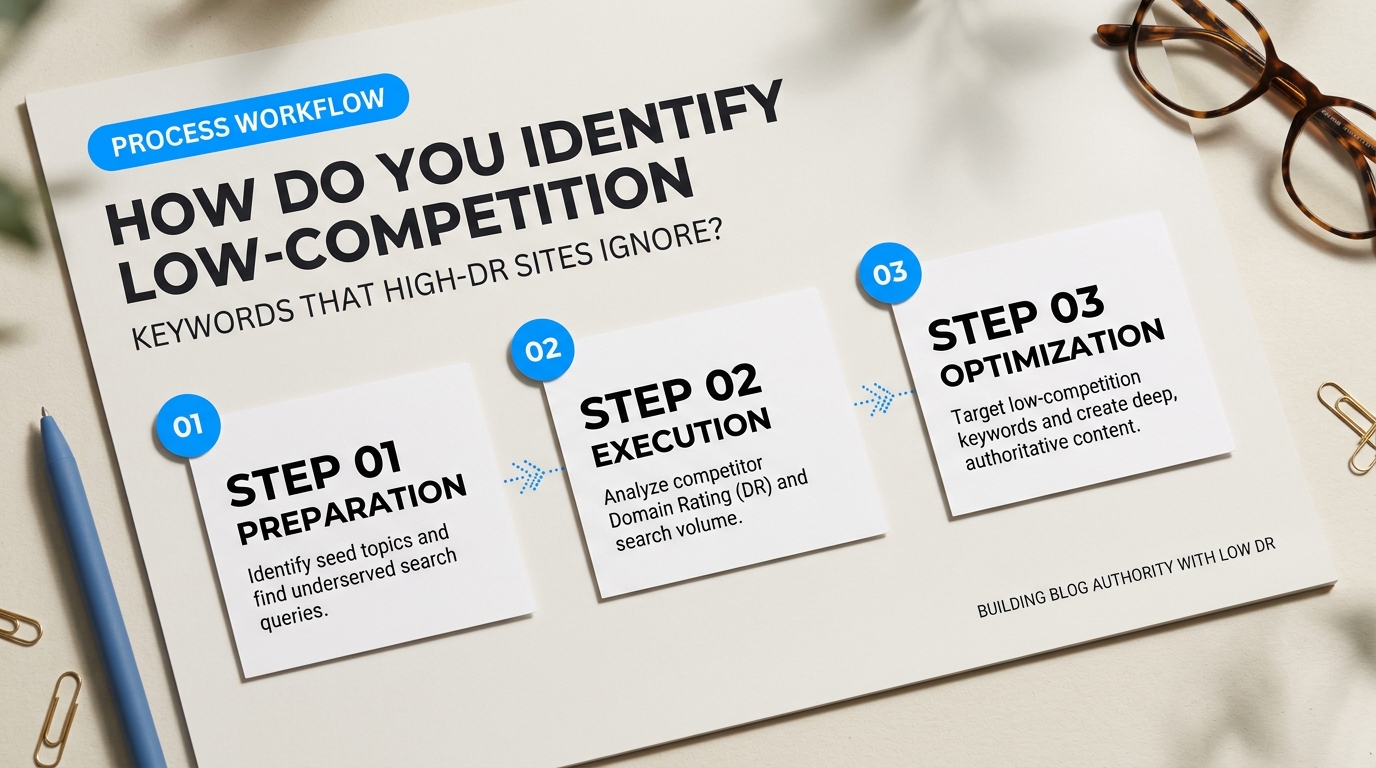
Giant websites operate like massive cruise ships. They can’t dock in shallow waters. They ignore search queries with under 100 monthly searches because their bloated editorial teams need massive traffic to justify their publishing budgets. That’s your unfair advantage. If you want to understand how to build blog authority with low dr, you must hunt in the shallow waters where those big sites won’t fit.
Look for User-Generated Content (UGC) ranking on page one of search results. When Google places a messy Reddit thread or an unanswered Quora question in the top three spots, it signals a clear content shortage. The search algorithm simply lacks a comprehensive, well-formatted article to answer that user’s exact problem. You step in, solve the issue directly, and take the top spot.
“Looking for genuine user experiences… How does the quality and output hold up compared to manual workflows?” — A creator asking on Reddit's SaaS community forum about low-competition keyword strategies.
Manual search analysis works, but it burns valuable time. Automated tools speed up the process. A traditional software suite like Ahrefs excels at tracking massive site backlink databases, but its keyword difficulty scores rely heavily on backlink counts rather than real search result weaknesses. For low-DR sites, a specialized tool like LowFruits analyzes search engine result pages in bulk to highlight weak spots—like forum posts, free e-commerce storefronts, or personal blogs with low metrics. LowFruits uses a pay-as-you-go credit system, making it far more accessible for budget-conscious publishers comparing software pricing against overall performance.
Targeting Unmined Queries to Build Blog Authority with Low DR
Don’t trust search volume estimates blindly. Third-party SEO databases update their metrics infrequently for niche, hyper-specific search terms. A phrase labeled with zero search volume often generates dozens of qualified buyers and hundreds of visitors every month. These long-tail questions represent real people looking for fast answers right now.
| SERP Signal | What It Looks Like | Why High-DR Sites Ignore It | How You Win |
|---|---|---|---|
| Forum Gaps | Reddit or Quora threads rank in positions #1 through #3. | High-authority brands target broad search terms with generic product pages. | Write a clear, structured article that directly answers the thread’s core question. |
| Zero-Volume Queries | Keywords showing “0 to 10” monthly searches in standard tools. | Major publications deem low-volume topics financially unworthy of writer pay. | Group multiple related zero-volume questions into one tightly focused guide. |
| Outdated Content | Top results haven’t been updated in four years or lack real images. | Enterprise sites rarely audit low-traffic legacy content. | Publish fresh steps with updated screenshots, accurate instructions, and quick answers. |
Uncovering Zero-Search-Volume Keywords for Rapid Rank Gains
Zero-volume terms act like hidden backdoors into search engines. When you answer a hyper-specific question—such as a specific software error code or a niche product combination—you face almost zero competition. Your low domain authority doesn’t hold you back because no high-DR site has bothered to cover the topic.
Targeting specific user queries allows new blogs to secure early search traffic fast. Every time your post claims a top spot for an ignored search phrase, search engine crawlers measure your positive user engagement signals. Over time, mastering how to build blog authority with low dr comes down to collecting these small, compounding wins until your domain gains the trust needed to rank for tougher topics.
Demonstrating First-Hand E-E-A-T Without an Established Brand Presence
Google doesn’t know who you are when you launch a brand-new blog. You don’t have millions in ad spend or a decade of brand mentions. Search algorithms treat your content with healthy skepticism. That’s where Experience, Expertise, Authoritativeness, and Trustworthiness (E-E-A-T) come in. Think of E-E-A-T as showing your passport at border control. You don’t get through because of who you claim to be; you get through because your papers prove where you’ve been.
Publishing generic summaries of top-ranking articles won’t work anymore. If you want search engines to trust your fresh site, you must show proof of work. Take your own photos instead of relying on generic stock graphics. Run real experiments, log your results, and share raw datasets directly on the page.
Prove Hands-On Experience: How to Build Blog Authority with Low DR
If you test a software tool, include custom screenshots with your own account dashboard visible. Annotate those images to point out edge cases, hidden fees, and setup quirks. When readers see actual usage logs, they stay longer. Search engine evaluators look specifically for these real-world footprints when scoring content quality.
Many creators ask if gathering manual testing evidence is worth the extra time. On public forums, SaaS founders discussing E-E-A-T workflows often question whether manual testing beats automated content generation. The answer is clear: manual evidence creates an uncopyable moat. Automated tools can scrape text, but they can’t invent genuine user experience.

| Trust Asset | Superficial Content (Stock) | Deep E-E-A-T Asset (First-Hand) | Recommended Tool |
|---|---|---|---|
| Visual Evidence | Unmodified stock photos | Original photos, UI walkthroughs, annotated screenshots | Canva / Snagit |
| Data & Metrics | Re-hashed stats from old blogs | Proprietary surveys, internal test logs, raw spreadsheets | Google Sheets / Airtable |
| Entity Markup | Basic Organization schema | SameAs links, Person schema, Knowledge Graph markup | WordLift structured data suite |
Small sites frequently fail because they publish content under anonymous handles like “Admin” or “Staff Writer.” Search crawlers need clear entity anchors to map your expertise. Create dedicated author bio pages that link out to verified personal profiles. Link directly to your LinkedIn profile, Twitter account, published research papers, or industry podcast appearances.
Use structured data schema to connect these dots explicitly. You can use platforms like Schema App entity markup software to inject Person and author properties into your page code. This tells search engines exactly who wrote the article and why they have the background to speak on the topic.
“Search engine bots don’t guess your credibility anymore. They calculate it by cross-referencing your author entity with external web databases.”
What if you lack deep personal experience in a specific niche topic? You don’t have to fake it. Reach out to active practitioners and gather original commentary. A short 3-minute email exchange can yield a unique quote that elevates your article from a generic summary to a primary news source.
When learning how to build blog authority with low DR, remember that trust builds step by step. Every original chart, expert quote, and structured author bio acts like a deposit in your site’s credibility bank. Over time, search engines stop treating your low-DR site as a random blog and start treating it as a trusted destination.
Strategic Internal Linking: Maximizing Equity Flow Across Your Site
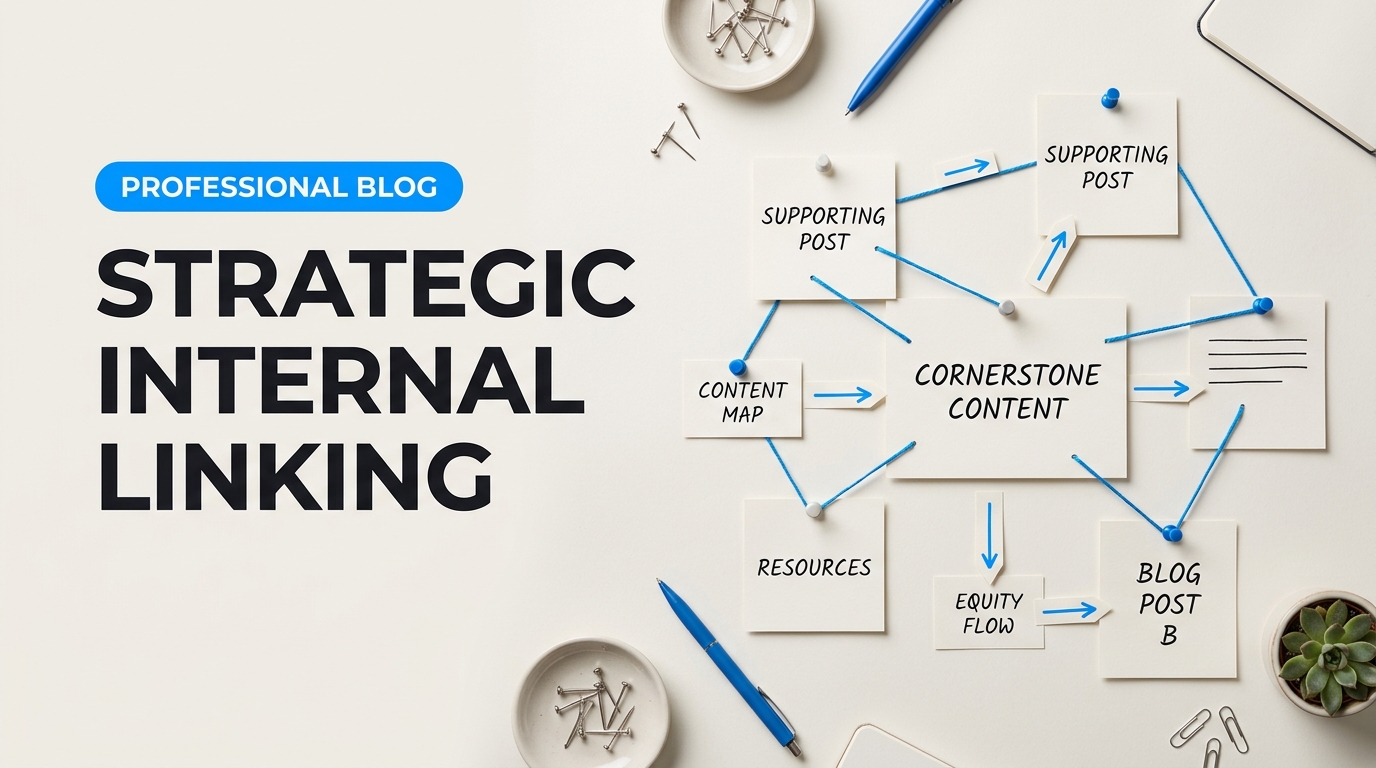
Think of your website as a network of connected water pipes. External backlinks pump fresh water into your main reservoir. Internal links carry that water to smaller tanks across your site. If your pipes leak or lead to dead ends, water gets wasted. When your site is brand new, you don’t have much water to spare. Every single drop must reach the pages that need it most.
Search engines use algorithms like PageRank—a system that measures a page’s importance by counting the number and quality of links pointing to it—to judge which pages deserve top rankings. When you don’t have hundreds of external backlinks, your internal link network becomes your primary tool for moving authority around your site.
Structuring Link Silos: How to Build Blog Authority with Low DR Websites
Locking your link equity inside tight topical clusters prevents authority from leaking out. If you want to know how to build blog authority with low dr, start by building strict internal silos. A silo is simply a group of closely related articles that link to each other and to a central pillar page.
Random internal linking dilutes your site’s focus. If you write a detailed guide on email marketing, every supporting article—such as subject line tips, list segmentation, and email design—should link to that core guide. They should also link horizontally to each other when relevant. Avoid linking that email cluster to an unrelated post about social media ads. Keeping link connections strictly within the topic tells search engines that your pillar page is the ultimate authority for that specific subject.
Reverse silos work exceptionally well for newer sites. Instead of sending all authority top-down from the homepage, you push authority bottom-up. You publish several long-tail, low-competition articles. As those low-competition articles gain traffic and minor backlinks, they pass their combined authority up to your higher-competition target page.
Anchor Text Diversity and Context-Rich Placement
Where and how you place your links determines how much equity they pass. Links placed inside the main body of your text carry far more weight than links tucked away in sidebars, footers, or navigation menus. Search engines treat body text links as editorial votes, assuming a human author chose that specific placement for the reader’s benefit.
Anchor text—the clickable text holding the link—tells search bots what the destination page is about. Avoid using generic phrases like “click here” or repetitive exact-match keywords. Over-optimizing anchor text with the exact same target keyword across fifty internal links can trigger spam filters.
- Exact Match: Use sparingly (10-15% of internal anchors). Example: “internal link architecture.”
- Partial Match: Use most frequently (50-60%). Example: “building an efficient internal link architecture for small sites.”
- Contextual / Phrase Anchors: Wrap descriptive context around the topic (20-30%). Example: “learn how to distribute page equity across your site.”
Make sure the text surrounding the anchor link adds semantic context. Search engines read the entire paragraph, not just the hyperlinked words. Placing a link inside a paragraph rich in relevant industry terms reinforces the destination page’s topical strength.
Automation Tools vs. Manual Workflows
Site owners frequently debate whether to use automated internal linking software or stick to manual audits. Automation saves hours, but poor software configurations can ruin your link structure by creating awkward, out-of-context links. Reviewing real user experiences on this Reddit SaaS internal linking debate highlights how smaller teams balance manual control against automated scale.
| Workflow Method | Setup Time & Cost | Anchor Precision | Best For |
|---|---|---|---|
| Manual Auditing (GSC + Spreadsheets) | High labor / Free | 100% contextual control | Sites under 50 pages; boutique brands. |
| Link Whisper (WordPress Plugin) | 10 mins / ~$77 per year | High (semi-automated suggestions) | Growing blogs; small editorial teams. |
| InLinks (Entity-Based Platform) | 30 mins / ~$39 per month | Automated via Schema & Entities | E-commerce stores; large content hubs. |
For small budgets, manual internal linking using Google Search Console works best. Search for pages on your site that already rank on page two for target queries. Open those pages and manually insert links pointing to your newest target content. If your blog has over 100 posts, semi-automated plugins like Link Whisper save massive amounts of time by scanning your site for relevant keywords and suggesting placement locations inside existing articles.
Passing Equity from High-Authority Assets
Every site has a few “power pages.” These are pages that have naturally earned backlinks, accumulated social shares, or secured steady organic traffic. You can leverage these high-performing pages to lift up lower-performing, newer content.
Open an SEO tool like Ahrefs or Semrush to pull your site’s “Best by Links” report. Identify the top five pages with the highest number of referring domains. These pages hold the largest pool of PageRank equity on your domain. Add fresh, contextually relevant internal links from those top five pages to your low-DR money pages or new blog posts. This acts like an internal siphon, immediately channeling accumulated authority directly to pages that need ranking power.
Pro Tip: Don’t leave orphan pages on your site. An orphan page is a page with zero incoming internal links. Search engine crawlers struggle to discover orphan pages, and without incoming link equity, those pages rarely rank regardless of content quality.
Frequently Asked Questions About Internal Equity Flow
Is strategic internal linking worth it for small e-commerce stores?
Yes. Small e-commerce sites often struggle to build backlinks to individual product pages. By publishing helpful blog posts that earn links naturally, you can pass equity directly from those blog posts to your product pages through strategic body links.
What is the biggest mistake to avoid when structuring link silos?
The biggest mistake is over-siloing to the point of breaking user experience. If a link genuinely helps a reader learn more or complete a task, include it. Never sacrifice user experience just to maintain a rigid link silo.
How many internal links should a standard blog post contain?
There’s no fixed limit, but a good baseline is 3 to 5 internal links per 1,000 words. Focus on link relevance and context rather than meeting an arbitrary metric.
How Can Low-DR Sites Earn High-Quality Backlinks Naturally?
Smaller blogs don’t need massive outreach budgets or thousands of dollars to secure links from top-tier publications. You don’t have to buy links from shady networks either. Understanding how to build blog authority with low dr comes down to creating assets that other writers actively look for while drafting their own articles. Think of high-authority sites as builders looking for raw materials. When you supply the exact data point, template, or calculator they need, they’ll gladly cite your domain as the primary source.
Link-Earning Tactics to Build Blog Authority with Low DR
Passive link magnets do the heavy lifting while you focus on content creation. These assets rank for terms that journalists, researchers, and content managers search when building citations.
Statistics pages work surprisingly well. Compile updated industry facts into a clear, easily scannable list. Writers rarely want to spend hours hunting down original research. They’d rather search for quick statistics and link to the page that rounded them up.
Interactive tools offer another scalable solution. Simple custom scripts or calculators earn backlinks naturally because websites prefer pointing readers to a functional tool rather than writing out math formulas. They save time for readers. They earn trust fast.

Templates and downloadable checklists pull in natural links too. If you design a helpful project management sheet or standard operating procedure, other creators will feature your resource in their best tool lists without you ever asking.
Proprietary Micro-Surveys and Data Reports
Original research beats rehashed opinions every single time. You don’t need a thousand survey respondents to uncover a story worth sharing. Gathering answers from 50 to 100 people in your niche gives you unique figures that nobody else owns.
Run quick surveys using platforms like Typeform online survey forms or simple Google Forms. Ask specific questions about industry challenges, average spend, or daily habits. Once you gather the numbers, publish a clean report with visual charts.
Journalists love fresh numbers. When you publish a headline stating that 68% of small store owners prefer asynchronous customer support, tech news outlets and industry blogs will use your metric as evidence. That citation turns into a permanent, high-value backlink.
Modern Digital PR Tools vs Manual Outreach
Many site owners ask on Reddit SaaS discussions on manual link workflows versus automation whether expensive digital PR software actually pays off for newer domains. The setup time and subscription costs of heavy enterprise software can hurt a growing budget. Choosing between manual effort and paid software comes down to your available hours and budget constraints.
| Outreach Method | Setup & Learning Curve | Typical Monthly Cost | Best Fit for Low-DR Domains |
|---|---|---|---|
| Manual Pitching (HARO / Connectively) | Low (1-2 hours to set up profiles) | $0 – $50 | Ideal for founders writing their own expert pitches to reporter requests. |
| Dedicated Digital PR Platforms (Pitchbox / BuzzSumo) | Moderate to High (Requires database setup) | $199 – $500+ | Best for growing teams needing automated media tracking and large lists. |
| Unsolicited Guest Pitching | Low setup, high ongoing effort | $0 (Time cost) | Effective only when pitching highly unique data or custom angles. |
“Looking for genuine user experiences… How does the quality and output hold up compared to manual workflows?” — Marketing lead evaluating outreach efficiency on limited budgets.
Avoid paid link networks or private blog networks (PBNs) completely. Search algorithms spot unnatural link patterns quickly, and a manual penalty will wipe out your search traffic. Focusing on real reporter queries through reactive PR platforms like Help A B2B Writer or Connectively builds a clean link profile. Review our comprehensive link earning strategy benchmark guide to see standard response rates across different niche markets.
Consistency matters far more than domain rating. When you supply real value, testable data, and helpful tools, high-DR websites will gladly link to your pages. That is how smaller sites win the long game in modern search engines.
Building a Sustainable SEO Strategy Beyond Third-Party Metrics
Chasing metric scores is an easy trap. Many creators spend thousands of dollars buying low-grade links just to watch a third-party score move up two points. Scores don’t buy groceries. Traffic does. Domain Rating is simply an external estimate—like a reviewer rating a restaurant without ever tasting the food. Google’s actual algorithm cares about context, user satisfaction, and topic depth far more than an arbitrary score calculated by an outside tool.
Mastering How to Build Blog Authority with Low DR Through Core SEO Fundamentals
Building real momentum requires a shift in mindset. You don’t need a high DR to dominate search results. We’ve seen lean e-commerce brands and solo founders outrank massive media outlets by doubling down on niche expertise. When you look at community discussions on sustainable SEO strategies, practical execution always wins over metric chasing. Map out every subtopic in your niche, write clear answers, and connect your pages with logical internal links.
Tool choice plays a massive role in where you spend your energy. Platforms like Ahrefs or Moz give helpful backlink snapshots, but relying entirely on their authority scores can blind you to real opportunities. Instead, pair Google Search Console with specialized discovery tools like LowFruits to spot low-competition search terms that high-DR competitors ignore. Search Console shows your actual impression growth and user queries directly from the source. It costs nothing and provides unvarnished truth when analyzing your overall measuring actual SEO return on investment.
Success in modern search comes down to consistency and topical ownership. Understand exactly how to build blog authority with low DR by serving your audience better than anyone else. Keep your publishing schedule steady, update old posts with new insights, and make your site fast and easy to navigate. Search engines will naturally treat your site as a trusted resource, turning your low-DR blog into a high-traffic asset that lasts for years.
Focus on the searcher, not the score. Sustainable search rankings belong to sites that answer questions completely, build tight topic networks, and deliver effortless user experiences.