7 Hidden Signs of High Functioning Burnout in Young Pros
7 Hidden Signs of High Functioning Burnout in Young Pros
Table of Contents
- The Illusion of Having It All Together: Unmasking Silent Exhaustion
- Subtle Signs of High Functioning Burnout You Might Be Ignoring
- Why Does High-Performing Ambition Turn into Chronic Depletion?
- How to Conduct an Honest Burnout Diagnostic Audit
- Immediate Nervous System Resets to Relieve Daily Overwhelm
- A Step-by-Step Roadmap to Reclaiming Your Energy and Focus
- Daily Rhythms and Mindset Habits to Prevent Relapse
- Redefining Success: Choosing Sustainable Vitality Over Empty Output
On paper, you have everything under control. You hit your project goals, reply to urgent messages in record time, and never miss an important milestone. Yet underneath that smooth surface, you are dragging yourself forward day after day. Spotting the early signs of high functioning burnout is tricky because your performance never noticeably slips. For motivated young pros, outward career wins often hide a quiet personal crisis where you look unstoppable to colleagues while feeling detached, flat, and hollow inside.
Society teaches us that exhaustion always looks like falling apart. We imagine missed shifts, messy desks, or sobbing in an office stairwell. When you hold yourself to high standards, your stress response works backward. Instead of dropping balls, you speed up. You push harder to compensate for fading focus. You put on a confident face, run morning meetings, and send midnight emails. The moment your laptop lid shuts, though, the performance ends. You crash on the couch, staring blankly at your phone with zero energy left for hobbies, healthy meals, or friends.
You are not imagining this disconnect. In real-world online community discussions about unexplained mental fatigue, hundreds of driven workers ask why they feel so persistently drained when their careers seem fine. Medical experts note that fatigue and reduced efficacy from chronic work stress do not always stop you from getting things done. Your work ethic simply shields the damage from view until your physical body forces you to stop. Learning to spot the covert signs of high functioning burnout helps you catch the slide early before simple weariness turns into total depletion.
The video above breaks down why you can achieve every traditional milestone and still feel like something vital is missing. That quiet emotional emptiness is your brain waving a red flag.
Facing this hidden exhaustion is not a confession of weakness. It is acknowledging the reality of running your mental engine in the red zone without stopping for maintenance. Let’s look closely at how quiet depletion develops, identify what is going on behind your drive, and build practical daily rhythms so your real vitality finally matches your external success.
Subtle Signs of High Functioning Burnout You Might Be Ignoring
Most people assume burnout looks like staying in bed for a week with the blinds drawn. For ambitious young pros, it rarely works that way. You still wake up on the first alarm. You hit your deadlines. You reply to emails with upbeat exclamation points. You look completely competent from the outside, but underneath that polished mask, your engine is running without oil.
You keep moving forward because stopping feels far more terrifying than pushing through the exhaustion. Recognizing the quiet signs of high functioning burnout early protects you from hitting a brick wall that could sideline your career for months.
Hidden Behavioral Signs of High Functioning Burnout
When high achievers burn out, their nervous systems do not simply shut down. Instead, they shift into functional freeze. Think of functional freeze like a car stuck in neutral while the driver floors the gas pedal. The engine screams at maximum RPM, heat builds under the hood, but the wheels barely turn.
On paper, you look like a productivity machine. You clear fifty inbox tickets, organize color-coded project boards, and respond instantly to every Slack notification. In reality, you are hiding behind low-impact busywork because your brain lacks the energy for deep, creative problem-solving. You work twelve hours just to complete tasks that once took three.
Alongside this frantic busywork comes a complete inability to enjoy your wins. You land a promotion, finish a grueling product launch, or hit your monthly sales goal. Instead of feeling proud, you feel a hollow shrug. The finish line just turns into the starting gate for another sprint. Your achievements bring relief rather than joy, accompanied by a quiet whisper: “Now I have to do it all over again.”
In the breakdown above, health researchers highlight the quiet physical and mental warning signs that high achievers routinely dismiss before total collapse.
Emotional Flattening and Sudden Micro-Irritability
Burnout does not always show up as intense sorrow or tears. Far more often, it feels like someone turned down the saturation slider on your life. Clinicians describe this as emotional flattening, a condition explored in detail by Talkspace's clinical overview on emotional detachment. You stop getting excited about weekend plans. Good news barely registers. Bad news leaves you numb. You become an emotional bystander watching your own life play out on a screen.
Then, without warning, that numbness gives way to sudden micro-irritability. A coworker sends a polite ping asking for a file update, and a wave of pure anger hits your chest. A slow Wi-Fi connection or a loud chewer nearby feels like a personal attack.
“I noticed I was losing compassion for everyone around me. Things that never bothered me suddenly sparked instant rage.”
That quote reflects what many frontline professionals sharing initial burnout signals report when their empathy tank empties. When your nervous system stays stuck in high alert for months, your brain views any extra request, no matter how small, as a threat to your basic survival.
Cognitive Fog and the Physical Whispers
Physical symptoms start as quiet whispers long before they turn into screaming emergencies. You might shrug off brain fog as bad sleep or blame caffeine withdrawal for your afternoon headaches. The table below helps you tell the difference between normal work fatigue and deep, chronic depletion.
| Signal Area | Normal Work Fatigue | High-Functioning Burnout |
|---|---|---|
| Mental Clarity | Clear focus after lunch or a short break. | Re-reading the same email four times without absorbing it. |
| Rest & Recovery | A good weekend reset brings your energy back. | Waking up exhausted on Monday morning after sleeping ten hours. |
| Perspective on Tasks | Tasks feel like challenges you want to tackle. | Every incoming meeting feels like an unbearable weight. |
| Physical State | Muscles relax easily once your laptop closes. | Tight jaw, locked shoulders, and shallow chest breathing all day. |
You cannot cure this state with another espresso or a weekend nap. Recognizing these behavioral and physical patterns is the first step toward stepping off the treadmill before your body pulls the plug for you.
Why Does High-Performing Ambition Turn into Chronic Depletion?
Ambition feels like a clean engine. It gives you focus, purpose, and momentum. Yet for many ambitious achievers, that clean engine slowly turns into an incinerator. You still hit your targets, answer every email, and smile in meetings, but beneath that polished exterior, you feel hollowed out. Why does a healthy desire to do well turn into deep, bone-weary depletion?
The answer rarely lies in the hours you work. It lies in why you work those hours and what happens inside your body while you do.
Psychological Roots Behind the Signs of High Functioning Burnout
Most driven people don’t crash from laziness. They crash because they have tied their personal worth directly to their output. When you live with achievement-based self-worth, a quiet day does not feel peaceful. It feels threatening. Skipping a task triggers a quiet wave of shame, making rest feel like an unearned luxury.
This trap often combines four subconscious habits:
- Perfectionism: You treat flaws as personal catastrophes. Doing a job well is no longer enough; it must be flawless to prove you belong in the room.
- Toxic Resilience: You wear endurance like a badge of honor. You push through sickness, skipped meals, and mental fatigue simply because you know you can take the punishment.
- Aversion to Stillness: When you stop moving, your brain finally has room to process unsettled feelings. To avoid that internal discomfort, you pick up another project.
- The Ever-Moving Finish Line: As soon as you hit a major milestone, you barely pause to celebrate. You immediately look for the next mountain to climb.
When you normalize living in overdrive, the early signs of high functioning burnout get swept under the rug as standard operating procedure. You tell yourself everyone feels this way. You tell yourself that feeling drained is simply the price of success.
In a vulnerable community discussion on burnout and ambition, one professional reflected on a hard truth: “As you start healing, you become less ambitious.” Many high achievers discover that their fierce drive was never about pure passion. It was a coping shield designed to outrun insecurity or self-doubt.
The video above unpacks why high-functioning anxiety and chronic stress masquerade as productivity, explaining how our minds rationalize red flags until our reserves run out.
The Biology of a Stuck Gas Pedal
Your mind might rationalize your heavy workload, but your biology keeps an honest balance sheet. When you push continuously without downshifting, your sympathetic nervous system stays locked in fight-or-flight mode.
Think of your nervous system as a car. The sympathetic system is the accelerator. It floods your bloodstream with cortisol and adrenaline so you can sprint away from danger—or meet a tight deadline. The parasympathetic system is the brake pedal. It slows your heart, supports digestion, and repairs muscle tissue during rest.
Under chronic ambition, your foot stays glued to the gas pedal. The car keeps moving forward at eighty miles per hour, but the brake pads have worn down to metal. Your brain stops seeing the difference between a real physical threat and a full inbox.
“High-functioning burnout does not announce itself through failure. It hides behind your competence.” — Dorlee Michaeli's breakdown of high achiever exhaustion
Eventually, constant chemical arousal wears down your cellular health. Your body stops producing steady energy and starts relying entirely on emergency reserves. You become tired yet wired. You find yourself exhausted at nine in the evening, but the moment your head hits the pillow, your heart beats fast and your thoughts race.
The High Achiever Rationalization Trap
Why do competent professionals let depletion get so bad before speaking up? They rationalize it away with convincing mental stories.
| What Your Mind Tells You | What Your Body Is Experiencing |
|---|---|
| “I’ll rest once this quarter wraps up.” | Adrenal fatigue from months of chronic stress spikes. |
| “I’m delivering great work, so I can’t be burned out.” | Cognitive narrowing where tasks take twice as much effort. |
| “I just need stronger espresso to get my focus back.” | A nervous system screaming for restorative delta sleep. |
| “Other people handle far more without complaining.” | Emotional numbness and loss of everyday joy. |
Recognizing this cycle isn’t an admission of weakness. It’s an act of clarity. True high performance requires biological recovery, not just endless willpower. Until you see your drive for what it is, your body will continue paying for the bills your ambition writes.
How to Conduct an Honest Burnout Diagnostic Audit
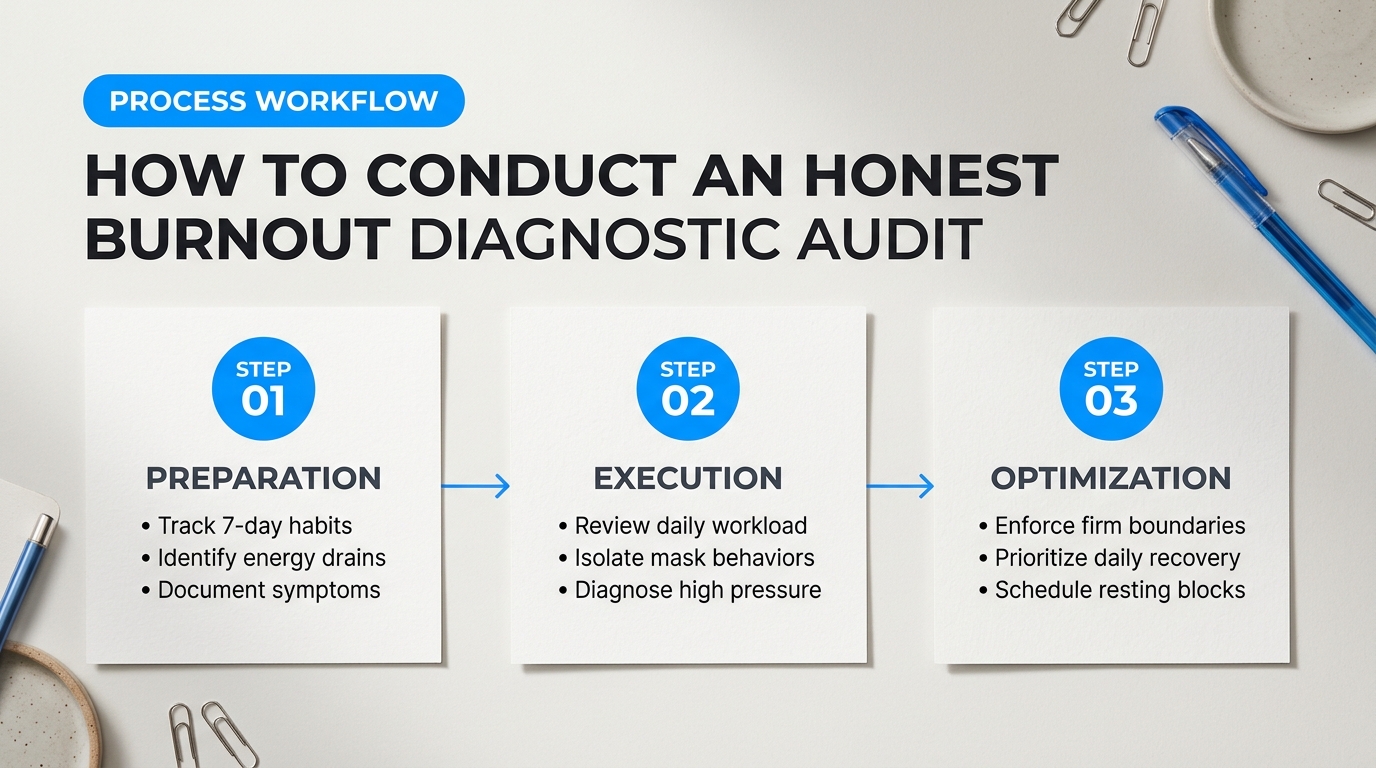
You can hit every project deadline and still be disintegrating from the inside out. For ambitious young pros, competence often acts as camouflage. Your performance numbers stay clean, so nobody around you suspects you are running on fumes. You keep pushing forward on caffeine, panic, and sheer willpower, rationalizing that you just need to power through one more busy quarter.
That gamble rarely pays off. As one professional candidly shared in honest accounts of late-stage burnout, ignoring subtle internal friction eventually leads to a point where your body makes the decision for you, forcing a sudden and total shutdown. To stop that crash before it starts, you must stop measuring how much you produce and start auditing how much fuel you actually have left in the tank.
Auditing the Core Signs of High Functioning Burnout
Spotting the early signs of high functioning burnout isn’t about watching for workplace failure; it’s about tracking how much internal friction it takes to hit your standard output. When your nervous system is tapped, baseline tasks feel like running through wet sand.
Run through this four-domain diagnostic once a month. Rate yourself honestly against each category to see if your daily habits are building lasting capacity or quietly draining your reserves.
| Audit Domain | Sustainable Baseline | Warning Threshold | Redline Warning |
|---|---|---|---|
| Physical Recovery | Wake up rested; steady energy without heavy stimulant reliance. | Morning brain fog; jaw clenching; needing three coffees to initiate work. | Waking with racing heart; insomnia despite total physical fatigue. |
| Emotional Bandwidth | Patience for routine hurdles; empathy for teammates and friends. | Spike of irritation at minor calendar invites or casual text messages. | Emotional numbness; sudden bouts of tearfulness or explosive cynicism. |
| Cognitive Presence | Focus on complex tasks for 60-90 minutes without zoning out. | Re-reading paragraphs repeatedly; drifting into endless micro-distractions. | Severe working memory lapses; total paralysis when opening routine task lists. |
| Daily Joy Deficit | Anticipation for weekend plans; feeling pride after finishing a big project. | Completing big achievements brings zero relief, only dread of the next task. | Total anhedonia; spending days off lying motionless in darkened rooms to survive. |
Your nervous system sends clear warnings before it blows a fuse. If two or more domains sit in the Warning Threshold, you aren’t just tired. You’re bleeding bandwidth.
“When high performers burn out, they don’t stop delivering quality work. They stop experiencing their own lives.”
When focus unravels, many young achievers make the mistake of white-knuckling through the haze with more discipline. That approach only accelerates depletion. Rebuilding your cognitive baseline requires working with your neurochemistry rather than fighting it.
In this lecture, neuroscientist Andrew Huberman breaks down how attention circuits fatigue and shares practical behavioral protocols to steady your nervous system. Watching this helps explain why willpower alone cannot fix a brain that has run out of biological currency.
Look at your audit findings like dashboard gauges in a car. When the check engine light blinks, driving faster won’t fix the engine. Acknowledging that you’ve been redlining isn’t admitting defeat. It’s the first smart step toward reclaiming your edge before a forced shutdown decides things for you.
Immediate Nervous System Resets to Relieve Daily Overwhelm
When you spend weeks pushing through fatigue, your body treats every incoming email like an ambush. You might still hit your deadlines, but inside, your engine is running red-hot. Many young pros mistake this constant buzzing tension for everyday drive. In reality, it is one of the clearest physical signs of high functioning burnout, signaling that your internal alarm system has forgotten how to power down.
When your autonomic nervous system gets locked in fight-or-flight, cognitive reasoning will not rescue you. You cannot simply talk yourself out of a bodily panic response. As one overwhelmed professional shared in a Reddit self-care community discussion on daily overwhelm, you reach points where your brain is running on overdrive and passive distractions like scrolling do nothing to quiet the noise. You need physical, somatic levers to hit the brakes.
Interrupting Signs of High Functioning Burnout with Fast Somatic Shifts
To pull your body out of high alert, you must send tangible safety cues down the vagus nerve. The vagus nerve acts like a central brake line running between your brainstem and your gut. When you activate it, your heart rate drops, your blood pressure stabilizes, and your muscles stop bracing for impact.
The video above outlines the foundational skill of stepping away from hypervigilance into a grounded state. You can spark this transition in less than two minutes using three practical body-first protocols:
- The Double-Inhale Physiological Sigh: Take two sharp sips of air through your nose without pausing, filling your lungs completely. Then, release a slow, unforced exhale through your mouth until your chest empties. Repeating this cycle just three times reopens the tiny air sacs in your lungs, dumps trapped carbon dioxide, and triggers an immediate drop in resting heart rate. Think of it as popping the pressure release valve on an overheated steam cooker.
- Sensory Depatterning: High stress creates intense focal vision. Your eyes fixate on screens, your pupils contract, and your neck stiffens. Break this loop by switching to panoramic vision. Soften your gaze and look across the room or out a window. Without moving your head, notice what sits in your far left and right peripheral fields. Widening your visual field physically blocks the stress hormones pumping through your system.
- Bilateral Grounding Taps: Cross your arms over your chest and alternate gentle finger taps against your collarbones at a rhythmic, walking tempo. This cross-body movement balances electrical activity across both brain hemispheres, pulling you out of spiral thinking and anchoring you back in the present room.
True recovery during a high-stakes workday does not require an hour-long yoga class. It happens in the fifteen-second spaces where you decide to let your shoulders drop away from your ears.
Practical Triage: Rerouting Your Daily Work Schedule
Somatic exercises stop acute panic, but systemic daily habits prevent recurring depletion. A classic finding documented in Integris Health's guide to nervous system exhaustion is that prolonged mental overdrive ruins short-term memory and drains everyday focus. To stop this drain, you have to build structural shock absorbers directly into your schedule.
| The Burnout Habit | The Nervous System Reset | The Direct Benefit |
|---|---|---|
| Back-to-back 30-minute meetings with zero transition. | Ruthlessly end every call at the 25-minute mark. | Gives your brain a clear five-minute buffer to clear working memory. |
| Checking phone notifications during every brief lull. | Non-negotiable ninety-second sensory blackout pauses. | Stops sensory overload and lets baseline dopamine levels reset. |
| Saying yes to last-minute, low-priority team requests. | A mandatory 24-hour response delay rule for new asks. | Protects prime creative energy from reactive people-pleasing. |
Start small today. Pick one meeting on your calendar and prune five minutes off the end. Use that time not to prepare for the next task, but to look out a window and breathe. By interrupting the cycle before you hit empty, you take back control of your health while keeping your high-performing edge intact.
A Step-by-Step Roadmap to Reclaiming Your Energy and Focus
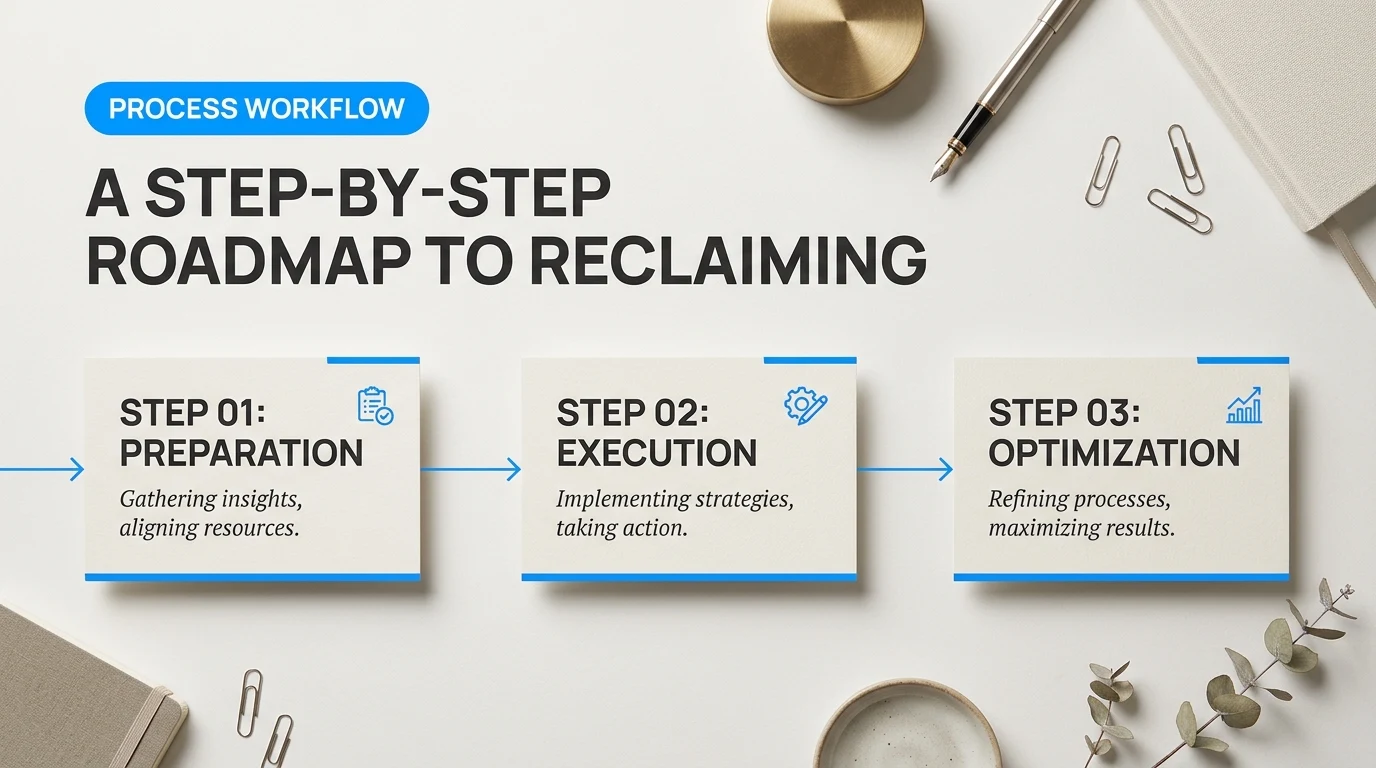
When you live in survival mode, recovery often feels like another demanding project. You try to optimize your rest the exact same way you optimize spreadsheets. You schedule ten-minute meditation breaks, gulp green tea between urgent calls, and silently panic when your nervous system stays wired. That approach fails every single time. Aggressive self-improvement cannot heal an overstimulated nervous system.
A popular thread in the Reddit productivity recovery discussion asked a blunt question: what do you actually do when you need to change your life from a place of deep exhaustion? The answer is rarely “try harder.” True recovery demands rewiring the unconscious performance drivers that forced your body into overdrive in the first place.
This video breaks down why high-performing professionals end up feeling trapped in an endless cycle of anxiety and fatigue despite external success. Breaking that cycle requires an intentional, step-by-step roadmap that rebuilds your schedule from the inside out.
Phase 1: Shift from Fear-Driven Speed to Values-Aligned Focus
Most ambitious professionals run on invisible fuel: terror. You work at breakneck speed not because the project demands it, but because stillness makes you uneasy. You fear that taking your foot off the gas will reveal you as an imposter, disappoint a client, or cause your entire career to stall. That is fear-driven productivity. It keeps your adrenal glands pumping around the clock.
Values-aligned engagement flips that equation entirely. You stop measuring your day by the volume of tasks conquered and start measuring it by intentional impact. Ask yourself: If nobody were watching or grading me today, what work would actually move the needle?
“When you derive your self-worth solely from constant availability, rest stops feeling like recovery and starts feeling like an existential threat.”
Start each morning by selecting just one primary focus task. Make it the project that genuinely aligns with your long-term goals or creative growth. Protect the first ninety minutes of your workday for that single priority before opening Slack, checking email, or answering team requests. You aren’t avoiding your job; you are teaching your brain that proactive creation matters more than frantic reaction.
Phase 2: Install Non-Porous Boundaries
Most young professionals believe they have boundaries. In reality, they have screen doors during a hurricane. You set a rule to stop checking emails after 7:00 PM, but you still glance at preview banners during dinner. You agree not to take weekend meetings, but you spend Sunday afternoon drafting project memos in your head. These are porous boundaries. They let work leak into your rest, leaving your nervous system on high alert.
Non-porous boundaries are structural walls. They do not rely on your willpower when you are tired. Here is how they look in practice:
- The Digital Sunset: Delete work messaging apps from your personal smartphone or set automated app timers that lock you out at 6:00 PM sharp.
- Scripted Delays: When asked to take on an unexpected assignment, never answer on the spot. Use a default script: “Let me review my current commitments and get back to you with my availability by tomorrow morning.”
- Separation Rituals: Close your laptop, put it inside a drawer, and physically step outside for a five-minute walk to mark the end of the workday. Give your mind a physical transition cue.
Phase 3: Synchronize Workload with Ultradian Rhythms
Society conditions us to treat energy like a steady light switch that stays flipped on for eight consecutive hours. Biology works differently. Human alertness operates on natural ninety-minute cycles called ultradian rhythms. During each wave, your brain moves from high-frequency focus down to an energetic trough where it seeks rest and consolidation.
| Time Window | Biological State | Optimal Work Focus |
|---|---|---|
| Early Morning (8:30 – 11:30 AM) | Peak Cortisol & Dopamine | Deep creative problem solving, strategic planning, writing |
| Midday Dip (1:00 – 3:00 PM) | Natural Energy Valley | Low-stakes administrative tasks, inbox cleaning, walking meetings |
| Late Afternoon (3:30 – 5:30 PM) | Secondary Focus Rebound | Collaborative brainstorming, wrap-up reviews, daily retrospectives |
Stop forcing your brain to draft complex proposals during the 2:00 PM trough. When you honor your natural energy waves instead of fighting them with another double espresso, work gets done twice as fast with half the mental friction.
Tracking Signs of High Functioning Burnout During Habit Resets
Recovering from prolonged overwork is rarely a straight line. Old reflexes resurface the moment work pressures spike. You might find yourself agreeing to unrealistic deadlines or working through lunch without realizing it. Monitoring subtle personal shifts helps you catch the early signs of high functioning burnout before they push you back into chronic depletion.
Pay close attention to changes in your baseline temperament. As outlined in Mental Health America's guide on burnout causes and recovery, creeping cynicism, emotional numbness, and fractured sleep patterns are classic red flags that your boundaries are eroding. If you notice yourself treating hobbies as chores or dreading messages from colleagues you normally enjoy, take it as biological data. Pause your schedule. Re-anchor your non-negotiable boundaries before your nervous system makes the decision for you.
Daily Rhythms and Mindset Habits to Prevent Relapse
You take a long weekend, catch up on sleep, and wake up feeling capable again. Then, almost on autopilot, you volunteer for an extra project, skip lunch to clear unread messages, and pack your calendar wall-to-wall. Six weeks later, you find yourself right back where you started: running on caffeine, irritable, and numbly going through the motions. Relapsing into overwork is not a lack of discipline. It happens because high achievers default to old survival patterns the moment their energy creeps back up.
Staying well requires steady daily rhythms that shield your nervous system before fatigue forces you to stop.
Weekly Energy Accounting to Stop Overdrafting Your Reserves
Think of your mental stamina like a checking account. You wouldn’t spend five thousand dollars when you only deposited three thousand. Yet driven professionals consistently spend energy they never restored. Weekly energy accounting is a simple habit to ensure your baseline never dips into a deficit.
| Energy Deposits (Inflow) | Energy Debits (Outflow) | The Maintenance Rule |
|---|---|---|
| 8 hours of deep sleep, zone 2 walks, quiet solo mornings | Back-to-back client calls, high-stakes presentations | Schedule deposits on your calendar before booking meetings. |
| Creative play, unstructured hobbies, phone-free meals | Emotional caretaking, resolving team conflicts | Cap heavy decision days at three major tasks maximum. |
Every Sunday evening, look at the week ahead. If you see four back-to-back high-stress meetings on Tuesday, deliberately block off Wednesday morning for low-demand, quiet work. Balance the books before the week begins.
Spotting Early Signs of High Functioning Burnout Before a Relapse
Relapse does not happen overnight. It creeps up through tiny behavioral shifts you might easily dismiss. You start checking your inbox before brushing your teeth. You cancel a coffee date because talking to anyone sounds painful. You notice yourself feeling resentful over mild work requests.
Catching these quiet shifts allows young professionals to pump the brakes before their nervous system hits emergency shut-down. When you notice these early signs of high functioning burnout, treat them like a check-engine light. Do not wait for smoke to pour out from under the hood. Pull back on elective tasks immediately.
Resetting your biological baseline works best when you intervene physically rather than mentally. As highlighted in the video above, small adjustments to your body position, temperature, and light exposure help your vagus nerve release built-up fight-or-flight tension in seconds.
Deliberate Downtime and the Digital Curfew
High performers often suffer from “fake rest.” You sit on the sofa, but your laptop sits open on your lap. You stream a movie while answering work chats on your phone. Your brain never gets the biological signal that the workday has ended. It stays on high alert, soaking in blue light and cortisol spikes.
True downtime must be deliberate and non-negotiable:
- The 8:00 PM Tech Curfew: Place work phones and laptops in another room to charge overnight. If a device is within arm’s reach, your fingers will wander toward it.
- White Space Windows: Block out forty-five minutes every day where nothing is planned. Stare out the window, fold laundry, or sit in silence without audiobooks or podcasts.
- Friction Points: Log out of team communication apps on your personal devices every Friday afternoon. The extra friction of having to type your password on Monday morning stops weekend browsing.
“Keeping an intentional rhythm is rarely about monumental discipline; it is about keeping small promises to yourself that preserve your peace.”
As contributors pointed out in a candid discussion on micro-habits with major impact, lasting self-mastery is built on basic, boring routines rather than massive lifestyle overhauls. Limiting social media before bed and drinking enough water quietly protects your baseline stamina.
Psychological Reframing: Breaking the Overcommitment Habit
Why do ambitious people take on more than they can carry? Usually, it’s rooted in the fear that saying “no” will make them look weak, lazy, or unreliable. You tie your worth to how much pressure you can tolerate without breaking.
To prevent chronic backsliding, you have to rewrite the internal scripts driving that behavior.
Old Script: “If I don’t take on this project, my team will struggle and my leadership will question my commitment.”
New Reframe: “Saying yes when my plate is full means I deliver half-baked work. Saying no protects the high quality of my current commitments.”
Old Script: “I need to earn my rest by finishing everything on my to-do list first.”
New Reframe: “Rest is not a reward for finished labor. Rest is the fuel that allows me to do meaningful work in the first place.”
When someone asks you for a favor or hands you an extra task, resist the urge to say yes immediately. Build a mandatory twenty-four-hour delay into your speech: “Let me review my calendar and commitments; I will get back to you tomorrow.” That small pause gives your nervous system time to settle so you can make a choice based on actual capacity, not guilt.
Redefining Success: Choosing Sustainable Vitality Over Empty Output
We’ve spent years believing that success requires sacrificing our health. You hit your goals, lead projects with grace, and never miss a deadline. Yet, beneath that steady surface sits a quiet numbness. Wins don’t feel exciting anymore. Rest feels like wasted time. When your identity wraps itself entirely around how much you can produce, your body pays the bill in silence.
Fatigue is not a trophy. Real power isn’t about running on adrenaline until your spirit snaps. Many high achievers share on open professional forums that they spent entire decades performing for external validation, only to realize they missed out on their own lives. True growth asks for something braver than endless grinding: it demands that you honor your limits.
Moving Beyond the Subtle Signs of High Functioning Burnout
Spotting the early signs of high functioning burnout is not an admission of defeat. It’s the exact moment your self-awareness catches up with your drive. When you treat chronic fatigue as a simple lifestyle habit rather than a distress signal, you end up emotionally detached from the things you once loved. Psychologists call this state anhedonia—the sudden inability to feel joy from normal pleasures.
Understanding how chronic stress turns off your emotional brain helps you stop blaming yourself for feeling disconnected. Watch this breakdown by Dr. Sanil Rege on why emotional numbness takes over when your nervous system remains stuck in survival mode:
Sustainable vitality changes how you wake up each morning. Instead of asking yourself how much you can squeeze into twelve hours, you begin asking what kind of energy you want to bring to your day. You stop treating rest as an emergency response to collapse and start treating it as the bedrock of clear thinking. That shift alone separates temporary high performers from enduring leaders.
“Success without vitality is just uncelebrated exhaustion.”
You don’t need to abandon your ambition to heal. You simply need to anchor it to something deeper than empty metrics. Professional research documented in clinical frameworks on high-functioning exhaustion proves that long-term excellence comes from deep nervous system recovery, not uninterrupted output.
Give yourself permission to pause. Step away from the screen when your workday ends. Let a project sit overnight without checking your inbox before bed. Measure your days not by how depleted you feel at sundown, but by how present you were for your work, your loved ones, and yourself. When you choose vitality over volume, you reclaim the life you worked so hard to build.